
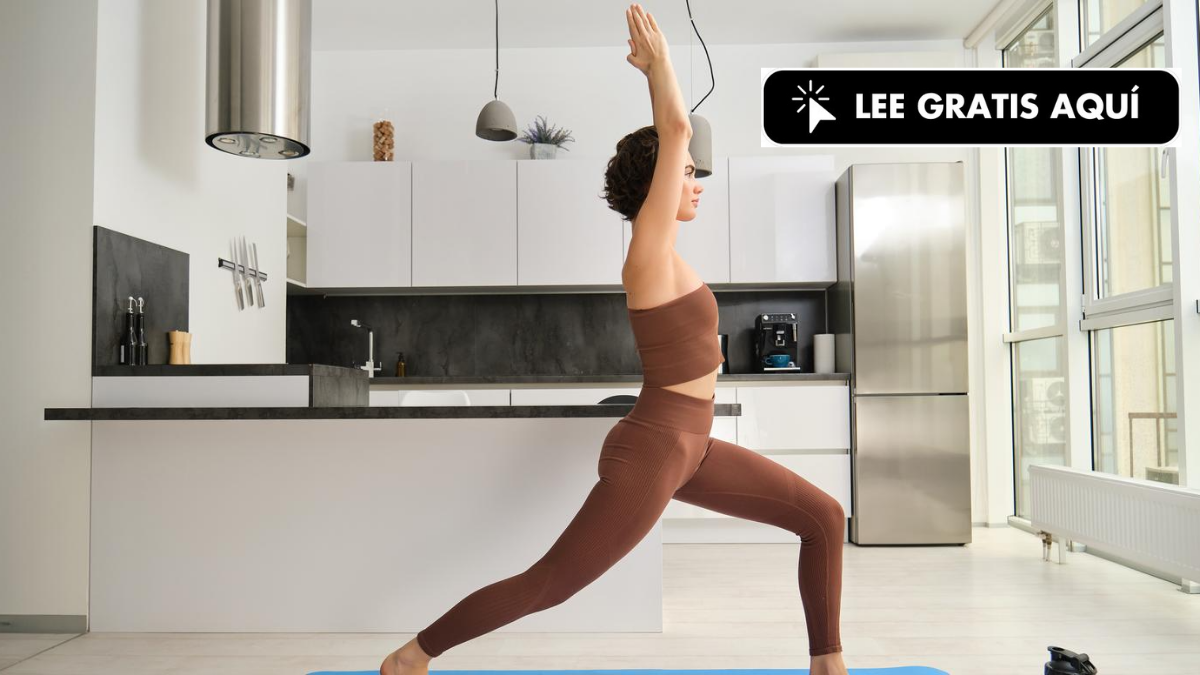
Strength training at home may seem, at first glance, far less effective than working out in a gym. There are no machines, no bars loaded with plates, and perhaps space is limited as well. But there is something that can completely change the way you train: you don’t need longer workouts; you need to make your muscles work a little harder each time.
For a long time we have linked muscle growth to lifting heavy weights and spending hours among machines. Yet, strength training can be much simpler.
A workout mat, a set of dumbbells, and a resistance band can be enough to start training your entire body from the living room.
And here is the often overlooked key: exercising is not exactly the same as progressing.
You don’t need to train more: you need to make your muscles work a little harder
The body adapts. What feels challenging in the beginning may, after a few weeks, stop presenting a real challenge. That’s why repeating the exact same routine over and over is not the best strategy if we want to keep gaining strength.
This is known as progressive overload and it does not necessarily mean buying heavier weights every time.
You can achieve it by increasing the reps, slowing down the movement, holding a position for longer, reducing rest periods, widening the range of motion, training one leg or one arm at a time, or simply choosing a more difficult variation of the exercise.
For example, if doing regular squats is already too easy, it might be more interesting to switch to a Bulgarian split squat than to try to perform 50 or 60 repetitions.
And this detail completely changes the perspective: you don’t need to train for an hour to see results.
A 15-minute session can make sense if it’s part of a routine you can maintain over time.
In fact, training a little, but frequently, can be much more sustainable than a single long workout on one day followed by weeks of inactivity.
The exercises you can do in the living room to work your entire body
Bodyweight can be enough to get started and, moreover, allows you to train virtually all major muscle groups.
For the legs and glutes, you can turn to reverse lunges, deadlifts, hip thrusts, step-ups, and Bulgarian splits. For the upper body, the push-ups, rows, chest press, and bicep curls are among the easiest movements to incorporate.
The core shouldn’t be left out either. Planks, dead bugs, and standing marches can help us target the abdominal area and improve stability.
And if we want a single exercise that involves several areas at once, a simple option like combining a squat with a shoulder press can turn the movement into a full-body workout.
The conclusion is rather liberating: you don’t need to find the perfect routine. The best routine is the one you can actually sustain.
The most common mistake when training at home has nothing to do with weights
Perhaps the main problem with home workouts is much simpler than we think: not doing them with enough frequency.
It’s easy to get motivated on a Monday, complete a draining session, and think we are doing things right. The problem arises when the mat ends up tucked away in a closet for the next three weeks.
Sweating more doesn’t necessarily mean gaining more strength. If we can perform 40 or 50 squats comfortably, perhaps we don’t need to do even more reps. It could be the moment to change the exercise and raise its difficulty.
And there’s another fundamental part that is often forgotten: recovery. Getting enough sleep, resting, working on mobility, and allowing muscles to recover are also part of training.
Moreover, for women, maintaining a healthy muscle mass becomes especially important with age. Strength training helps preserve muscle, promote strong bones, improve balance, and maintain physical functionality.
So perhaps building muscle should not be viewed solely as an aesthetic concern. It is also about constructing a strong body that can accompany us for many years.
And the best part is that you don’t need to wait for next Monday, join a gym, or buy half a catalog of sports gear to start. You simply need to start, stay consistent, and find new ways to challenge your body as what used to be difficult begins to feel easy.
