
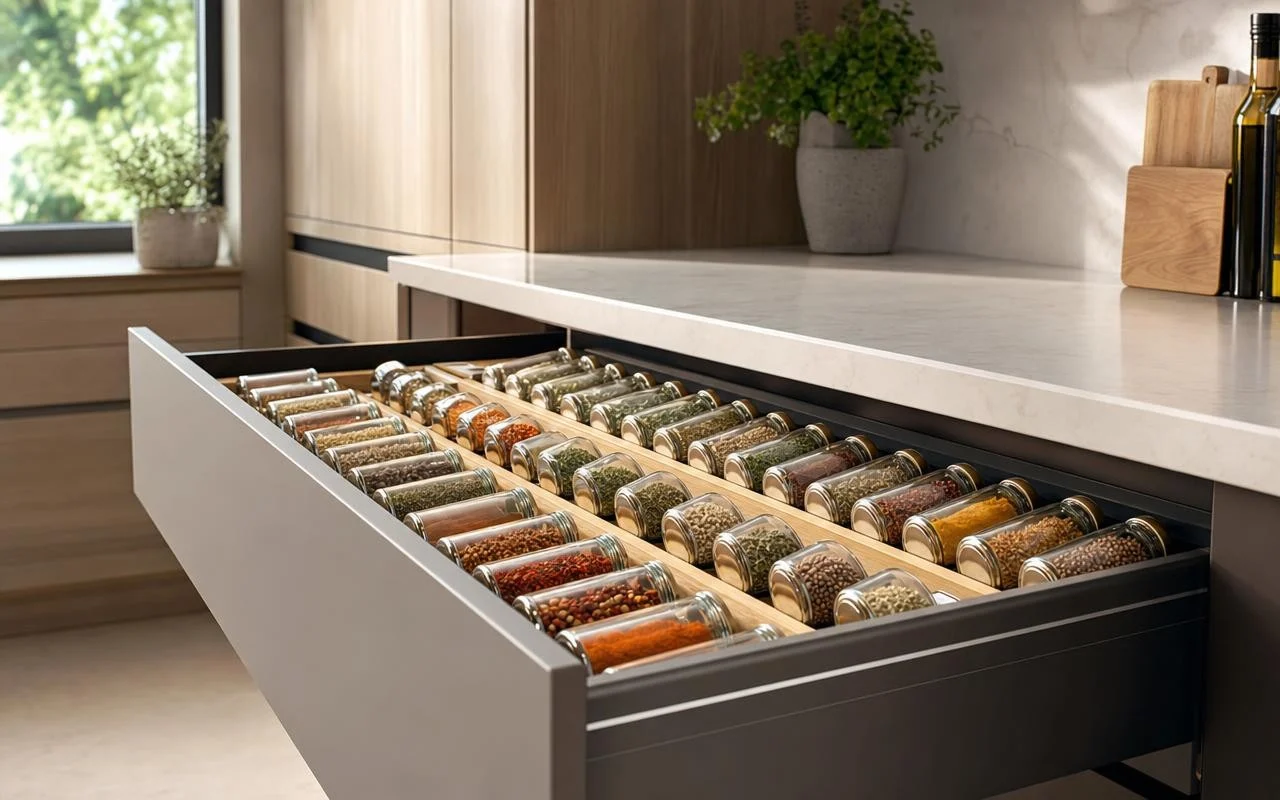
For years, my colorful spice jars lined up on the countertop, right beside the stove. I found it practical and rather pretty, even if I always ended up cooking squeezed between jars of cumin, paprika, and curry. During a session with a kitchen designer to rethink the space, he studied this cluttered scene for a few minutes. Then he explained that the real problem wasn’t the number of jars, but where I stored them.
He spoke to me about aromas that evaporate, heat that dulls spices, and steam that seeps into lids that aren’t tightly closed. In his view, my neat alignment on the countertop checked off exactly everything to avoid for proper storage. He also pointed to the tall cabinet above the oven, where I kept “pending” refills. In just a few sentences, I realized there was a different system, far more logical: I only needed a forgotten drawer to change everything.
Why the countertop damages spices and clutters the kitchen
Placing spices on the countertop, within easy reach, seems logical. Yet this area concentrates light, heat, and humidity—the trio that makes ground blends lose their aromas within a few months. Close to the cooking zones, the jars endure constant temperature fluctuations and clouds of steam that creep into the lids. When the kitchen rises above 23°C, as in spring or summer, this warm and slightly humid environment also promotes storage problems.
Other classic hiding places don’t fare much better. The tall cabinet, especially above the oven or hood, receives heat rising with every cooking session. Open shelves expose the transparent jars to daylight, slowly bleaching turmeric, paprika, or dried herbs. Vertical storage where you only see the lids forces you to pull out several jars before finding the right spice, which ends up creating duplicates and bottles forgotten at the back.
The spice drawer under the countertop: the reflex of kitchen designers
The kitchen designer showed me the solution that’s now returning in many fitted kitchens: a horizontal, shallow spice drawer just beneath the countertop, but outside the hot zone. The jars lie on their sides, lined up side by side, with a label stuck on the top of the lid. When you open the drawer, you see everything at a glance, without moving anything. The spices stay shielded from light, suffer fewer temperature variations, and still remain within reach while you cook.
No need to redo the entire kitchen to adopt this principle. It’s often enough to free up an existing drawer near the cooking area but away from the oven and dishwasher, which emit a lot of heat and steam. Adjustable modular inserts, made of wood or food-grade plastic, sold at IKEA, Leroy Merlin, or Lapeyre, let you position the jars lying down without them rolling. The ideal is to use airtight jars of identical size, in tinted glass or opaque material, with a reliable seal to block damp air and the tiny storage mites that measure less than a millimeter.
Organizing the spice drawer: a simple method that lasts
The reorganization starts with a real purge: empty the countertop and the old spice cabinet, discard fragrance-free or too-old blends, then transfer the rest into the new jars. On each lid, a label indicates the name of the spice and, if possible, the opening date. It’s better to fill the jars with reasonable quantities rather than keeping large opened sachets for months. This approach minimizes forgetfulness and encourages regularly renewing what you use most.
For the sorting, two approaches work well. Some people prefer grouping by usage: everyday savory, sweet, grill blends, and more exotic reserves stored a little farther away. Others opt for alphabetical order, very effective when you have many references. In all cases, the rule remains “first in, first out” to finish the oldest jars first. A quick check every two or three months, especially when the kitchen gets hotter than 23°C, is enough to keep a clear spice drawer, a freed countertop, and flavors that stay intense.
