
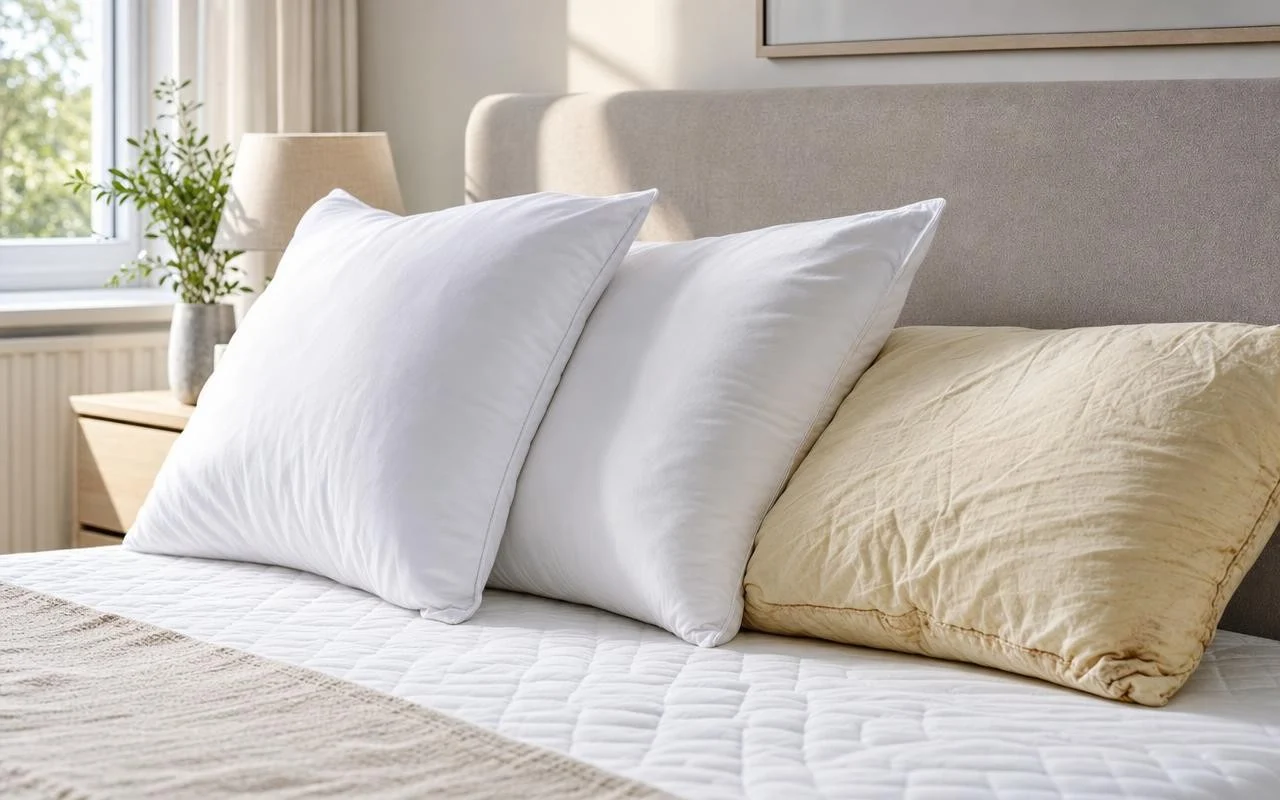
People change their sheets, but they replace their pillows far less often. Yet these are the items that cradle your head each night and support the neck. Between washes, we shake them out, sometimes machine-wash them, hide stains under a clean pillowcase… and we end up keeping them for years, sometimes well beyond what is advised.
The message from sleep and skincare experts is clear. From dermatologist Jennifer Holman to the Sleep Foundation or the Cleveland Clinic, all remind us that a pillow eventually loses its support and becomes home to dust mites, bacteria, and skin debris. The question that unsettles many at bedtime is: when is it really time to replace it?
When to change your pillow: the 1- to 2-year rule explained
For the experts consulted, the answer rests on a simple range. A pillow should generally be replaced every 1 to 2 years. The Sleep Foundation also notes that renewal can occur between 1 and 3 years depending on the material and the condition. In other words, after two years of regular use, it becomes reasonable to seriously consider whether it still fulfills its purpose.
That limit is not arbitrary. Pillows eventually harbor bacteria, dust mites, and dead skin cells, with the possibility of allergies or irritations. There is also a posture-related concern. “Pillows also help maintain the alignment of your neck and back while you sleep, and that matters for limiting pain and misalignment during the day,” explains Jennifer Holman. When the filling becomes compressed, the body quickly notices it upon waking.
Durée de vie des oreillers selon la matière et signes d’alerte
The lifespans vary a lot depending on the filling. The article notes that memory-foam pillows, including those with memory foam, typically last 2 to 3 years, latex ones about 2 to 4 years. Models made of down or feathers are rated at 1 to 3 years, whereas versions in synthetic down or polyester rarely exceed 1 to 2 years of proper use.
To know if your pillow can last a little longer, the signs are fairly telling. If it no longer adequately supports the neck, if you wake up with pain in the neck, shoulders, or head, it is probably near the end of its life. The folding test is useful: folded in half, it should unfold on its own. A persistent odor, stains that won’t come out, itching, or repeated sneezing after a night complete the picture.
Fréquence de lavage de l’oreiller et cas où le remplacer plus tôt
Proper maintenance helps keep a pillow healthy until it is replaced. Experts advise washing a machine-washable model every three to six months, while the Cleveland Clinic recommends cleaning pillows, duvets, and mattresses roughly every six months.
Yellow stains aren’t always decisive: they mainly stem from sweat, sebum, saliva, hair products, and humidity. A pillow can often be revived with a good wash. But if the odor persists, if the filling stays compressed, or if the rings won’t come out, it’s best to replace it. Down or synthetic pillows typically tolerate machine washing in warm water, whereas memory foam or latex models are generally cleaned only on the surface. Holman also recommends allergen-impermeable covers; in cases of allergies, asthma, or a pet that sleeps on the bed, the pillow and its linens should be refreshed and washed more frequently.
