
When the spray goes astray, the pressure dips suddenly, and white spots start to appear, you know it: our clogged shower head is acting up. The culprit is the limescale from hard water that gradually settles in the nozzles. Many households grab the good old trick of a plastic bag tied around the faucet, hoping to restore a powerful shower without replacing the entire setup.
For a long time, I did the same as everyone else: a plastic bag filled with white vinegar, sometimes accompanied by a spoonful of baking soda to “boost” the effect. The mixture started to bubble, I told myself it decalcified better, and I let it sit for hours. Until the day I realized that this spectacular foam did not mean my shower head was better descaled, far from it.
Why the vinegar-and-baking-soda duo isn’t so magical
Reading explanations from chemists, I understood what was off. In the account published by Le Parisien, the writer sums up this moment of realization very well: “And one day, I discovered that it was totally counterproductive, because the acid in vinegar and baking soda largely neutralize each other,” she explains. In other words, this foaming mixture triggers an acid-base reaction that releases gas, but makes the solution less acidic, therefore less effective on the limescale.
Vinegar alone remains very popular, and it can indeed dissolve deposits. But used too hot, too concentrated, or left on for several hours, it ends up attacking rubber seals and dulling some chrome finishes. Manufacturers like Hansgrohe specifically recommend citric-acid-based descalers, gentler on the fittings. That’s where I shifted to a new ingredient, one I haven’t left behind since.
Citric acid and the shower head: the method that changes everything
This ingredient is citric acid, a powder derived from citrus fruits that you simply dissolve in water. I use it as a natural descaler: for a lightly soiled head, I pour about two to three tablespoons into a liter of hot water; for well-settled scale, I go up to four or five tablespoons. I always work with gloves, as the solution remains acidic and can irritate sensitive skin.
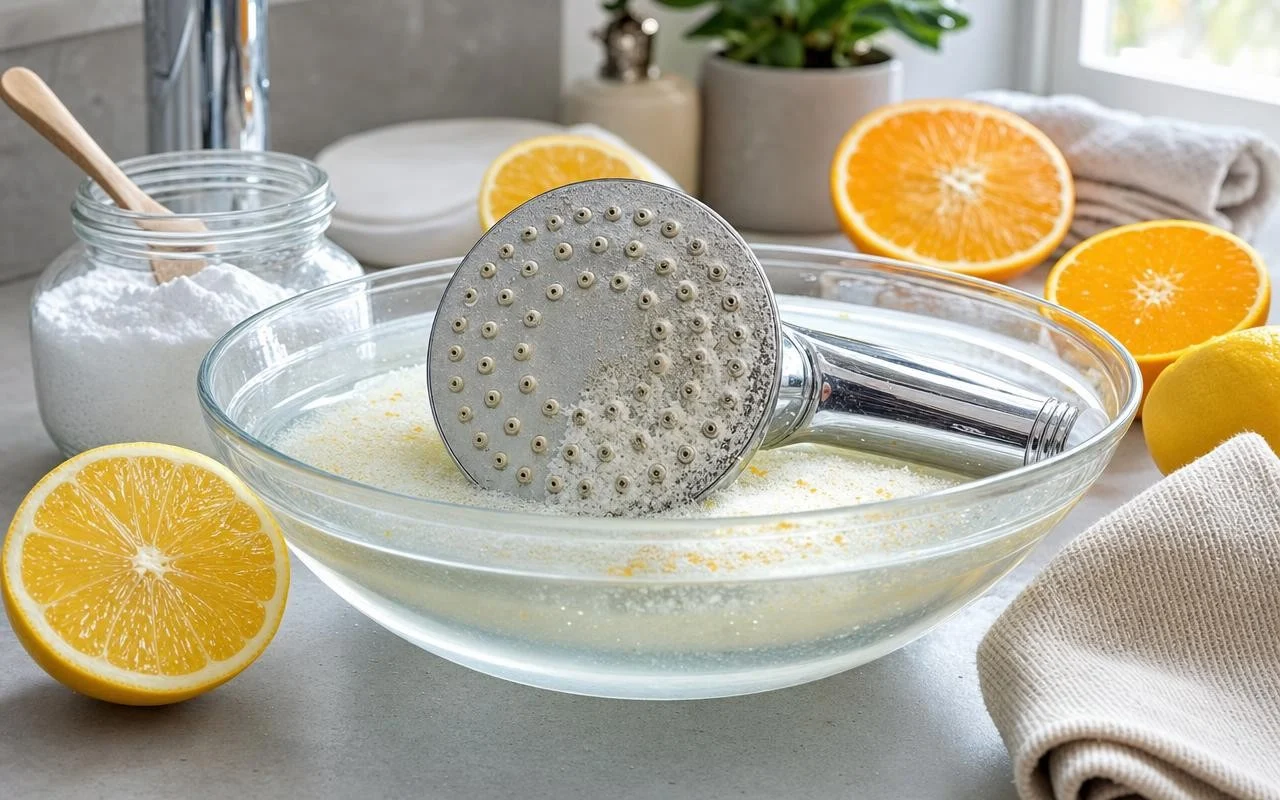
For a deep clean, I unscrew the shower head and dip it in a container of solution. I let it soak for thirty minutes to an hour depending on the buildup, then I scrub the nozzles with an old toothbrush. The deposits come off quickly, a thorough rinse with clear water finishes the job. This way of descaling a shower head restores regular jets without replacing the equipment.
Precautions, teardown-free method and anti-scale routine
When I don’t have time to dismantle, I revert to the plastic bag method, but filled with citric-acid solution. I attach the bag to the head, already in place, so only the head soaks, then I pour warm water, never boiling. Ten minutes is usually enough; for delicate finishes I stay nearby to supervise. I no longer add baking soda: if I use it for the drain, it’s later, after a careful rinse.
To limit the return of scale, I keep in mind that the root cause is often hard water rich in calcium. After every shower, I quickly wipe the head with my hand or a microfiber cloth to remove the droplets. In carbonate-rich regions, I plan a quick citric-acid bath about once a month; this regular maintenance generally keeps the jets clear. If the pressure remains low, the issue is more likely the plumbing than the shower head.
