
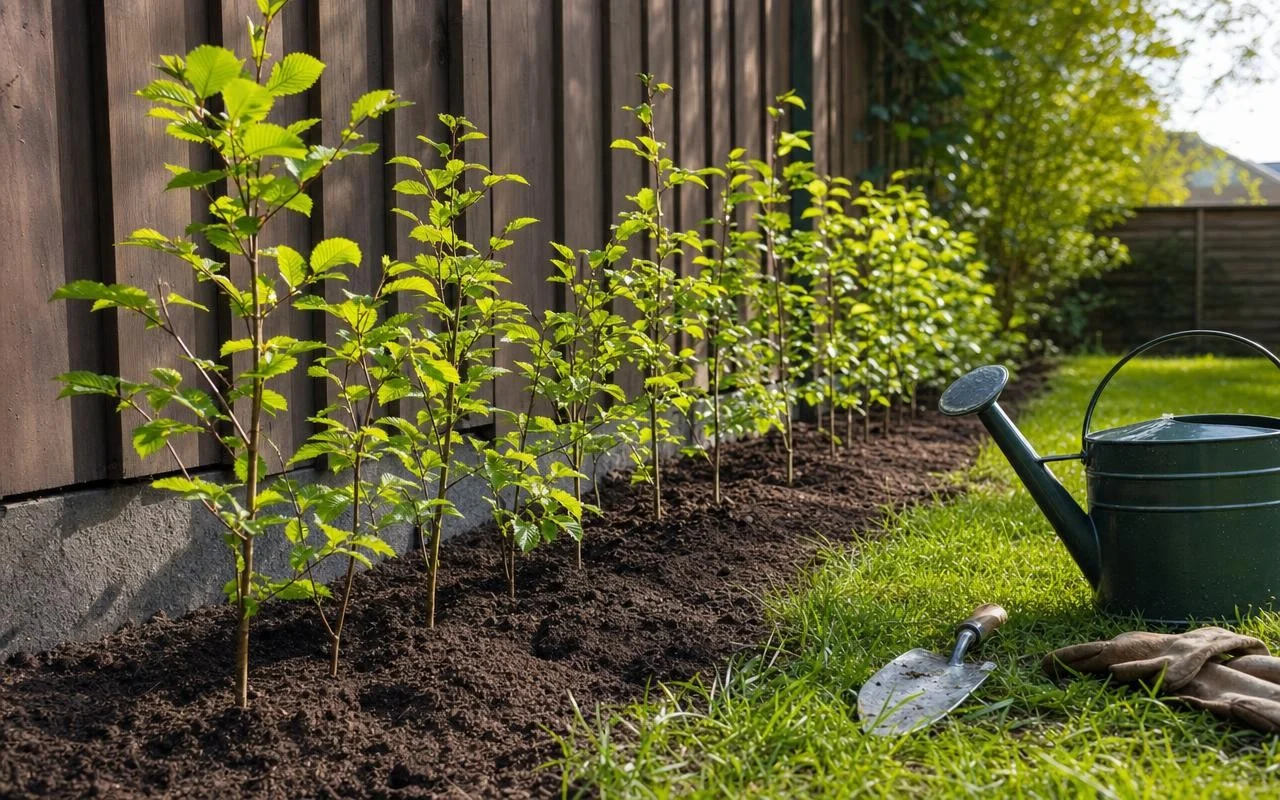
In spring, I did what everyone does: on a beautiful April weekend, I planted my first hornbeam hedge along the fence, convinced that the sun would help it get off to a good start. The pots were fresh from the nursery, the soil was warming up, and I could already imagine a lush green screen for the summer. I didn’t think to ask my landscaper why he waited until autumn.
The first summer brought me back to reality. The young hornbeams saw their leaves turn yellow and then brown despite nearly daily watering. A few days of heat during the heatwave were enough to scorch entire branches: a classic sign of water stress on shallow roots. Between the water bill and the hedge’s appearance, I realized the issue wasn’t just the heat.
Hornbeam Hedge: why April Tricked Me
Returning to the site, my landscaper was blunt: for a hedge, the right season isn’t the one you enjoy the garden, but the one when the soil stays cool and moist. The LPO reminds us that hedge planting is traditionally done in autumn or winter, when the soil is sufficiently moist and there is no frost.
Planting in April gave my hornbeams only a few weeks to put down roots before the furnace of summer arrived. The roots remained confined to the uppermost centimeters of soil, where the ground dries the fastest. Guides dedicated to the common hornbeam advise instead planting bare-root stock from November to March, outside frost, and reserving spring for plants already well established in containers.
Hornbeam: the decisive advantage of a September planting
When he plants a hedge of hornbeams in pots himself, my landscaper often aims for the second half of September. A specialized article explains that placing shrubs between September 10 and 30 gives the roots time to deepen before winter. The soil is still warm, autumn rains return, and the shrub quietly builds a robust root network without enduring the stress of a first summer.
For an effective privacy hedge, spacing also plays a crucial role. On the neighborly side, Article 671 of the Civil Code requires at least 0.50 m from the boundary if the hedge does not exceed 2 m in height, and 2 m if it is higher. Between two hornbeams, horticultural sources suggest about 40 to 50 cm: squeezing them too tightly triggers a war of roots and bases that become bare quickly.
Hornbeam Hedge: How to Salvage a Failed Planting
With my spring-planted hedge, the priority was to curb thirst. I abandoned small, frequent waterings in favor of more spaced-out but substantially deeper soakings, in the evening, to encourage the roots to dive downward. I also installed a thick mulch, as the LPO recommends for young hedges: about 15 cm of chipped wood or fallen leaves to retain moisture and block competing weeds.
In the following autumn, I took advantage of the favorable window to correct the course. The spindly specimens were pulled out and replanted farther apart according to the recommended spacing, and new bare-root hornbeams took their place. Their roots were dipped for a day in a pralin before planting. Pruning, meanwhile, was reserved for the winter, avoiding the nesting period from March 15 to August 31.
Sources
- Modes & Travaux
“Private-hedge planting distance trap: the reason your shrubs become transparent after two years”
