
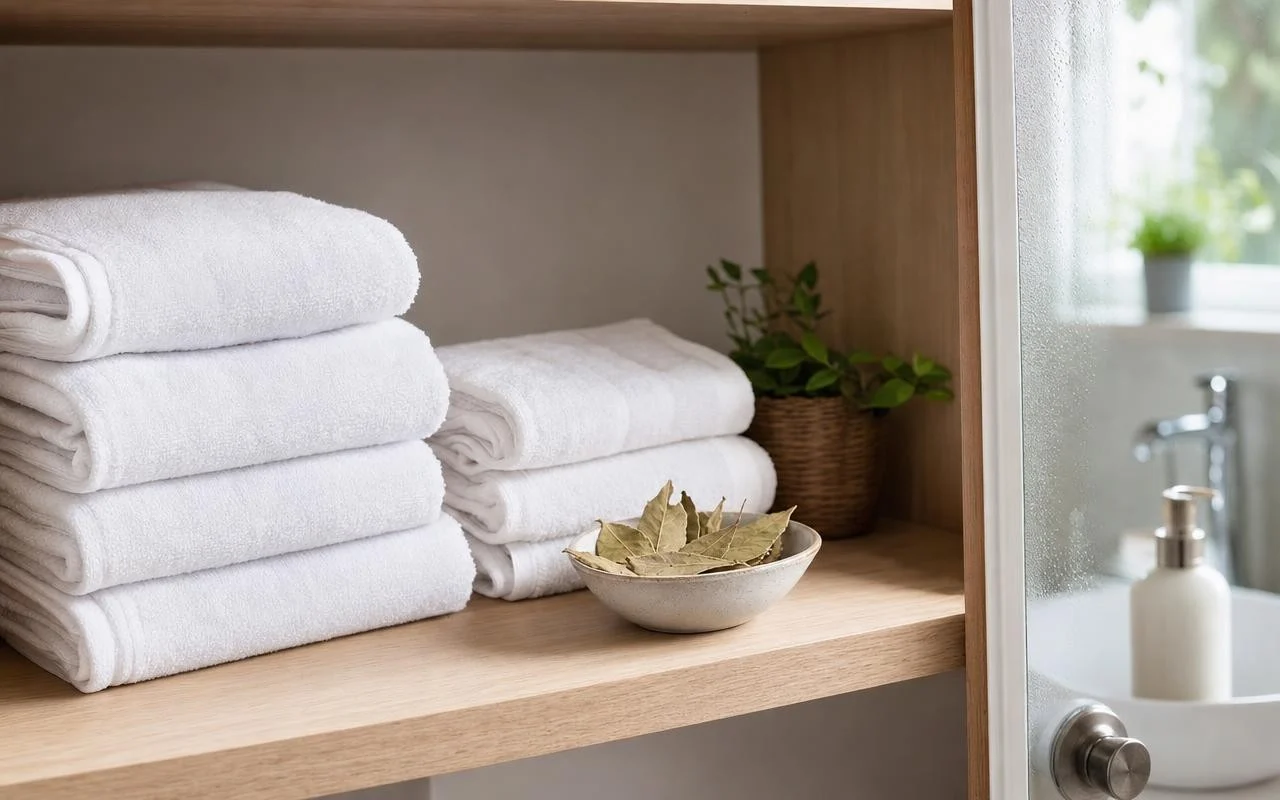
Your towels come out of the tumble dryer soft, and two days later they smell like the damp closet. Many families know this annoyance, especially in windowless bathrooms where humidity tends to get trapped. Among generation-spread remedies, one gesture intrigues: tucking a bay leaf into the storage.
A musty odor isn’t merely an unpleasant scent; it signals the presence of microorganisms that enjoy textiles that are still slightly damp. In a bathroom closet, the air circulates poorly, humidity remains trapped between piles of sponges and the cold walls. The bay leaf, used since Antiquity to preserve foods, can limit this phenomenon. Provided you know which leaf to use, and especially how to place it.
Why do your towels smell musty in the bathroom closet
According to the Scientific and Technical Center for Building and ADEME, the ideal humidity for a bathroom sits between 50 and 70%. In a closed closet, this hygrometry can climb to 85%, especially after a hot shower or if the door stays shut all the time. The towels then absorb the steam, maintain a slight dampness, and offer a perfect ground for invisible mold.
Microscopic fungi like Aspergillus develop on the surface of fibers when the air is humid and stagnant. They are the ones that produce that characteristic odor of fabric left too long in a bag or basket. Air the closet, let bathroom linens dry completely, and limit clutter as the base course. A plant-based fragrance with antifungal properties, such as that of the bay leaf, comes in to reinforce the effort.
Bay leaf (Laurus nobilis): essential oils and antifungal effect on laundry
The bay leaf, Laurus nobilis, is a Mediterranean shrub from the Lauraceae family, not to be confused with the oleander, an ornamental and highly toxic plant. Its leaves contain between 0.8 and 3% essential oils. Among them you can find, for example, 1,8-cineole and eugenol, along with other aromatic compounds. Studies cited in phytotherapy describe antibacterial and antifungal properties for these leaves.
These aromatic molecules diffuse slowly into the air of a small enclosed space like a cabinet. They disrupt the membranes of certain bacteria and fungal spores, which limits their establishment on dry textiles. The effect is modest but real as a preventive measure: the bathroom closet smells fresher, moldy odors reappear more slowly. The bay leaf does not fix a structural humidity problem; it complements ventilation and proper drying.
How to use bay leaf in the closet without harming your towels
For this trick, only the well-dried bay leaf works. It is simply dried flat on a clean cloth or as a bouquet, head downward, in a well-ventilated area for at least fourteen days. A fresh leaf contains about 80% water: confined in a dark closet, it will release this water, further increasing humidity and could stain cotton towels. Once your leaves are perfectly dry and your towels are fully wrung out or air-dried, you can adopt a simple, very easy ritual.
- Slip 3 to 5 dry leaves into a small breathable cotton sachet.
- Place a sachet near each pile of towels, without burying it.
- Replace the sachets about every 3 months or as soon as the fragrance becomes very faint.
This system lightly fragrances the laundry and helps slow the emergence of the musty odor on clean towels. If mold stains or a very strong odor are already present, you should rewash the laundry, check the bathroom ventilation, and address the humidity cause before using bay leaf. The bay leaf provides a natural boost, provided it stays dry, discreet, and is clearly identified as bay leaf.
