
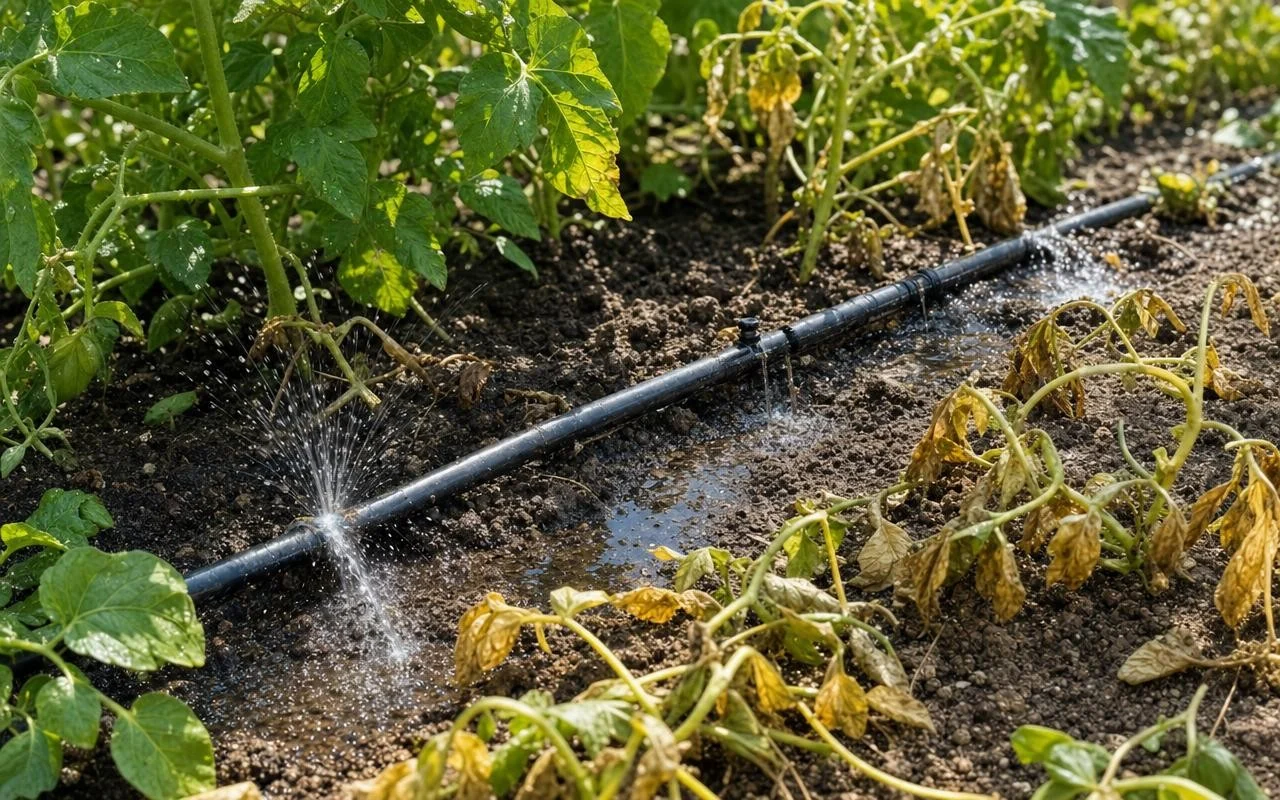
The vegetable garden was starting to yellow, the temperature was rising, and the water bill was climbing as well. Looking at the main pipe, I had the same thought that many gardeners share: if the flow seems to weaken, surely the solution is to raise the drip irrigation pressure so water reaches farther and more forcefully to the tomatoes and zucchini.
So I opened the tap a little more, convinced I had found the answer. Three days later, amid puddles, uncontrolled jets, and weakened plants, the verdict was entirely different. All of this for a simple quarter turn of the tap that turned the system against my garden.
Why increasing the drip irrigation pressure ends up watering less effectively
A domestic micro-irrigation system is designed to operate at low pressure, generally between 1 and 1.5 bar. Beyond that, the emitters do not release more usable water; they spray it. The nozzles can come loose, the fittings begin to leak, and some emitters may crack. Water then travels through the hose too quickly, losing pressure along the line, and the distribution becomes very uneven from the start to the end.
Technical guides remind us: if the last meters stay dry at the end of the cycle, the problem often comes from a hose that is too long—more than about 50 meters—or from a diameter that is too small, whereas a 16 mm tube holds pressure more reliably. The objective isn’t to achieve maximum pressure but uniform pressure, to avoid this phantom drip that wets the first plants very well and leaves the ones at the back thirsty, even when programmed every evening.
Signs that appear in three days when the pressure is too high
The consequences show up quickly. On the first day, a suspicious puddle forms near the main connection: a seal has failed under the impact of overpressure. The next day, some emitters no longer drip steadily but spray a small jet, causing surface runoff rather than deep infiltration. The soil appears damp, yet the roots remain dry.
After three days, the plants speak for themselves. The lower leaves on several plants yellow, others have soft leaves in the heat of the day, a sign of water stress. At the same time, the excessive pressure has knocked loose particles of lime and sediment from inside the pipes, which clog the finest emitters. A system designed to water automatically becomes a puzzle, even as water usage increases.
Restoring the drip irrigation pressure to the proper level and preventing a recurrence
The good news is that you only need to restore order, not buy a new kit. The method recommended by specialists consists of a few simple steps:
- Set the drip irrigation pressure regulator back to around 1 bar and shut off the water.
- Take apart and rinse the central filter located after the tap, whether it’s a 120-mesh screen or disk type.
- Bleed the line by opening the end of the main hose and letting water run for one to two minutes to flush out lime and impurities.
- Unscrew the emitters that remain clogged, soak them in white vinegar, replace those that are cracked.
- Check fittings and seals, tighten clamps, reattach the stakes that support the hoses.
- Gradually restore water and verify that at the end of the line each emitter delivers a steady drop, not a jet.
Once the installation is back in proper alignment, maintenance prevents the issues from returning. In summer, cleaning the filter every two to three weeks, or even every two weeks during heatwaves, is enough to maintain a stable flow. A quick rinse of the line at the end of the hose and a quick look at the end of each row confirm that everyone gets their share.
To ensure every liter truly reaches the roots, specialists recommend watering deeply but less often, early in the morning or in the evening, then protecting the soil with a mulch layer 5 to 8 cm thick. With controlled drip pressure, an appropriate diameter, and, if needed, a looped network with self-compensating emitters, the vegetable garden benefits from regular watering without waste, even in the heart of summer.
Sources
- Marie France
“Garden irrigation: the mistake many people make every evening that drives up the water bill” - Mon Jardin Ma Maison
“Neither 8 a.m. nor 8 p.m.: it is at this precise hour that hydrangeas should be watered in summer”
