
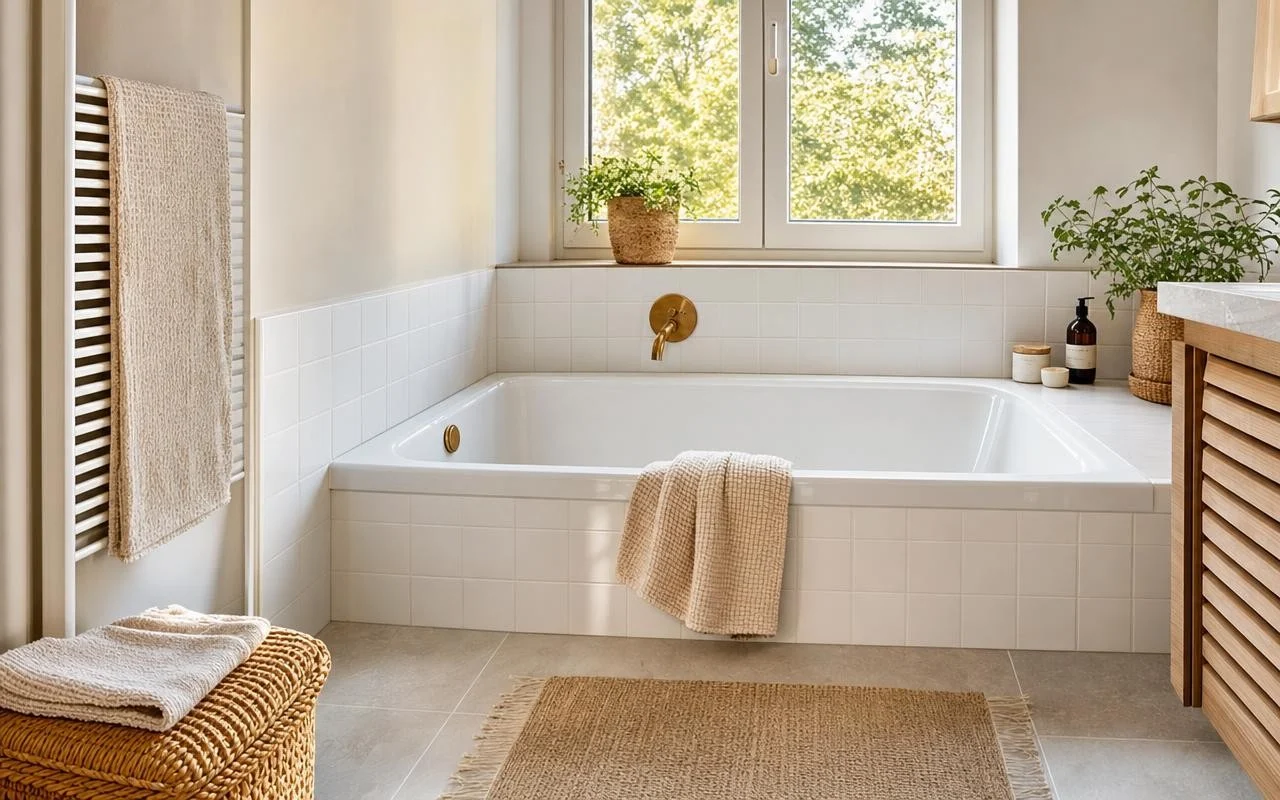
For years, the freestanding bathtub was the star of interior design magazines, installed at the center of the room like a luxury object. Beautiful in photos, a bit less so when it comes to cleaning behind it or moving all around it on a daily basis. Many homeowners renovating their bathrooms today are starting to realize this.
Meanwhile, models once thought to be tucked away in the memory aisle—the alcove built-ins with an 80s look—are reappearing everywhere. The Wall Street Journal as well as the CozyPlaces community on Reddit spot this comeback, and a 2023 Houzz France study already shows 42% built-in alcoves versus 18% islands in renovations. One might wonder whether the freestanding tub hasn’t lost its crown.
Pourquoi la baignoire îlot séduit moins dans les salles de bains actuelles
A freestanding bathtub needs space around it to stay comfortable. Experts advise around 55 cm of passage on each side to enter, exit and clean properly. In a bathroom of 8 or 9 m², a common configuration in France, this requirement often obliges sacrificing a piece of furniture, reducing the shower, or complicating circulation.
The budget also matters. According to rough estimates published by Hansgrohe, a freestanding bathtub starts around €500 and easily climbs toward €2,000, excluding installation. A simple built-in alcove tub can start around €150 in end-of-series stock, with an average between €500 and €1,000. For a visual result that can be quite similar, many homeowners hesitate to pay more for a freestanding model, which also exposes its plumbing and fittings to view.
The retro 80s alcove built-in tub returns, but fully redesigned
The image of the “beige acrylic tub” wedged between three walls is no longer current. Architects now treat the tub apron as a true decorative element. The Scotsman Luke McClelland has, for example, dressed the skirt and adjacent walls with dark green tiling, to evoke a vintage atmosphere while staying highly contemporary. Wood, zellige, large-format sandstone: the built-in version becomes a centerpiece rather than a hidden element.
Designer Jessica Helgerson explains that several of her clients eventually gave up a freestanding tub in favor of a more classic alcove tub, deemed more convivial and easier to access for people of all ages. This movement isn’t limited to a few high-end projects. On Houzz France, 42% of bathroom renovations report a built-in tub, including 20% in rectangular alcove form, compared to only 18% freestanding island tubs installed.
The practical benefits of built-in tubs in real life
Technically, the California-based architect Tom Perkins notes that plumbing embedded in the wall simplifies installation and maintenance. Pipes and drains disappear behind the apron, which reduces dusty corners and makes interventions easier via a removable panel. In a small space, it becomes possible to combine a shower and a built-in tub in a single footprint, by installing a glass partition along the edge of the tub.
Another argument that appeals to families: the ledges. Trends tracked by distributor Facq point to a pronounced lip of 10 to 20 cm around the tub, very practical for placing shampoos, children’s toys, candles or potted plants. This ledge also serves as a support to enter and exit, with a lower risk of slipping than the high edge of an island, an asset appreciated by children as well as seniors. In many projects, this retro 80s built-in tub finally appears as the chicest and easiest to live with.
Sources
- JLM
“The end of freestanding bathtubs: these 80s models are making a big comeback, more stylish and more practical than ever”
