
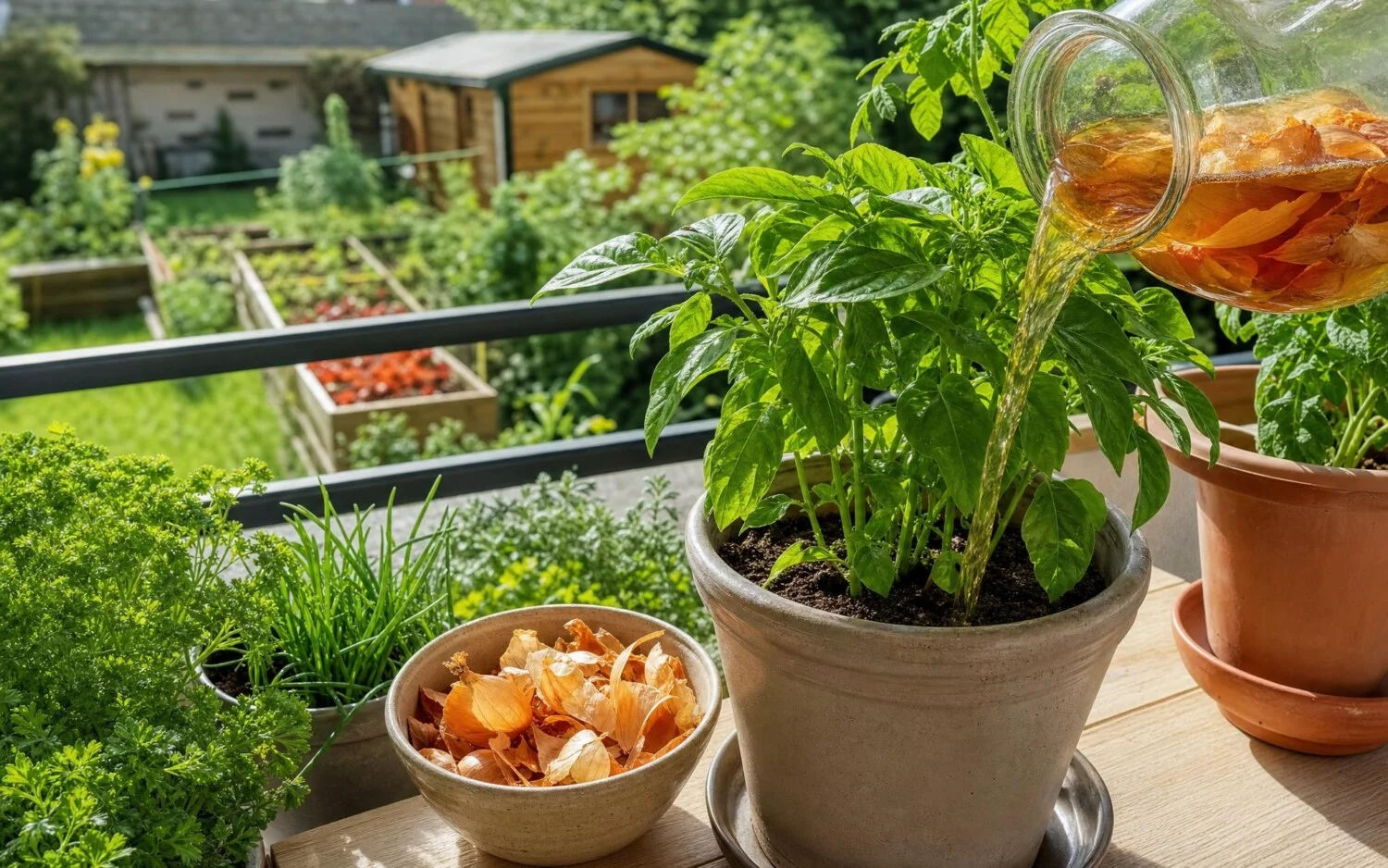
Onion peels often end up in the trash after dinner, even though they can still serve the garden. Transformed into onion water for plants, they become a valuable home remedy for both indoor pots and the vegetable garden. Many gardeners still ignore this small zero-waste trick that truly changes the look of foliage.
The Argentine gardener Hugo Correa, followed by more than 345,000 subscribers on YouTube, highlights this preparation in his videos. He reminds us that the peels concentrate compounds such as flavonoids, phenols, tannins, but also phosphorus, nitrogen and potassium. In other words, everything needed to nourish plants without buying chemical fertilizers.
Onion Water for Plants: A Zero-Waste Potion Easy to Prepare
The onion water for plants is nothing more than a maceration of peels in water. Only the dry skins are used, which are soaked in one liter of water to transfer their minerals to the liquid. This slightly colored water then serves as a natural fertilizer, for both indoor plants and garden beds.
In the method popularized by Hugo Correa, one simply covers the peels with this liter of water and lets it sit for twenty-four hours. Some people prefer to boil the peels for ten minutes before letting them cool. In both cases, it is important to filter carefully to remove any residue, in order to avoid odors and the appearance of mold.
The 4 Little-Known Benefits of Onion Water for Your Plants
This homemade fertilizer works on several fronts at once, which explains its success among gardening enthusiasts. According to Hugo Correa’s explanations, onion water provides at least four concrete advantages for plants, from stronger roots to protection against certain pests.
- Builds up the substrate with potassium, calcium, magnesium, phosphorus and nitrogen, for a richer soil.
- Supports root and leaf growth in stressed or slow-developing plants.
- Acts as a natural repellent against several insects, thanks to the sulfur compounds typical of onions.
- Helps slow the development of fungi on foliage and near the stem base.
In practice, this blend can give a boost to a pot that is turning yellow, support a young plant that is languishing, or limit insect attacks on roses and the kitchen garden. It also provides a little support to plants sensitive to powdery mildew or other fungi, in addition to good aeration and controlled watering.
How to Use Onion Water Safely for Your Plants
The method of applying onion water depends on the type of plant. For those that mainly draw their nutrients from the soil, the filtered liquid is poured at the base, like a regular watering. For orchids and a few species that benefit from leaf absorption, it is preferable to use a sprayer and mist the entire foliage lightly.
Even though this preparation is natural, it should not be used every day. A weekly application is enough to avoid nutrient overload and the risk of root burn. If the mixture starts to ferment or emits a bad odor, better to discard it and make a fresh batch, and do not store onion water for more than a few days in the fridge.
