
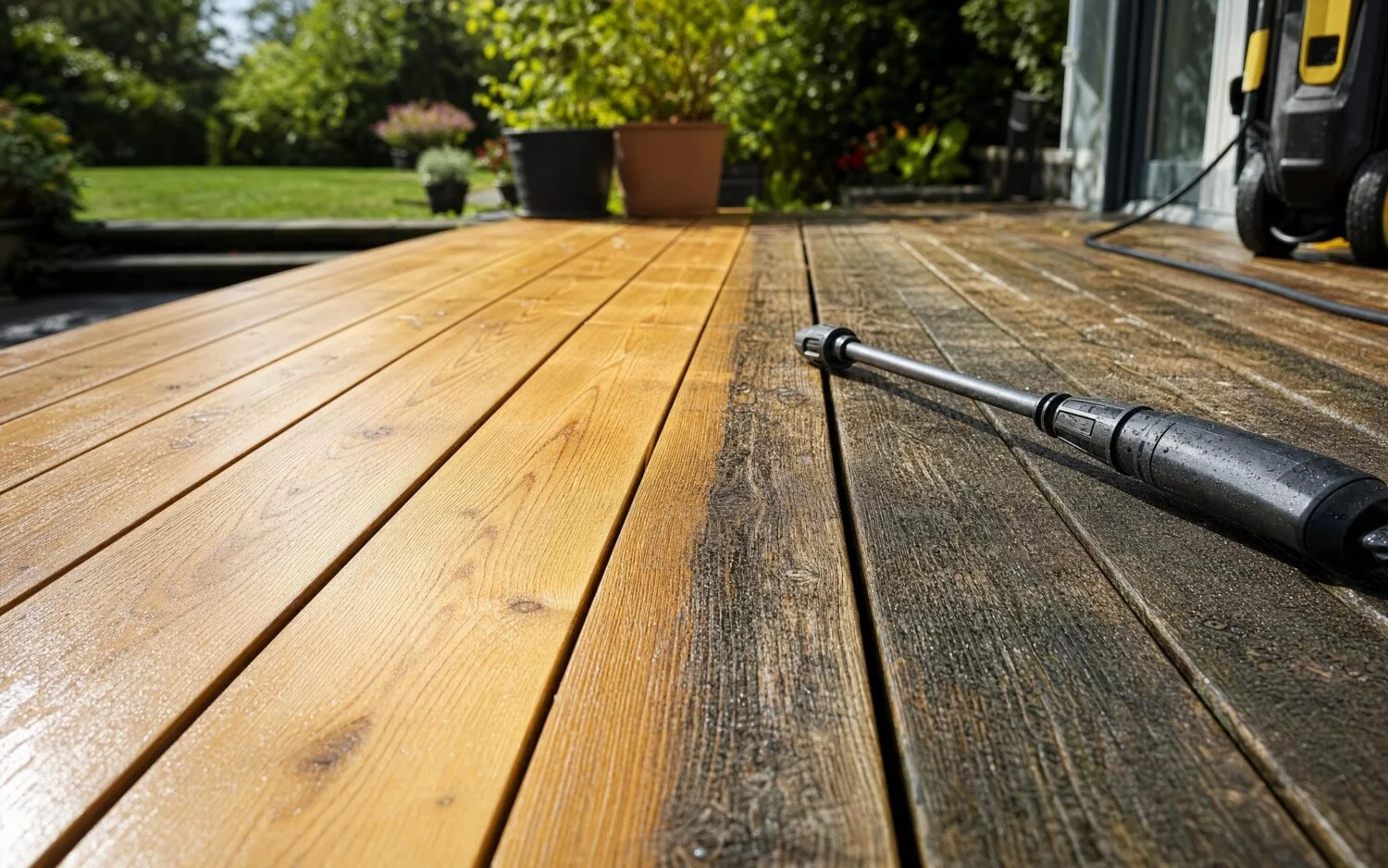
Every spring, my wooden deck would regain the same weary look: grayness, moss, and stains under the pots. That year, I decided to act fast. I pulled the pressure washer from the garage, adjusted the wand, and in thirty minutes the slats looked almost new. No more green, a lighter shade, the satisfaction of having stripped everything effortlessly, with the deceiving feeling that the machine had saved my deck.
At the time, I saw no flaw, so I tucked the device away and forgot the episode. It was only after a few weeks, on a sunny day, while idly running my hand over the boards, that I realized: the surface had become rough, uneven, nearly bristly. Small splinters pricked the skin, walking barefoot became risky. The real danger of a pressure washer on a wooden deck hides there.
Pressure washer on a wooden deck: a before-and-after that deceives
In the Seniors’ Journal, a homeowner describes this exact scene: an eight-year-old autoclave-treated pine deck, gray and overgrown with moss, followed by a miracle in half an hour. The wood regains a light hue, almost new, and the before-and-after contrast is spectacular. As the article notes, the reflex has become almost automatic: draw the washer to scrub everything in ten minutes, without imagining for a moment that the real, slow erosion work has only just begun.
The reason lies in the way the machine acts on the material. “A pressure washer works like a blade of concentrated water,” explains the Seniors’ Journal. The force of the jet tears away the thin outer layer, lifts the fibers of the wood, and leaves a texture that seems smooth while the wood remains damp. On soft woods like pine or Douglas-fir, this lifting is even more pronounced.
What the jet really tears away from the wood fibers
Wood is not tile: its organic fibers resemble tiny straws stacked together. The Seniors Journal’s piece on older decks notes: “The damage is often not immediately visible: the blade looks lighter, cleaner, but weeks later, under the sun and temperature changes, the weakened areas crack, lighten unevenly, or retain more dirt.” A bristled surface also traps more dirt and moisture.
As a result, the gesture intended to clean often sets the stage for faster soiling the following year. The pressure plays a crucial role: at 150 bars, a jet acts like a razor and shreds the fibers. Experts advise keeping a deck’s pressure between 80 and 100 bars, or a maximum of 120 bars with a wide nozzle and always in motion.
Wooden deck: gentler settings, black soap, and possible remediation
In practice, several parameters matter as much as the displayed power. The wand should stay about 50 centimeters from the wood, never pressed against the slats. Within 15 centimeters, the risk of damage soars. The Seniors’ Journal also reminds readers to avoid the rotary nozzle and to never remain still on a stain. After rinsing, let it dry for 24 to 48 hours before applying a saturator or oil.
To avoid this scenario, the time-tested method remains the safest: a bucket of warm water, about five tablespoons of liquid black soap, and a stiff brush worked along the grain, possibly with a bit of baking soda on the stains. When the damage is already done, all that remains is a light sanding, a deck stripper, and then a saturator. As the Seniors’ Journal reminds us, “once the fibers are ripped out, no product can glue them back.”
Sources
- Maison & Travaux
“If you have a pool, ditch the wood: this faux-wood cladding is cheaper and requires no maintenance.”
