
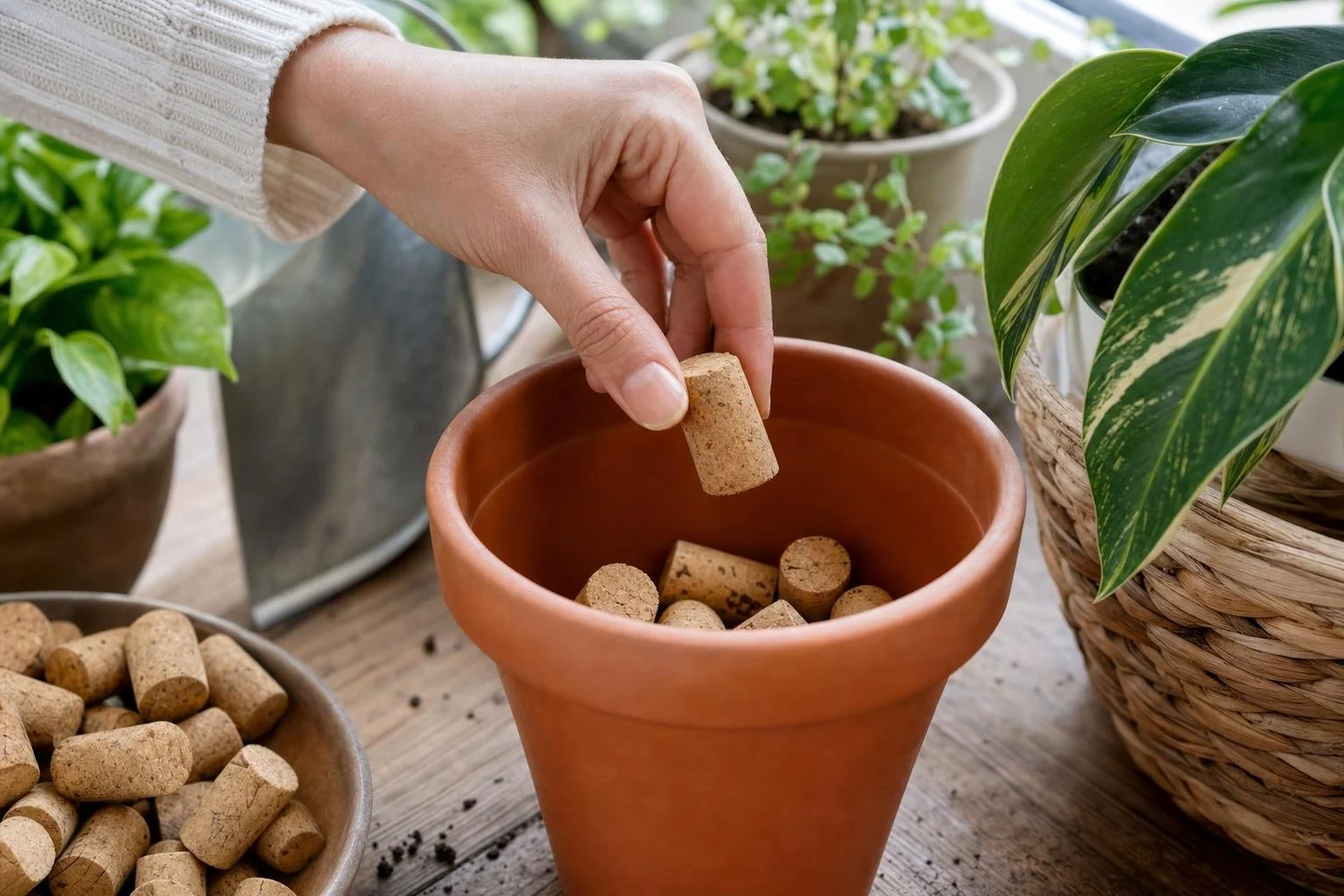
We often keep them in a drawer, not quite sure what to do with them. Yet cork wine stoppers can enjoy a surprising second life: more and more gardeners are placing them at the base of their **flower pots**. This simple gesture is intriguing, because it challenges years of gardening habits, especially the use of those famous clay pellets.
For a long time, people learned to fill the bottom of pots with gravel or clay balls to improve drainage. Nurserymen even stopped this practice as early as the 1950s after observing root rot. Studies relayed by botanist Linda Chalker-Scott, from the University of Washington, describe a perched water table that questions this reflex. So what can a few cork stoppers change in the equation?
Why cork stoppers replace clay balls
The heart of the issue lies in the contact between the fine potting mix and a coarser layer beneath. When these two textures are stacked, water does not descend as one might expect: it remains trapped in the soil just above the ballast of gravel or pebbles, until saturation. Researchers refer to a perched water table, and a study published in 2025 showed that this arrangement can sometimes increase residual moisture.
Natural cork plays a different role. Derived from the bark of the cork oak, it has a honeycombed, air-filled structure that allows water to pass through without holding onto it, while remaining rot-proof. Another advantage is its lightness: a 30 cm pot drained with cork stoppers weighs, on average, 400 grams less than with traditional drainage, which matters for balconies and delicate shelves. This material also forms a thermal and hydric buffer around the roots.
Bouchons en liège dans les pots de fleurs : à quoi ça sert vraiment
Cork stoppers do not feed the plant and do not make it grow faster. Their interest lies in the behavior of the substrate. By placing them at the bottom of the pot or in pieces within the soil, the substrate stays lighter, less compact, which facilitates the passage of water and air toward the roots. Excess water can escape more easily, which helps prevent the stagnation feared in indoor settings.
Another sought-after effect is more stable humidity between waterings. Cork does not act as a sponge, but its hollows reduce drastic shifts between drought and waterlogging, which helps small pots and indoor plants in summer. Used on the surface as a light mulch, it also protects the soil from direct sun and makes the establishment of small soil-dwelling gnats a little more difficult.
Comment utiliser les bouchons en liège dans un pot de fleurs sans erreur
To enjoy these advantages, the amount of cork matters a lot. Professionals advise a layer of 1 to 2 cm just above the drainage holes. The guideline is based on the number of stoppers cut in half or broken according to the pot’s diameter.
- Pot of 15 cm: 4 to 6 cork stoppers.
- Pot of 20 to 25 cm: 8 to 12 cork stoppers.
- Pot or planter of 30 cm: 15 to 20 cork stoppers.
Only natural cork is suitable: plastic stoppers provide neither aeration nor water regulation. This material serves as a supplement, not a nutrient-rich soil; it never replaces the substrate. The pot must keep holes at the bottom, otherwise no trick will protect the roots from overwatering. One can place a few pieces near the holes, mix them into the soil, or leave them on the surface as a light mulch, a zero-waste gesture that recycles the corks from aperitif bottles.
