
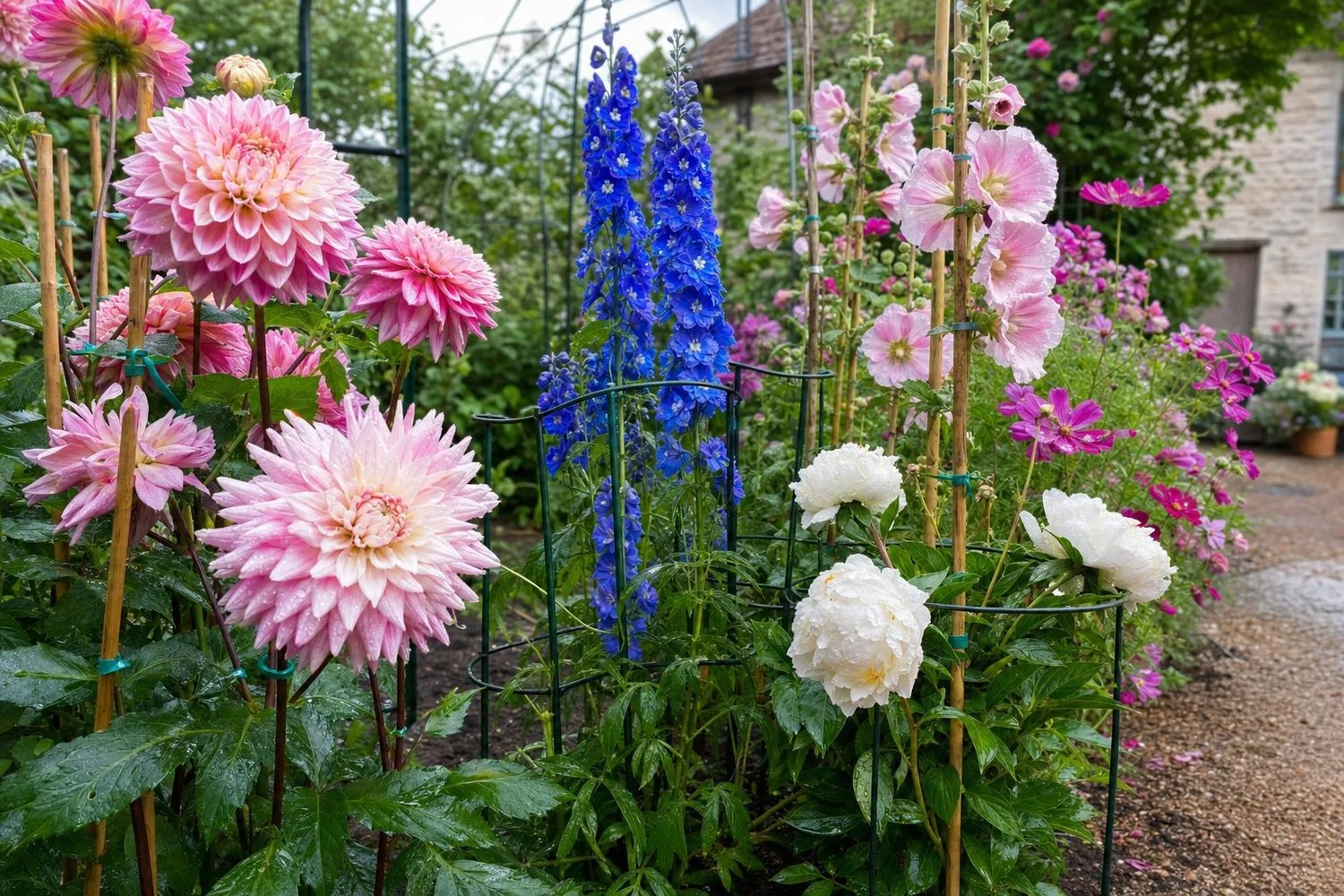
A shower, a gust of wind, and your beautiful flowering stalks end up lying in the mud. Giant dahlias, delphiniums, hollyhocks or peonies: many garden stars literally bend under the weight of their blooms. For these plants, letting nature take its course often means damaged flowers and snapped stems.
Experienced gardeners quickly notice this: some species almost always need a stake to reveal their best display. Height, rain, wind, and soil richness all play a role, but fifteen major classics keep coming back in lists of plants that require reinforcement. And it is precisely these that we will review.
Why staking flowering plants changes everything
When a slender stem bears huge flowers or a tight inflorescence, the slightest storm is enough to lay it down. The droplets further weigh down petals, the plant deforms, the blooms get smeared with dirt and slugs. For some perennials over 1 m tall, this scenario repeats every year.
The staking simply keeps the flowers at eye level, well airy and clean. It limits breakages, makes bouquets easier to cut, and often allows more flowering stems to develop. “The simplest approach is to install the supports early, before they are required. As the plant grows around it, the support becomes almost invisible and does not distract from its beauty,” explain specialists from a gardening magazine.
How to choose stakes and supports for flowering plants to stake
For solitary, very vertical stems, such as delphiniums, digitalis, lilies, or tall foxgloves, a single bamboo or metal stake is enough. It is driven in near the base, ideally at planting time, then the stem is tied with flexible ties, loose enough to allow a slight natural sway.
As soon as the clump comprises several stems, crossing grids and tomato cages become very practical. Asters, Boltonias, cosmos, heleniums, peonies or goldenrods then stay fairly upright, each stem guided by a discreet mesh. Gladioli benefit from crossing a horizontal trellis, and hollyhocks often prefer a trellis or fence.
15 flowering plants to stake without hesitation in the garden
Here are the fifteen major flowering plants to stake almost systematically to keep a neat blooming, even in the rain. The heights indicated are those of the tall varieties, which require sturdier support than the dwarf forms.
- Asters (Symphyotrichum): varieties above 1 m, perfect with a grid or cage.
- Platycodon grandiflorus: slender, fragile stems, to be supported by a small stake or cage.
- Boltonia asteroides: 0.9 to 1.8 m, a cloud of flowers, grid indispensable.
- Cosmos (Cosmos bipinnatus): up to 1.5 m, flexible stems, to be circled with bamboo.
- Dahlias: large varieties with heavy blooms, sturdy staking from planting, regular ties.
- Delphiniums: flower stalks up to 2 m, one stake per stem or a small grid.
- Digitalis (Digitalis): very tall spikes, easily unbalanced, to be tied to a discreet stake.
- Gladioli (Gladiolus): heavy flowering stalks, kept upright by horizontal mesh or a cage.
- Solidago (Solidago) Goldenrod: 0.9 to 1.5 m, best in clumps supported by a grid.
- Helenium autumnale: up to 1.5 m, especially in windy areas, a cage recommended.
- Roses trémières (Alcea rosea): 1.8 to 2.4 m, sheltered by a wall or trellis.
- Lilies (Lilium): 1.2 to 1.8 m, stake planted from the bulb then extended upward.
- Lupins (Lupinus): fragile stems up to 1.2 m, grouped in a small grid.
- Herbaceous peonies (Paeonia lactiflora): large heavy corollas, a ring or cage placed before full development.
- Snapdragons (Antirrhinum majus): up to 1.2 m, brittle stems, better held with arches or a light trellis.
Last tip: always use flexible ties and check the links after every heavy rain.
