
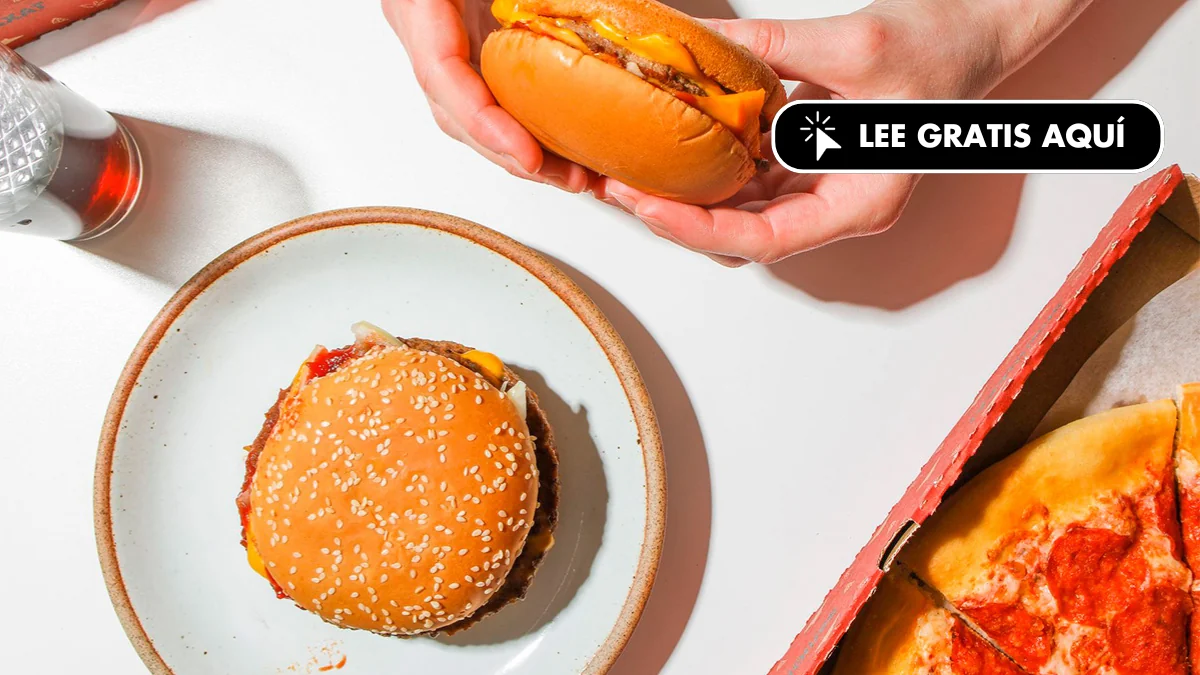
You may have found yourself giving in to what is commonly called junk food more than once. On the list of usual suspects, pizzas, burgers and fried foods, as well as certain salty snacks, tend to top the list, though they aren’t alone.
In fact, the term is far from precise, which doesn’t mean it hasn’t left an imprint on the collective imagination. Dr. Cristina Sánchez explained on her social media the three different realities encompassed by this term, with the aim of being more precise and banishing it.
Not because it doesn’t exist, but because it is “not an exact scientific category.” Under this label lie everything from fast food, that is, “fast, cheap, standardized and accessible food,” to ultra-processed foods, which are “industrial formulations with additives, flavors and emulsifiers that do not exist in a home kitchen.” Nevertheless, she left the door open to a definition backed by the NOVA system, devised by Brazilian Carlos Monteiro: the foods are “hyperpalatable.”
Although the word sounds strange and is a neologism not yet accepted by the RAE, its meaning is easy to understand: “especially appealing combinations of fat, salt, sugar and texture.” So, why do they lure us? Why, when we seek these foods, do we not really want to satisfy hunger?
All the physiology behind junk food is not a coincidence
That hyperpalatable foods live in that balance that makes us ask for more, and that, for instance, does not happen with a stalk of broccoli or a can of sardines, is no coincidence. Years of industry study have gone into designing products that know how and when to reach our brain and to get our cravings to respond at certain moments.
The issue is that this type of products, warned Cristina Sánchez, does not usually appear naturally with that combination that our brain loves so much. “There is no natural food that contains fat and many refined carbohydrates together,” she stated.
Precisely that is what fast food does, and very well, on a constant basis. “Pizza, pastries, a burger with white bread, French fries…,” she commented. The union, in this case, makes strength. In fact, she cited a study published in the scientific journal Cell Metabolism that focused on that combination.
See this post on Instagram
James Whitaker
I’m James Whitaker, a UK-based journalist focused on emerging trends and everyday stories gaining attention across the country. I cover the topics people start talking about before they fully break into the mainstream. My work aims to stay clear, factual, and closely connected to how news is actually consumed today.