
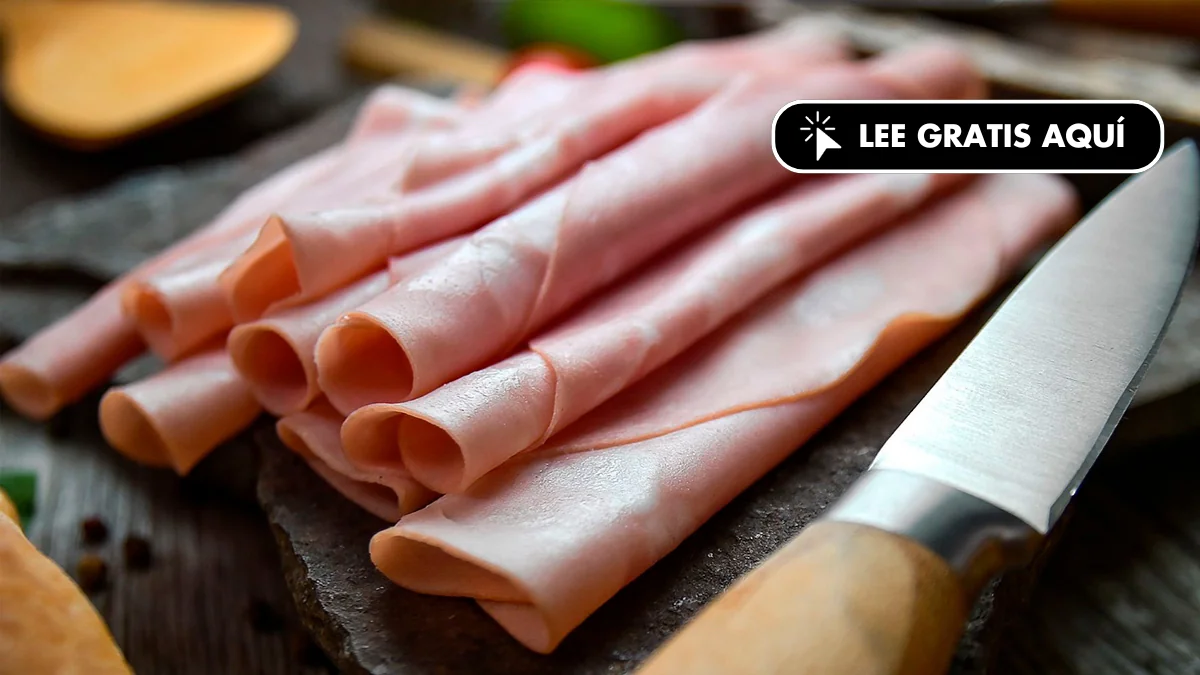
Cooked ham is one of the most popular deli products in our supermarkets and homes, but we don’t always choose the best one. At least, not if we judge by its nutritional profile. Traditionally considered a milder deli meat for its texture, its gentle flavor, and for containing less fat than conventional sausages, cooked ham has always had that role of a healthy option beside its fellow cold cuts.
However, not all cooked hams are equally advisable, and that is why it is worth reading the labels. Likewise, it should not be forgotten that it remains a processed product, which is why it should not be consumed in large quantities, especially if certain ingredients appear in its composition.
Something that nutritionist Blanca García-Orea recalled on her social networks, where she signs as @blancanutri, and clarified what we should pay attention to when talking about cooked ham. Versatile, all-terrain and very affordable, cooked ham also has, in a sense, subcategories worth knowing to understand what we are buying.
Moreover, in good faith we commit a recurring mistake: assuming that sliced ham is nutritionally superior to the packaged variety. The truth is that there is no reason for it to be, and above all, we will not be looking at the label, but blindly trusting the butcher. Blanca García-Orea made it clear: “Don’t trust sliced ham from the butcher, they are the worst,” and invited us to ask for the label. Something we have also stressed at THE OBJECTIVE with other products.
The Fine Print of Cooked Ham
Blanca García-Orea first focused on an element recurring in the composition of cooked ham: “You have to pay attention to the additives.” In this case, she insisted on “avoiding nitrites”. These can appear on the label as “sodium nitrite,” but also with codes ranging from E 249 to E 252.
She recalled that nitrites “can increase intestinal inflammation and, furthermore, are considered potentially carcinogenic.” She also did not miss the opportunity to emphasize that we should seek cooked hams that “do not contain carrageenans,” such as E 407, “an additive that is worth avoiding because it can cause intestinal inflammation.”
Finally, regarding additives, she insisted on a third compound: phosphates. “Sodium tripolyphosphate, in large doses, could lead to digestive problems and hyperactivity,” she warned. This is why she laid another piece of evidence on the table: the meat percentage. This figure has become the nutrition totem. Therefore, many consumers only choose options with more meat, but pay little attention to the additives.
Ver esta publicación en Instagram
James Whitaker
I’m James Whitaker, a UK-based journalist focused on emerging trends and everyday stories gaining attention across the country. I cover the topics people start talking about before they fully break into the mainstream. My work aims to stay clear, factual, and closely connected to how news is actually consumed today.