
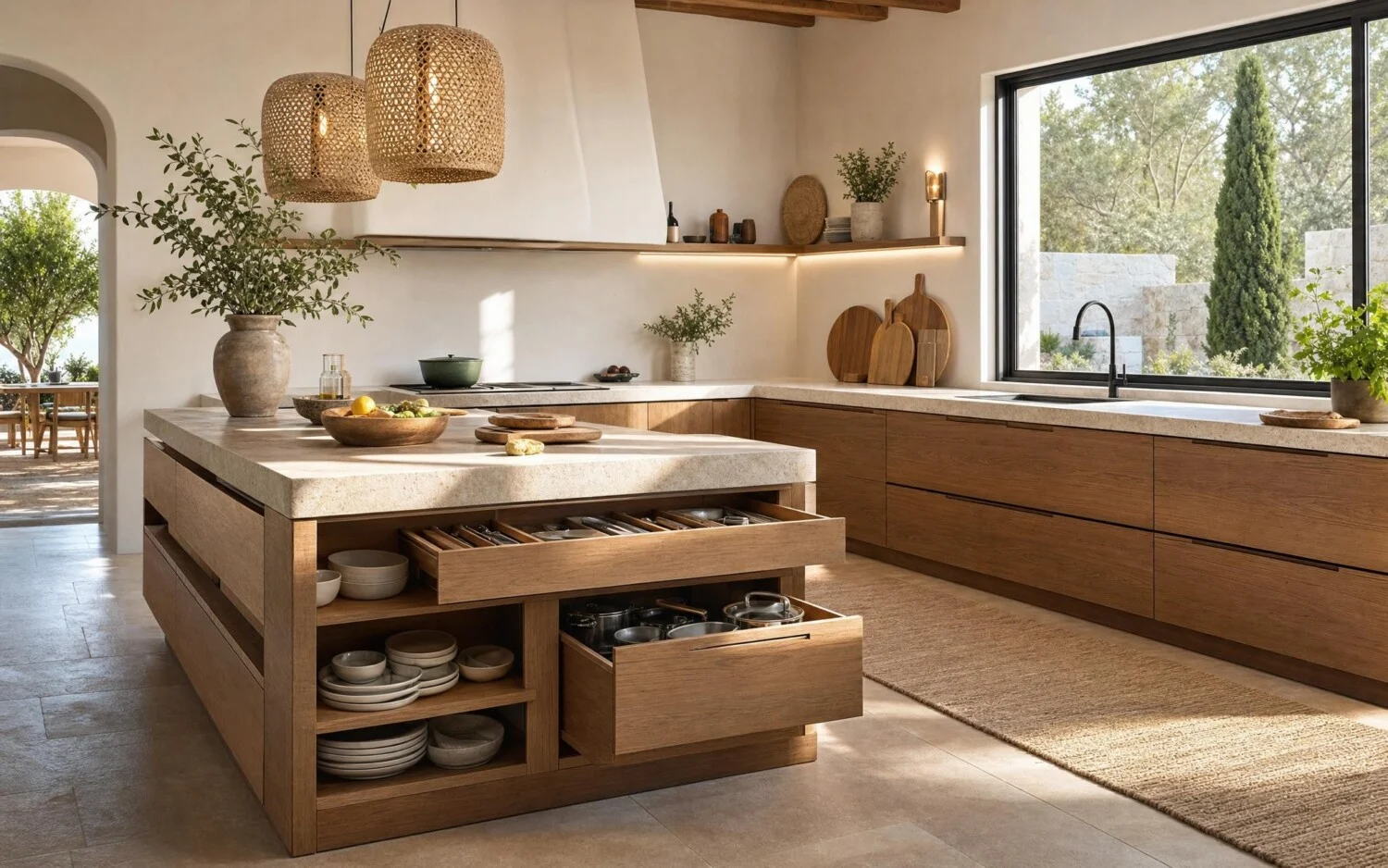
In most interiors, imagining a kitchen without a row of cabinets above the countertop seems almost impossible. Yet in recent years, a breeze from Spain has been shaking up this familiar setup. Walls are emptied, light is invited in, the kitchen blends into the living room, and tall cabinets gradually disappear, without families renouncing to store dishes and provisions.
For Maison et Travaux, this transformation is accelerating in 2026, driven by Iberian architects and echoed by sites like El Mueble or Okdiario. Stylist Olga Gil-Vernet summarizes the change: “It’s no longer just a place to cook, but a space where we share conversations, laughter, and intense moments with friends and family.” A large, very practical question remains: where does all the storage go then?
Why tall cabinets choke the kitchen
Decorators first point to the sense of clutter created by tall cabinets. “Upper storage can weigh down the space and reduce natural light,” explains designer Stephanie Mahaney, quoted by Le Journal de la Maison. Her colleague Jeanne Barber adds that “More and more, kitchens are designed to harmoniously integrate with other living areas, without that old ‘kitchen block’ effect,” which pushes to free up walls and the view.
Upper cabinets also block the light that should fall directly onto the countertop, notes the American site HouseDigest in 2026. In many homes, you have to climb onto a stool to reach the plates, with the risk of dropping a dish in passing. Moreover, replacing an entire wall of furniture is expensive. Hence this shift described by El Mueble and Okdiario toward walls that are much more airy.
What to replace kitchen cabinets with without sacrificing storage
According to experts interviewed by El Mueble, “If in 2025 we saw many kitchens without upper cabinets, in 2026 what we will see more and more are large display cabinets, spectacular creations.” These full-height display cabinets, often made of wood and glass, offer a capacity close to an old wall of cabinets. They display pretty dinnerware and a few objects, and the kitchen takes on almost living-room vibes while remaining very functional.
Next to them, the famous pantry — a tall pantry cabinet with drawers or sliding baskets — concentrates the dry foods. For Maison et Travaux, a standard wall cabinet can be replaced by a deep, well-compartmentalized drawer or a casserolier, often more legible. “The key is to find a balance between functionality and aesthetics, without sacrificing user comfort,” recalls designer Grey Joyner. Lapeyre also emphasizes optimized low furniture. Practically, the solutions often come down to:
- deep drawers and pot drawers that are easy to open;
- pantry columns with sliding baskets;
- an island with built-in storage or on casters;
- ready-made racks and movable baskets.
How to adapt a kitchen without tall cabinets at home
In a small kitchen without tall cabinets, kitchen designers often recommend clearing only one wall, the most visible, and keeping a few overhead storage units above the sink or the hood. Olga Gil-Vernet also reminds us that “We also reduce open shelves, which are impractical for daily use.”
In a large kitchen open to the living room, Maison et Travaux describes a sleek low run, one or two spectacular display cabinets, a pantry column, and, if space allows, a dining island. The mobile storage units complete the setup without weighing down the room.
Sources
- Maison & Travaux
“Adieu aux placards en hauteur: this trend from Spain reshapes the kitchen without losing storage” - Parole de mamans
“This old kitchen linen ruins your cabinets without you realizing it: here’s how to transform it into zero-waste storage”
