
The bathroom has just been cleaned, the toilet bowl gleams, the floor has been scrubbed… and yet, within a few hours, a toilet odor rises again. Many households feel they’ve tried everything inside the bowl, without understanding why the smells persist. Recently, housekeeping specialists have highlighted an ultra-simple gesture, based on white vinegar, which works not in the water but around the toilet.
Household tip articles published at the end of 2026 describe the same blind spot: the back of the toilet, the base and the nearby floor are rarely cleaned in detail, while they accumulate moisture, dust, and micro-splashes. On these surfaces, stains and stubborn odors quickly form. Experts therefore advise regularly spraying white vinegar around the toilet, then wiping, to prevent this mixture from setting in. This small acidic spray does not act only on the surface.
Why spraying white vinegar around the toilet truly limits odors
For many, the problem comes only from inside the bowl, while the most sensitive area sits right behind the toilet. On the wall, the base, and the tile, microscopic splashes and hard water leave a mineral film that traps dirt. Mixed with the room’s humidity and dust, this film creates a perfect ground for marks and odors that reappear despite cleaning.
White vinegar contains acetic acid, a weak acid capable of dissolving part of these mineral deposits and lifting the film that adheres to surfaces. Sources explain that its action is not to perfume the room, but to neutralize certain compounds responsible for odors. Used around the base and on the nearby floor, it also limits moisture-related stains and makes subsequent cleaning faster.
How to apply white vinegar behind the toilet step by step
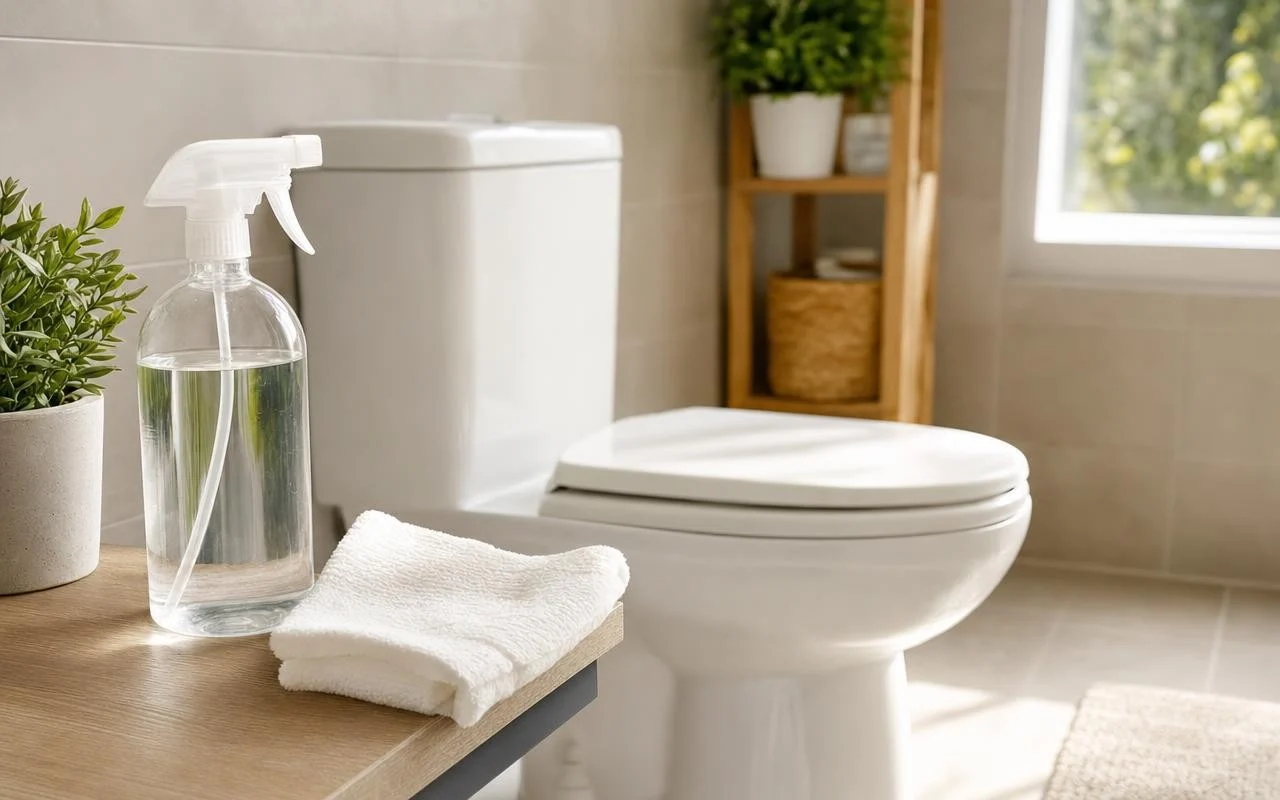
Specialists recommend incorporating this gesture into weekly maintenance, right after the usual toilet cleaning. Begin by removing dust and visible dirt behind and around the toilet with a cloth or small brush. Then fill a spray bottle with pure white vinegar and spray a fine mist on the wall, the base of the bowl, the sides and the immediate floor, without soaking the surfaces.
A light application is enough for the acid to start acting on the residues. Leave the vinegar in place for a few minutes; for a heavily marked base, some sources suggest ten to fifteen minutes before scrubbing. It remains then to wipe with a clean slightly damp cloth to remove dirt and product, then to thoroughly dry the wall, the toilet’s base and the tile. This final drying prevents moisture from settling and recreating odors.
Frequency, limits and precautions for vinegar around the toilet
Specialized articles present this spraying around the WC as a supplement to the routine, not as a catch-all solution. In practice, a full treatment once a week is often enough to limit deposits and odors, with a quick spray if an odor appears between cleanings. Experts remind that vinegar does not replace either a disinfectant product or a targeted treatment in case of mold or a leak.
The main precaution concerns safety: never mix white vinegar and bleach nor any chlorinated product, as this would release irritant gases. Each product should be used alone, in a well-ventilated room, with an interval between applications. Sources also advise drying the treated surfaces well, so that water does not stagnate. This simple trio—spray, wipe and dry—suffices to make the surroundings of the toilet cleaner and noticeably less odorous.
Sources
- Maison & Travaux
“Spraying vinegar behind the toilets: what experts know about these odors that come back”
