
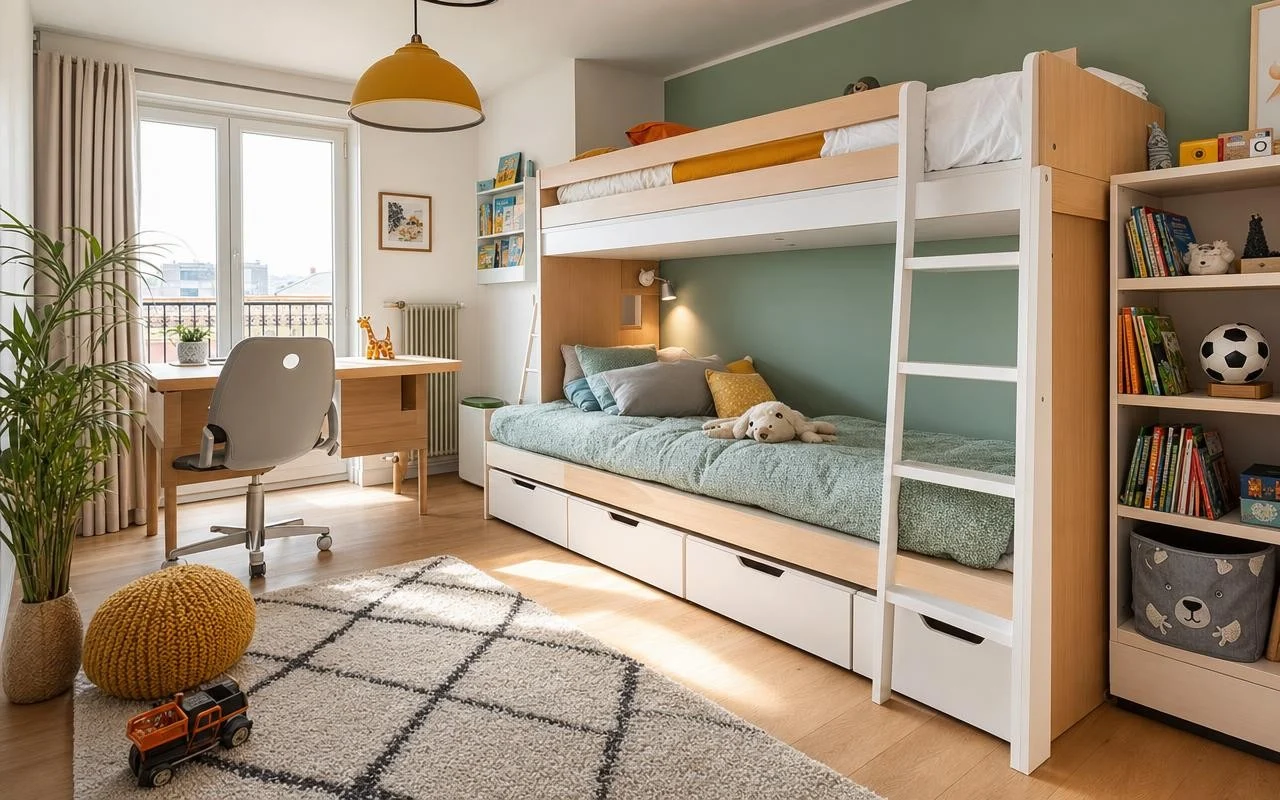
In the small 12 m² bedroom shared by my two children, I weaved around the beds like a maze. Two 90×190 cm sleeping setups placed on the floor, a storage unit jammed near the door, a few toy bins: on a daily basis, the room felt stuffed. As the kids grew, I found myself daydreaming about pushing the walls apart to finally breathe.
One evening, after tripping over a toy car for the umpteenth time, I seriously considered tearing down a wall to enlarge this room for two children. I began to imagine the construction, the plans, the noise, the dust. Then one idea stopped me in my tracks: what if the problem wasn’t the surface area, but the bed itself?
Why enlarging a two-child bedroom starts with the bed
In a shared bedroom, every square inch counts twice. Two standard beds placed side by side often saturate the space and give the impression that several square meters are missing. That’s exactly what Mon Lit Cabane describes in its advice on evolving furniture: the feeling of cramped space usually stems from how the sleeping area occupies the floor, more than from the actual size of the room.
By measuring honestly, I realized that the two beds and the circulation area around them blocked more than half of the 12 m². There remained a narrow corridor for play, clothing, and, in the long run, two small desks. The room wasn’t tiny; it was simply poorly organized. As long as I kept these two large rectangles on the floor, enlarging the room without renovations seemed impossible.
Knocking down a wall, or installing a movable partition: what these solutions hide
The radical idea was to knock down a wall to gain a portion of the adjacent space. On paper, the promise of a large single bedroom sounded ideal. In reality, one would need to verify whether the wall is load-bearing, have a professional come in, manage dust for several days, and anticipate any building-permitting steps. The budget would climb quickly for heavy renovations whose outcome remained uncertain.
I also looked into the lightweight partitions offered by Castorama. A movable partition in MDF or wood, in a lattice style, lets you create two visual worlds without a major upheaval, with the advantage of being easily dismantled if you move or change decor. The Alara modular partition, with its adjustable uprights, its varied panels (white, paintable, cork, glass), and its 4 cm thick boards, provides a sturdy, dismantlable solution that requires no anchors, with only a few holes to fill. These partitions separate spaces, but they don’t free up even a single centimeter of floor space.
The evolving bed that really enlarged the room without any work
The real turning point arrived when I discovered the evolving bed range from Mon Lit Cabane. This type of furniture is designed to grow with the child, in dimensions or configuration, without needing to buy a new bed every two or three years. The evolving kits even allow transforming an existing bed: the Evolutive Kit for Premium Bed starts at €75 in Natural, €85 in Vintage. For a loft bed configuration, the dedicated kit costs €140 in Natural and €160 in Vintage, far below the cost of a full renovation.
Before choosing, I revisited the criteria recommended by specialists to optimize a shared children’s room:
- The actual floor space available
- The number of children occupying the room
- The ceiling height, especially for a cabin bed or a bunk bed
- The overall budget, between a transformation kit or a complete bed
- The dimensions of the mattress you already own
In my case, an evolutive kit was enough to transform the sleeping arrangement and free up play space. For other families, the Evolutive Beds Tipi Premium Brasilia or Dakar in 90×190 cm, offered around €360, or the Cabane Beds B and DB Premium, from 70×140 to 90×200 cm between €360 and €380, provide a real space gain. Once the new bed was installed, circulation became fluid and the famous wall to be knocked down simply vanished from our discussions.
