
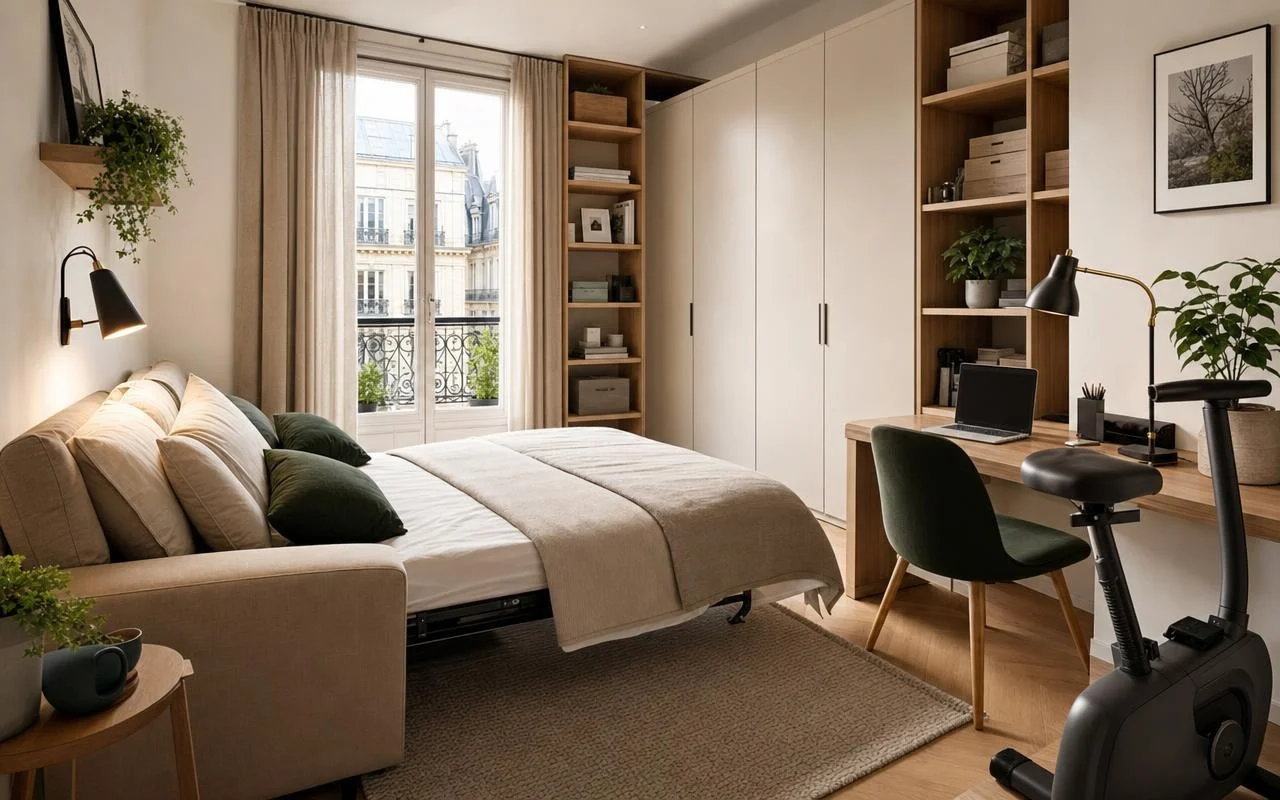
In many French homes, there is a door that stays almost permanently closed. We rush in just before the in-laws arrive, we change the sheets, shake a pillow, then vanish for weeks. The guest room often welcomes only a few nights of guests per year, sometimes as few as three. The rest of the time, it occupies precious square meters, heated and furnished, but rarely lived in.
Because leaving a room almost empty 362 days out of 365 raises questions, especially when the price per square meter is soaring and daily life is more centered around home. Regular telework, at-home workouts, the need for storage, the desire for a calm reading corner—everything gets disrupted. As a result, this inert space becomes a discreet luxury that many no longer want, or no longer fully, to shoulder the silent cost.
Guest room: an underutilized space that questions housing
Overnight guests are fewer, large family gatherings rarer. The second edition of the survey “La France à table” by the Jean Jaurès Foundation and L’ObSoCo shows that 43 % of the French regularly dine alone, compared with about 29 % twenty years ago. Hosting has become more demanding. “To receive is no longer a pleasure; it has become a trial,” notes Sandra Thomann, author and culinary blogger, quoted by Fémina.
Living spaces have also changed. Catherine Sabbah, from the Institute for Advanced Studies in Housing Action, recalls that a study of recent flats shows kitchens that shrink, the disappearance of the traditional dining room, and that “very few have a true guest room.” In this context, a room set aside for occasional use logically gives way to a space useful for daily living.
Office, dressing room, home gym: what the French actually install there
According to Journal des Seniors, the office clearly leads the way in transformations. With hybrid work, having a closed, isolated home office becomes a real criterion of comfort. The guest room, often a bit set apart, lends itself well to videoconferences and tasks requiring concentration, provided that the lighting is redesigned and sound insulation is improved if the room is used several days a week.
Another big winner is the dressing room version. In homes with few built-in storage options, transforming the guest room into an organized wardrobe helps relieve the main bedrooms and better structure daily life. The home gym corner is also progressing, driven by at-home fitness: a treadmill, a few dumbbells and an open space are often enough. Journal des Seniors also notes a rising, though more discreet, share of rooms converted into libraries or tranquil reading nooks.
How to transform without renouncing the occasional sleeping arrangements
For many, the real challenge is to gain a useful room without totally giving up hosting family or friends. Reversible solutions answer this dilemma. The sofa bed remains the safe bet: in a study or a reading corner, it offers a comfortable sleeping option for a few nights without intruding on daily space. Convertible benches or high-quality inflatable mattresses complete the arsenal for truly occasional welcomes.
When the room must stay very clear, the fold-down bed fixed to the wall is increasingly appealing, especially in cities. When raised, it frees the entire floor for a desk or a workout area; when lowered, it becomes a real bedroom again. Journal des Seniors notes that this type of solution, as well as a custom dressing room, represents a budget well above 1,000 €, whereas a simple desk costs only a few hundred euros. To succeed with the layout, several points repeatedly come up:
- plan for task lighting in addition to the central ceiling light;
- choose modular furniture if some sleeping space remains necessary;
- avoid overloading the room to preserve fluid circulation;
- pay attention to sound insulation if the room becomes a regular office.
