
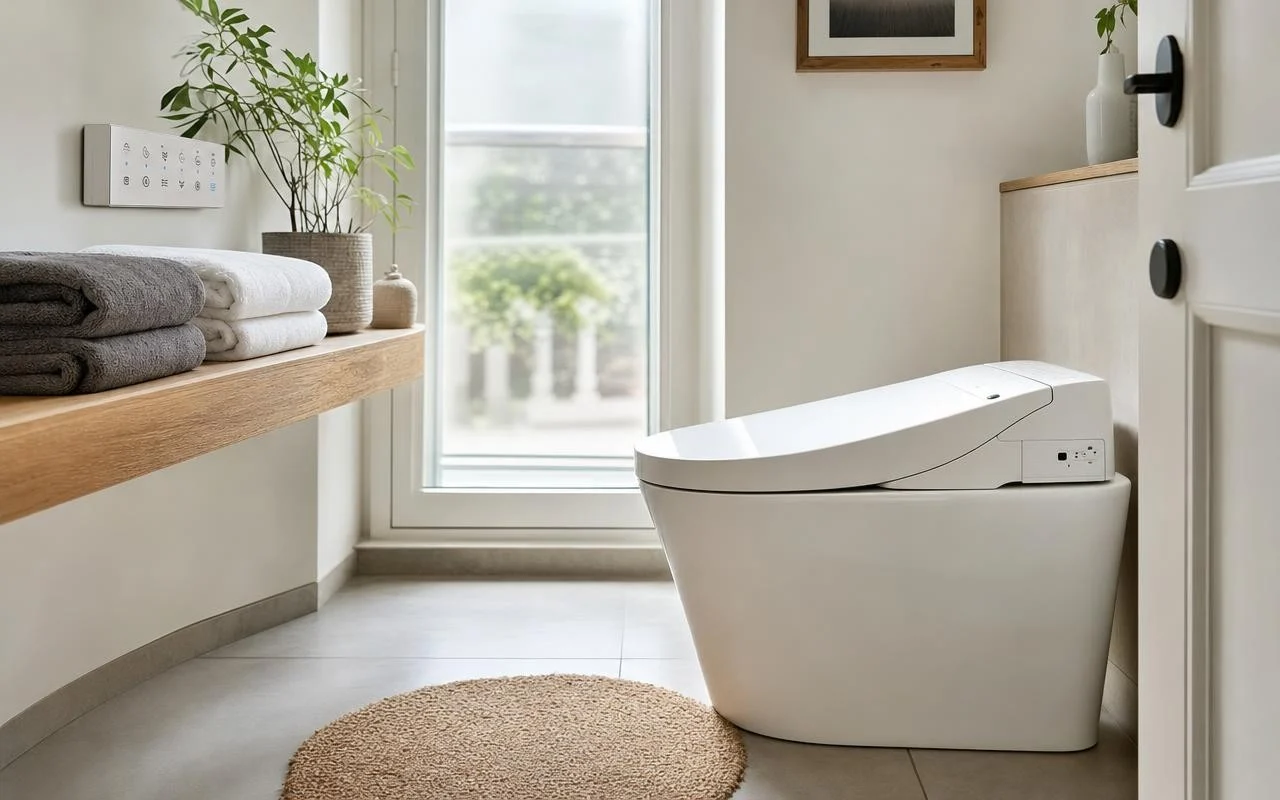
For a long time, the throne of the bathroom was never a topic for debate: a white ceramic block, discreet and standardized. Easy to match, reassuring, it eventually went almost unnoticed. Yet, this everyday symbol begins to wobble, unsettled by a new generation of sanitary ware that is much more sophisticated.
In French do-it-yourself stores, sales of toilet spray nozzles have tripled by the end of 2025, according to France Info. In Spain, the press already highlights “smart toilets” from Japan. And several studies suggest that by 2027 water could largely replace toilet paper for intimate hygiene. The great replacement is playing out here.
Smart toilets: the high-tech replacement for the white toilet arriving in Spain
A Japanese-style toilet or smart toilets are first and foremost a sanitary fixture equipped with electronic components and automated systems. The concept was popularized in Japan as early as the 1980s, incorporating bidet functions directly into the toilet seat. Today, these devices are said to be present in nearly 80% of Japanese homes, making it more of a standard than a curiosity.
In Spain, these models are beginning to be installed in bathrooms being renovated. The principle: a water wash after flushing, via a nozzle that emerges beneath the seat. The user can adjust the temperature, the pressure, and the position of the jet. A hot-air drying then takes over, greatly reducing the need for paper. Heated seat, automatic opening and closing of the lid, night LED lighting and a control panel often complete the package.
Cleaner and more comfortable: what these Japanese toilets change in daily life
The first argument highlighted remains hygiene. Washing with water is considered gentler and more effective than rubbing with paper, especially for people suffering from hemorrhoids or having sensitive skin. Some models add a dedicated wash program for female anatomy, or a “massage” mode with a jet that moves back and forth.
Manufacturers also work on keeping the device itself clean. The wash nozzles benefit from self-cleaning functions after every use, sometimes complemented by an ultraviolet lamp that automatically disinfects the spray arm. A special enamel designed to repel dirt limits residue adhesion, while an odor absorption system keeps the toilet air more neutral than with a classic model.
- Water jet adjustable in temperature, pressure and direction for precise cleaning.
- Hot-air drying with several levels to limit toilet paper use.
- Female programs, gentle modes and a “massage” function depending on the models.
- Nozzle self-cleaning, sometimes complemented by UV disinfection.
- Integrated deodorization and night LED lighting for a more comfortable use.
Prices, connected health and the future of toilet paper by 2027
In Europe, entry into this universe can be gradual. A simple toilet spray attached to the faucet costs around 40 euros. The more sophisticated bidet seats exceed 1000 euros, with heated rim, drying, and memory settings. The toilet paper budget, meanwhile, can surpass 100 euros per year depending on habits, which makes these devices interesting in the long term.
At the top of the pyramid, complete toilets like the VOVO NEO Smart Toilet are listed at $4,999, or about €4,300, and have been recognized at the CES Innovation Awards 2026 in the Smart Home category. This model combines hot-water washing, hot-air drying, heated seat, intelligent flushing and deodorization, with in addition a urine-analysis sensor to monitor hydration and well-being. A feature called Jindo the Dog even records bathroom visits and can alert a relative if no use is detected for 8 to 12 hours, a safety net for seniors living alone.
According to several media outlets, bidet toilets and toilet spray devices could, by 2027, significantly reduce paper usage without eliminating it entirely. The ecological argument also weighs in: Pleine Vie recalls that every avoided toilet paper roll saves the water, wood and energy required to manufacture it. Between the widely adopted Japanese model, the first well-installed devices in Spain and the rise in France, everything indicates that the old white toilet is seeing the emergence of a far more modern, cleaner and more functional successor.
Sources
- Melty
“The toilet paper is over: here is what will replace your rolls in your toilets and bathrooms by 2027”
