
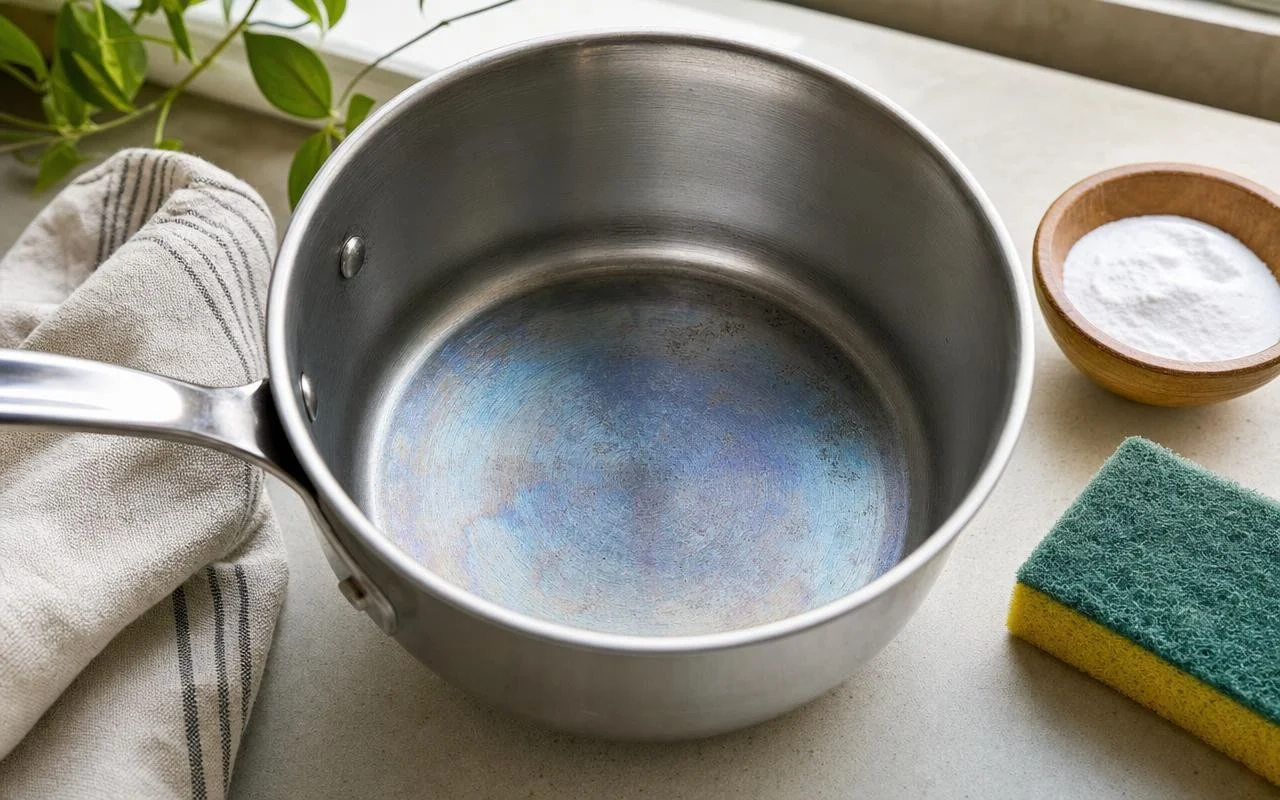
You’ve just emptied your pasta, rinsed the pot, and at the bottom, there’s a surprise: a blue, violet, almost pearlescent veil, forming rainbow streaks. The surface looks smooth, the pot seems clean, yet the color stubbornly clings. Many immediately think of a scorched bottom or a coating that’s deteriorating, with the fear of needing to replace the entire set of cookware.
This phenomenon mainly affects stainless steel pots used daily for boiling water, cooking rice, or potatoes. Across online forums and family conversations, opinions vary on the origin of these marks and their health risk. Before tucking your pan away, it’s worth understanding what’s happening at the metal’s core. The reality is less worrying than it might seem.
Where do rainbow traces in a stainless steel pan come from?
Experts in stainless steel cooking describe a simple surface phenomenon. The expert Saliha Özcan summarizes: “Colored discolorations, often called the rainbow effect, appear when stainless steel is heated and constitute a natural oxidation process,” explains Özcan from Sallys Welt. In other words, heat briefly alters the thin oxide layer that protects the steel, causing light to refract and producing iridescent reflections at the bottom of the pan.
This display of colors tends to appear after high-heat cooking, a heat that lasts a bit too long, or when the bottom is left on the flame nearly dry. According to tips shared by consumer sites, these iridescences also form during cooking pasta or rice rich in starch, or when cooking with very hard water in a pan that already shows marks. Experts remind that these stains are harmless, do not alter the taste of foods, and do not diminish the inox’s ability to heat.
How to remove rainbow stains without damaging the stainless steel
To make the rainbow traces disappear in a stainless steel pan, white vinegar is your best ally. The simplest method involves pouring into the cookware a mixture of water and vinegar in a three-to-one ratio (three parts water to one part vinegar), as recommended by German practical guides. Let the solution act for a few minutes, preferably warm or hot, then rinse thoroughly. If the veil persists, bring this mixture to a gentle boil before washing the pan with a soft sponge.
Reader-shared kitchen tips add other gentle options. You can boil in the pan about 500 milliliters of water with 150 milliliters of white vinegar, let it cool, then rub, as described in a detailed step-by-step guide. Another option is to line the bottom with baking soda, add a little water, bring to a boil, then clean after it cools. Some replace baking soda with coarse salt or simply rub with lemon zest. Experiments with very hot water and a dishwasher tablet also work on stubborn iridescences, provided you rinse well afterward, never using highly abrasive products, aggressive cleansing milks, or a metal pad that would permanently scratch the stainless steel.
Preventing the return of iridescence and spotting lime scale
The same pots sometimes display white, powdery stains. These correspond to deposits of lime scale or calcium left by hard water after boiling, or to crystals of salt that didn’t fully dissolve.
To limit iridescence and tartar, it’s best to avoid heating stainless steel empty, rinse after use, dry thoroughly, and maintain a medium flame.
