
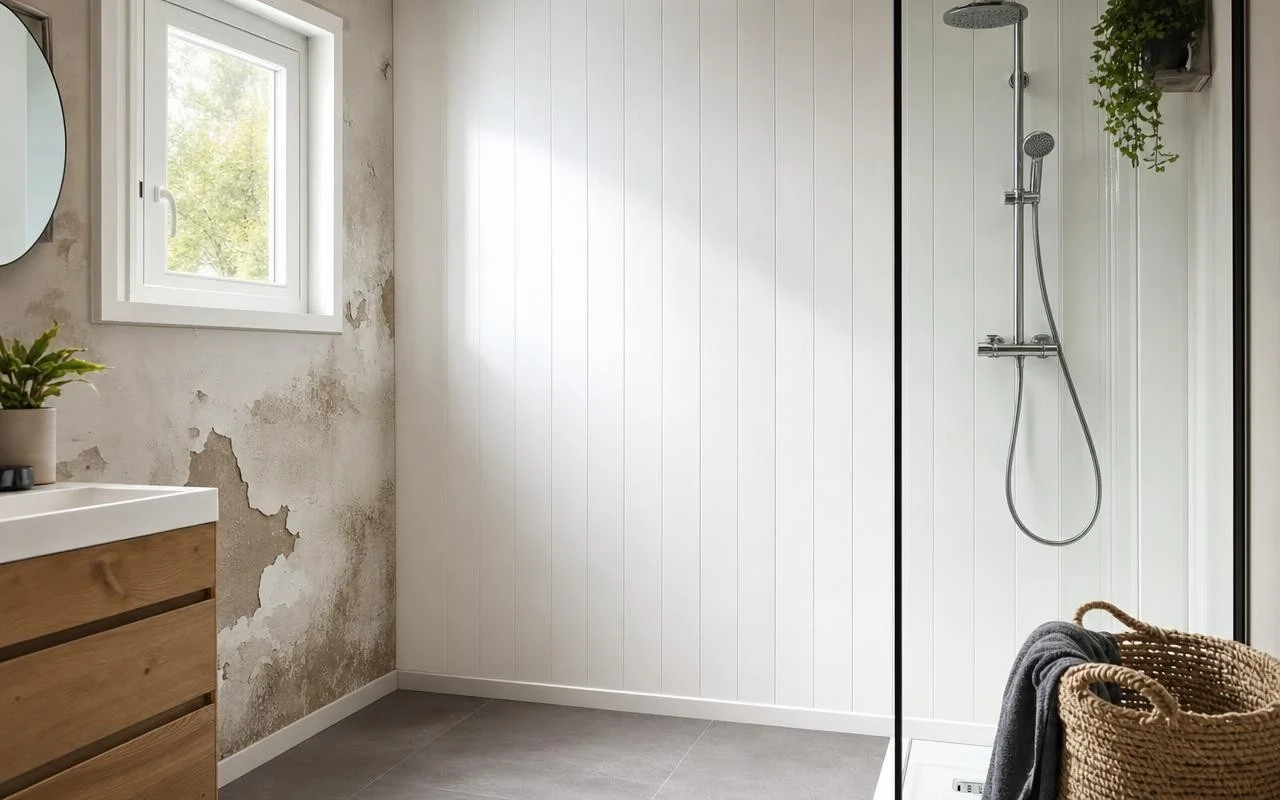
Between loads of laundry and the children’s shower, you’re fed up with seeing the paint blister above the bathtub or the worn tiles behind the sink. The PVC wall panels promise a bathroom or a kitchen that looks “like new” in a weekend, without dust or major work. It’s hard not to be tempted.
This success is nothing surprising: these panels snap on quickly, wipe clean with a single sponge, and tolerate steam very well. Many homeowners choose them for humid rooms, precisely to turn the page on condensation marks and splashes. Everything actually happens behind the panel.
PVC wall panels for humid rooms: what they really do
A piece of PVC (polyvinyl chloride) is a lightweight panel that serves as a PVC wall cladding for damp rooms or as a false ceiling. You’ll find it in panels or planks, in finishes that imitate wood, marble, concrete, or simply solid colors. They are installed over an existing prepared substrate: sound-painted wall, old tile that adheres well, old paneling. The idea is to cover, not to demolish everything.
In a bathroom, a kitchen, or a laundry room, their major advantage comes from the material itself: PVC is non-porous; it does not absorb water. Drops bead off, grease cleans off with a sponge and an appropriate product, and there’s no need to repaint every two years. Visually, the renovation is immediate, which makes it an appealing option when you want to refresh a damp space without starting a major project.
Moisture, condensation, efflorescence: what PVC protects… and what it hides
Once installed edge to edge and sealed, the panels form a relatively closed film on the wall, somewhat like a resin on a concrete slab or a varnish on old clay tiles. If the backing is sound and dry, it’s ideal: the wall stays clean, condensation no longer directly attacks the plaster or paint, and maintenance is limited to surface cleaning. For bathroom humidity, related to steam and splashes, this works very well.
The scenario changes as soon as the moisture comes from inside the wall. Infiltration through a crack, a leaking pipe, capillary rise: water advances within the masonry, becomes laden with mineral salts, and then ends up trapped behind a waterproof coating. Over time, this can cause blisters, peeling, odors of stuffiness, or a whitish veil of efflorescence at the base of the walls. We think we have protected the wall; we have mostly trapped a structural moisture that continues to work silently.
Before installing PVC panels on a damp wall: the right reflexes
Before pulling out the saw and glue, a quick home diagnosis is in order. Condensation that appears after a shower and disappears quickly when you open the window or when the ventilation system is running points to ambient humidity. A localized stain that gradually enlarges suggests an infiltration or a leak. Crumbling baseboards, halos rising from the floor, and efflorescence point toward capillary rise to be treated in depth.
On a murky mineral wall or slab, some on-site guides recommend a very simple test, derived from the American method ASTM D4263: cut a square of transparent plastic film about 50 x 50 cm, seal it tightly to the surface, and wait at least 24 hours. If droplets form under the plastic, or if the material darkens, it means the substrate is still releasing moisture. In that case, it’s wiser to address the source of the problem – drainage, resealing, more effective ventilation – before installing PVC wall panels that would merely hide the symptom.
