
The scenario is all too familiar: the thermometer climbs above 35°C, you open the patio door, place a foot on the terrace… and you immediately go back to fetch sandals. Dark wood, traditional concrete, or dark stone quickly turn into a scorching hot plate in full sun, to the point of making the space nearly unusable during the hottest hours.
Yet landscape designers have noticed that one type of flooring remains surprisingly bearable, even when the air temperature approaches 38°C. It is not some gimmick nor a miracle paint, but a material + installation duo that changes everything for barefoot walking without fearing burns.
Why a light porcelain stoneware keeps the terrace cooler
Dark materials absorb a large portion of solar radiation and release it as heat. Conversely, a light coating has a higher albedo: it reflects more rays and stores less energy. As a result, the surface temperature rises more slowly, which limits the scorching-surface effect during heat waves.
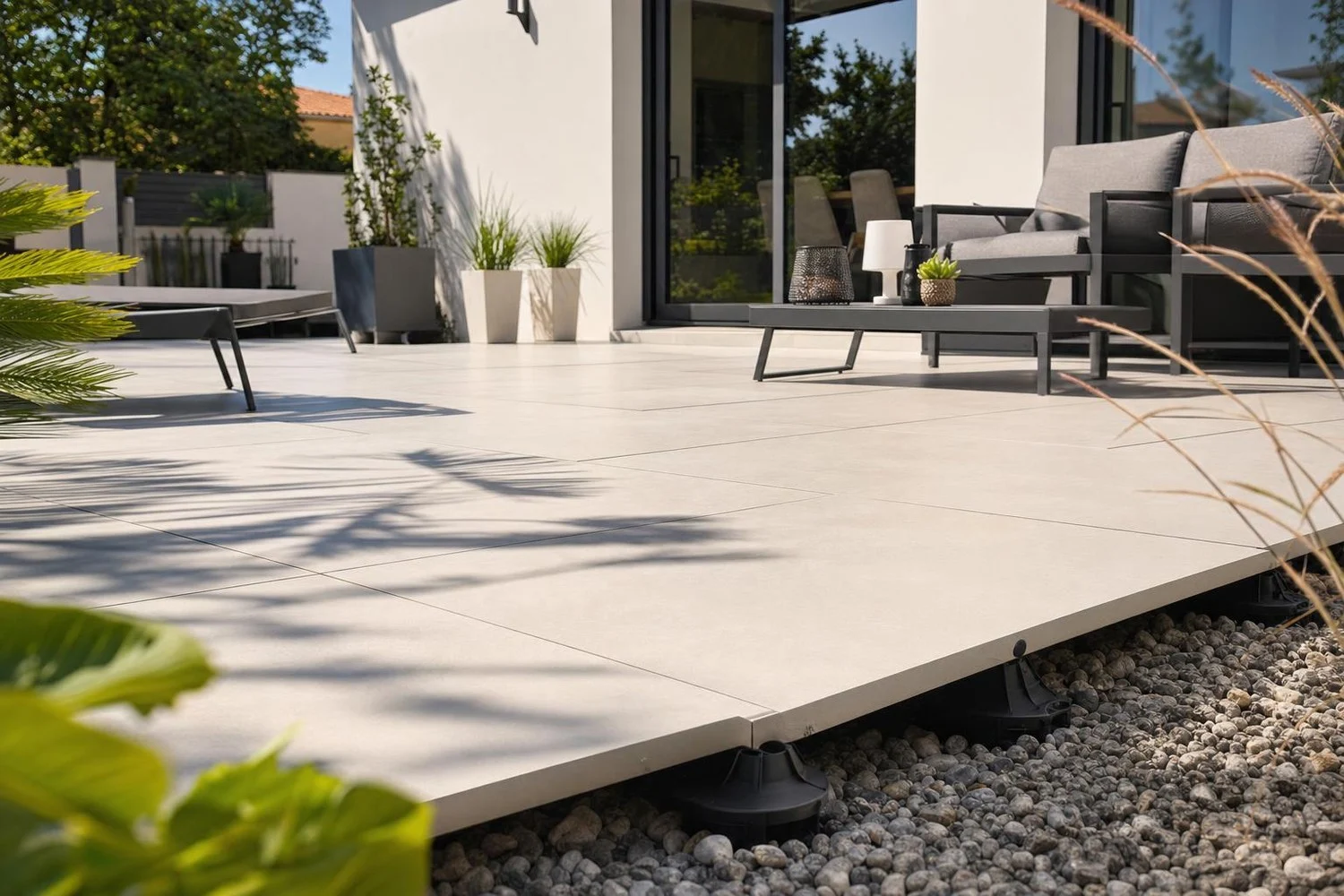
That is where light porcelain stoneware comes into play. This high-density ceramic, fired at temperatures above 1,200°C, offers low water absorption (often below 0.5%) and excellent stability. In an exterior 20 mm thick version, in beige, sand, or pearl gray shades, it reflects a significant portion of the radiation and remains noticeably more comfortable to the touch than dark concrete.
The secret of landscapers: light porcelain stoneware on pedestals with an air layer
Choosing a good material is not enough. Professionals almost always pair these slabs with a pedestal-supported installation. The tiles are then slightly elevated, without adhering to a sun-warmed concrete slab. Between the substrate and the coating, a ventilated air gap is created and acts as a thermal buffer: heat dissipates more quickly.
Air also circulates between the joints left open, which further enhances the sense of coolness and eases drainage during summer storms. Tutorials from major retailers generally recommend four pedestals per slab, i.e., around six pedestals per square meter depending on the format. This technique, increasingly chosen for terraces planned for 2026, remains accessible for both renovations and new builds.
Checklist to prevent scorching ground for a terrace in light porcelain stoneware on pedestals
To achieve a true terrace that does not burn the feet, landscapers rely on a few simple criteria. They look at color, surface texture, safety in rain, and the quality of pedestal installation, which determines ventilation beneath the slabs.
- Light shade (beige, sand, pearl gray) rather than anthracite or dark brown.
- 20 mm thick slabs, compliant with EN 14411.
- Non-slip surface rated at least R11, ideal around a pool.
- Installation on adjustable pedestals with open joints to allow air and water to pass.
Experts also remind that an extremely light floor can dazzle at noon and reflect a portion of the heat back toward the legs. Hence the value of combining this system with shaded areas (drapery, light pergola, vegetation) and avoiding finishes that are too polished and highly reflective. When chosen and installed correctly, light porcelain stoneware on pedestals can indeed let many gardens enjoy barefoot walking even when the mercury rises well above 35°C.
