
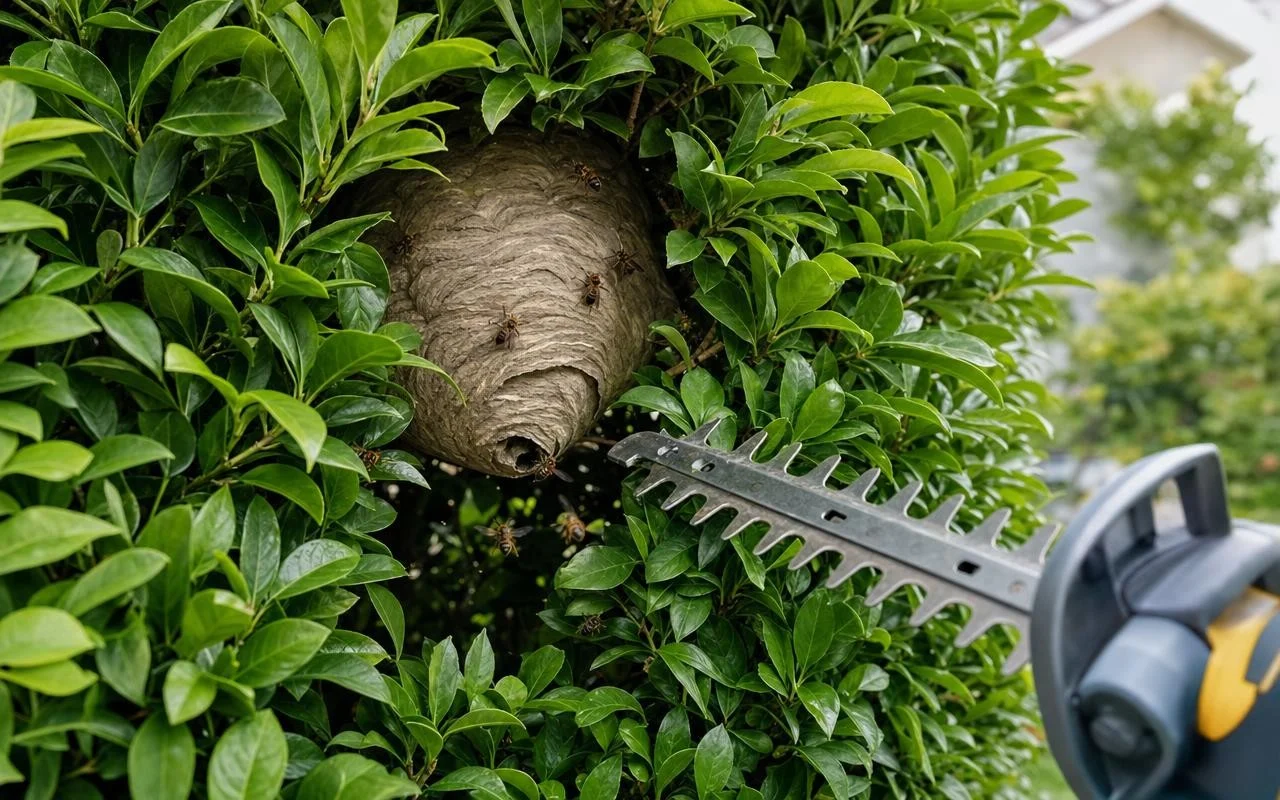
At the end of August, the sun still pours onto the terrace and we tell ourselves it’s time to trim the laurel hedge before returning to routine. We bring out the hedge trimmer, check the extension, sometimes slip on only a T-shirt and sunglasses. The blade bites into the glossy foliage, branch after branch, in a steady hum. Everything seems ordinary, until something rumbles at the heart of the branches.
In a matter of seconds, a cloud of insects erupts, and the gardener understands that he has just awakened an Asian hornet nest hidden within his laurel hedge. The instinct is to step back, to shield his face with his forearms, to run toward the house while the insects pursue him. The stings come one after another, especially if the colony feels threatened. This scenario, recounted by many individuals, returns every late summer in French gardens and continues to surprise just as much.
Late August, when the laurel hedge awakens an Asian hornet nest
Around the end of August, Vespa velutina nigrithorax colonies reach their peak strength. According to the National Plan for the Fight against the Asian hornet from the Ministry of Ecological Transition, a secondary nest can gather several thousand workers, sometimes more than 5,000 individuals. The structure, 40 to 70 centimeters in diameter, resembles a large papier-mâché ball, but inside a hedge it remains almost invisible.
The National Society of Horticulture of France notes that nests located in hedges are among the most dangerous to humans, as they are often at head height and react to the slightest disturbance. Laurel, cherry laurel, photinia, privet, or thuja provide dense cover, perfect for sheltering a colony. When the blade of a hedge trimmer vibrates in the wood, the hornets interpret this tremor as the attack of a predator.
Before trimming the laurel, spot the signs of a hidden nest
Before restarting the engine in late August, a few minutes of observation can change everything. The French Biodiversity Office already reminds us to avoid hedge trimming from March 16 to August 15 in order to protect nesting birds; right after this period, hornet nests are flourishing. It is therefore wiser to perform a visual inspection before any cut, without shaking the branches or forcing the tool into the foliage. Certain signals, easy to see or hear, should raise alarms.
- A back-and-forth movement of insects toward a single point in the hedge, like a small aerial corridor.
- A deep, continuous buzzing that persists even when everything around is calm.
- A section of foliage that seems to vibrate or flutter even in the absence of wind.
- A gray or beige rounded mass, glimpsed by slightly parting the branches.
- Insects larger than wasps, dark brown to black, with yellow-tipped legs typical of the Asian hornet.
To verify without exposing oneself, observe the interior of the hedge from a distance, from several angles. If the insects’ back-and-forth convergence keeps aiming at the same foliage hole, it’s better to postpone the trim and seek advice from the town hall or a specialized platform.
Attack during trimming: vital reflexes and emergency contacts
If a heavy buzzing erupts during the cut, immediately switch off the engine, release the tool, and move in a straight line, with the face and neck protected by the arms.
If multiple stings, facial swelling, breathing difficulties, or a malaise occur, immediately dial 15 or 112. At the slightest doubt, keep the hornet nest in place, remove children and pets, and call in a professional pest controller to handle the situation.
Sources
- Modes & Travaux
“Sève de laurel-rose: le danger invisible qui guette les jardiniers imprudents lors de la taille” - L’Ami Des Jardins
“Laurier rose peu fleuri suivez ces 5 regles dor pour doper sa floraison”
