
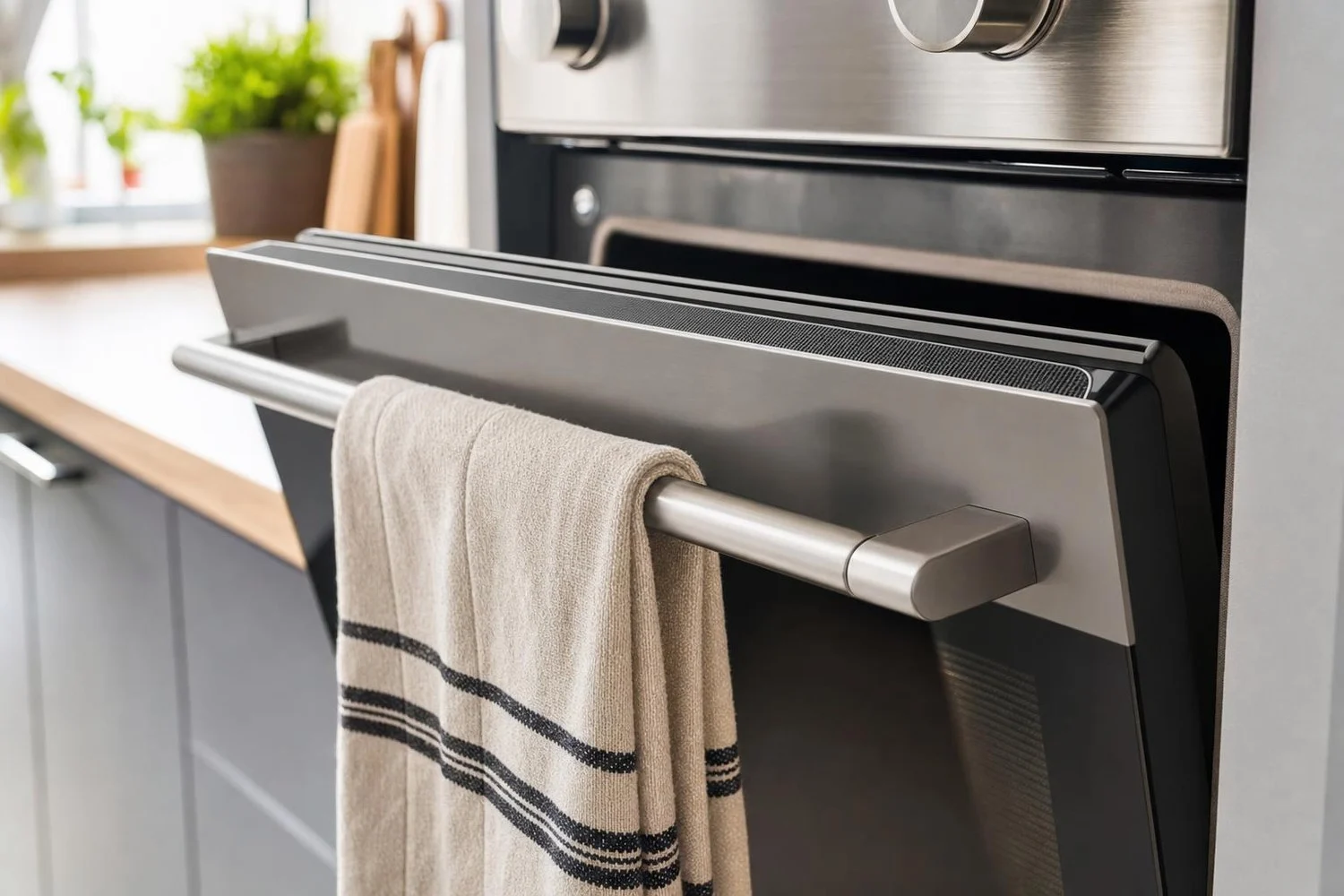
Everyone knows this scene: you neatly fold your dish towel over the oven door, you turn your back for a few minutes, and it ends up on the floor, sometimes in a puddle or in front of the dog. This little recurring mishap is tiring, soils the handle, and forces you to swap towels several times a day.
In the kitchen, this detail disrupts the rhythm: you search for the towel, you bend down, you rinse your hands again… when all that’s needed is for it to stay in place. There is a solution, very discreet, that simply relies on the contact between the fabric and the oven door. And that’s where everything changes.
Why Towels Slip on the Oven Door
The cause is mainly mechanical. The oven handle is often smooth, sometimes rounded, while the towel is soft and light. With every opening, closing, or mere brushing, the fabric unfolds a little, loses its support, and ends up falling. As soon as the towel is slightly damp, its weight increases and the slipping accelerates.
Many households try to wedge the cloth into the seal, tie a knot around the handle, or add a small weight. These improvised solutions rarely hold up over time, sometimes hinder the door from closing properly, and leave marks. The need is clear: keep a towel accessible, clean, and stable, with no visible DIY or risk to the oven.
The Non-Slip Tape to Stop Towels from Slipping on the Oven Door
The answer lies in a simple non-slip strip placed on the inner edge of the door. Made of silicone or food-grade rubber, it remains invisible when the door is closed. Its role is to create a light amount of friction where the towel rests: the fabric is pinched just enough to stop slipping, without being damaged or caught in a mechanism.
Models sold by the meter can be cut to the right length, with a recommended width of between 0.5 and 1 cm for most ovens, up to 2 cm depending on the door shape. These strips withstand heat, do not touch the interior of the oven, and clean with a quick sponge wipe. Result: towels stay clean, the handle retains its look, and the kitchen no longer gets cluttered with towels on the floor.
Properly Placing the Non-Slip Strip and Daily Best Practices
Installation takes less than five minutes. Start by gathering the supplies:
- a thin non-slip strip in silicone or food-grade rubber;
- a pair of scissors;
- a dry towel for testing.
Begin by thoroughly degreasing the upper inner edge of the door, then let it dry completely. The strip is cut to the useful width, and adheres or slides into place depending on the model, exactly where the towel sits. Then simply check that the door closes without forcing, and hang the towel flat: the effectiveness is immediate.
A few detail-oriented habits make the daily difference. A very dry towel sticks better and avoids the feeling of heaviness. It’s better not to stack multiple layers so that the door remains perfectly airtight. The strip can be cleaned regularly, like the handle, to maintain its anti-slip power. For those who reject any adhesive on the appliance, an alternative exists: sew a small hook-and-loop strip onto the cloth, which festoons around the handle—slightly more visible but just as practical.
