
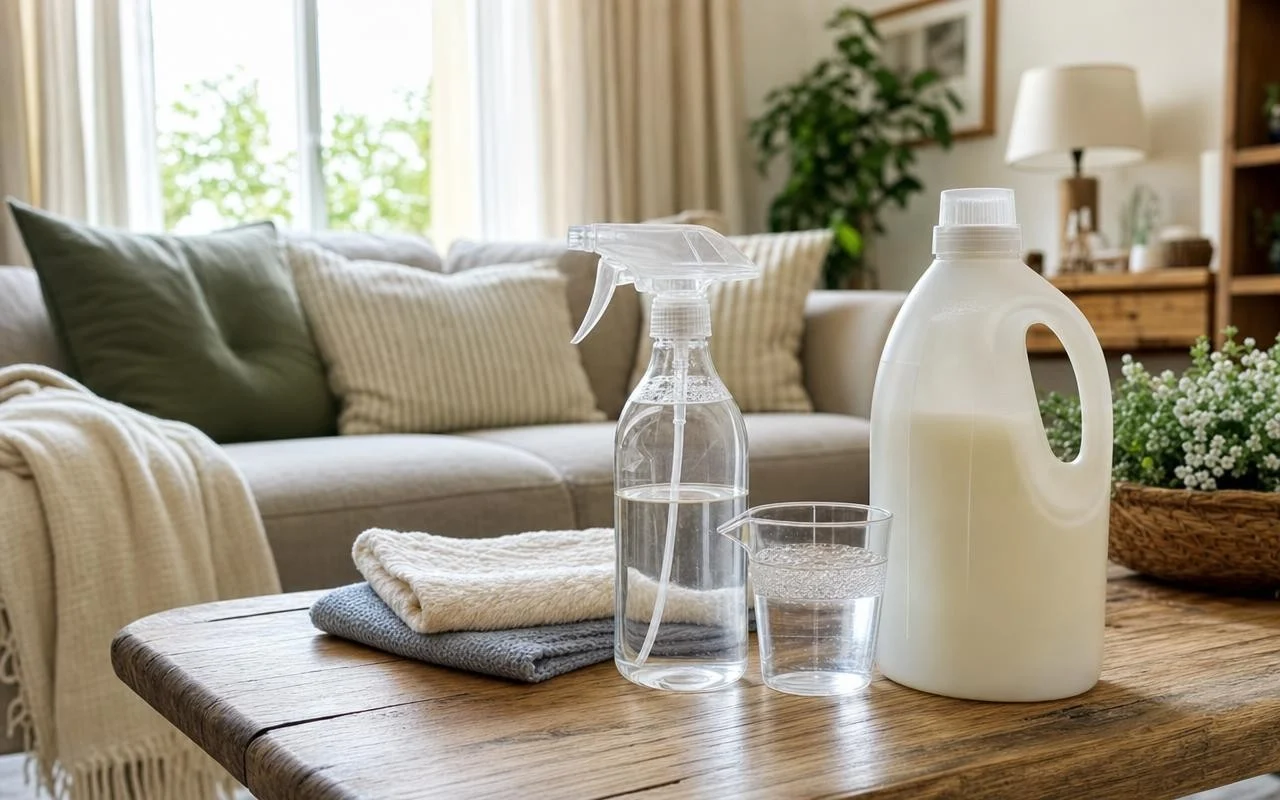
When a home smells musty despite cleaning, the usual culprits are the textiles: curtains, sofas, cushions, bedding, and carpets. They absorb odors from cooking, humidity, or tobacco and keep them for a long time. Organization and cleaning experts, such as Alicia Martínez, have highlighted a very simple trick to address this: a homemade textile fragrance, prepared in minutes with what you already have under the sink.
As several home specialists summarize, “to prepare a homemade textile fragrance, you only need a little fabric softener and alcohol.” This DIY solution scents fabrics, helps drive away bad odors, and costs very little. The challenge is to know the right blend and the precautions to use it without damaging your favorite textiles.
Homemade textile spray with fabric softener and alcohol: the experts’ recipe
The recipes shared by these experts revolve around the same trio: water, household alcohol or 70% alcohol, and fabric softener. A widely circulated ratio is to mix about 200 ml of water, 200 ml of alcohol, and 100 ml of fabric softener in a clean spray bottle. The goal is to obtain a solution dilute enough not to soil the fibers, but scented enough to leave a real impression of clean laundry on the fabrics.
Each ingredient has its role. Alcohol helps the mixture dry quickly and disperses odor molecules, water moderates the blend, and the fabric softener provides the scent. The technical sheet for ELIDOU Fabric Softener notes that “The ELIDOU Fabric Softener formula is enriched with additives that durably fix the fragrance onto laundered textiles and facilitate ironing.” These fixing additives explain why a simple diluted softener leaves a scent that lasts reasonably well on curtains or throws.
Prepare and apply your homemade textile fragrance
The preparation is a matter of a few steps. First pour the water into the spray bottle, then the alcohol, and finally the fabric softener, to limit foaming. Close it and shake vigorously to homogenize. Drawing on DIY cosmetic-style recipe formats, these experts advise using a well-cleaned bottle and keeping the mixture closed, away from heat and light, for about three months.
For application, textile fragrance brands generally recommend spraying at about twenty centimeters from the fabric, onto a clean and dry surface. This approach also works for the homemade spray, on surfaces such as:
- Curtains and sheer drapes
- Fabric sofas and armchairs
- Cushions, throws, and bed heads
- Bedding and bedspreads
A test on a hidden area remains essential, especially for dark colors or delicate textiles. If the fiber changes appearance after drying, avoid applying the spray there. Many specialists suggest renewing the spray every two or three days, rather than soaking the fabric all at once.
Precautions, delicate fabrics and a stain-free alcohol-free alternative
On safety, it’s important to remember that fabric softener is an external-use product: do not swallow, do not spray near the face or on the skin, and store out of reach of children. The ELIDOU data sheet notes a pH around 6.5 ± 0.1, hence a relatively mild solution, and a typical dosage of 10 to 15 ml per kilogram of dry laundry in the machine. In the homemade spray, it’s best to limit the amount of softener to avoid any greasy film on the fabrics.
Alcohol remains the most delicate element: some textiles (silk, velvet, wool, leather, suede) react poorly to it. For these materials, a prior test is essential, or even full avoidance. Commercial textile fragrances, such as those offered by Kyphi, emphasize formulas “stain-free alcohol” designed to limit this type of risk. The homemade fabric-softener-alcohol spray remains a good trick for everyday washable fabrics, provided you ventilate the room after use and spray lightly—just enough for the house to regain that famous scent of cleanliness.
