
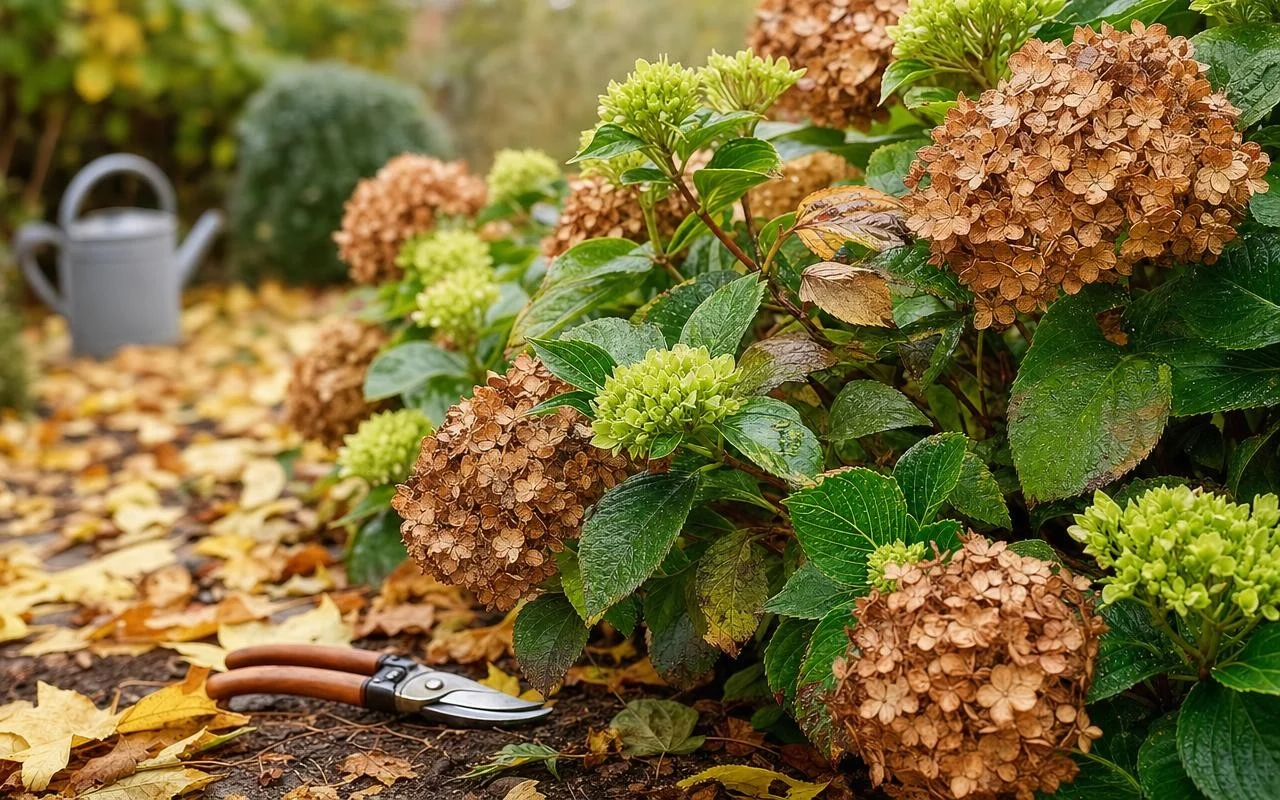
An hydrangea covered with colorful balls all summer is never by chance. This display is prepared in autumn, when the plant quietly forms its future floral buds. Depending on how you manage pruning, watering, and protection of your hydrangeas in October, you can multiply the flowers of the following year… or make them disappear.
Autumn is also a key period for planting a new hydrangea: the soil remains warm, the intense heat is behind you, and the risk of frost is not yet there. Between varieties that bloom on old wood and those that restart on the current year’s shoots, the right autumn care of hydrangeas requires a few simple guidelines.
Understanding Your Hydrangea to Succeed in Autumn Care
Many garden hydrangeas, such as Hydrangea macrophylla or Hydrangea quercifolia, carry their flowers on wood formed in the previous year. Their floral buds are set in August; therefore, pruning too late directly eliminates the following year’s flowering. Conversely, Hydrangea paniculata and Hydrangea arborescens bloom on the shoots of the year and tolerate a harsher pruning at the end of the season better.
Regardless of the type, plant your hydrangeas in a location that is half-shady, well-ventilated, sheltered from the noonday sun, as experts recommend. In autumn, it’s the right time to plant: the soil is still warm and the plant has time to establish roots before winter. In cold climates, placing the subjects near a wall or building helps limit the impact of icy winds.
October pruning of hydrangeas, faded flowers and buds to protect
In October, most inflorescences have withered. In regions with cold winters, it’s better to leave them in place: they form a small natural protection above the buds located lower, especially on hydrangeas with old wood. Experts advise avoiding removing the faded flowers after mid-August and cutting them only at the end of winter, once all risk of frost has passed.
In climates with mild winters, you can cut the faded heads in October with a clean pruning shear, cutting above a pair of leaves without touching the flower buds already formed. This is also the right time for a cleanup: remove at the base the dry, stained or diseased stems to aerate the shrub, limit botrytis and powdery mildew, and shorten as needed a few shoots under 30 cm.
Mulching, watering and potted hydrangeas: preparing for winter without harming flowering
In autumn, the hydrangea goes into rest; applying fertilizer is not useful, it will be far more effective at the start of spring. Watering becomes lighter but does not stop, especially for young plants that dry out quickly. The objective remains a moist, never waterlogged soil. A mulch of 5 cm in mild climates, up to 15 cm in very cold zones, with bark, pine needles, dry leaves or straw, preserves moisture and protects the roots from frost.
The potted hydrangeas require the same care, but their roots are more exposed. In October, bring the pots closer to a sheltered wall, in half shade, and generously mulch the surface of the substrate. When temperatures drop below about 7 °C, the ideal is to overwinter the pots in a garage or cellar that is unheated, dry and in dim light, watering just enough to avoid complete drying, then gradually reintroduce them to the outdoors in spring.
