
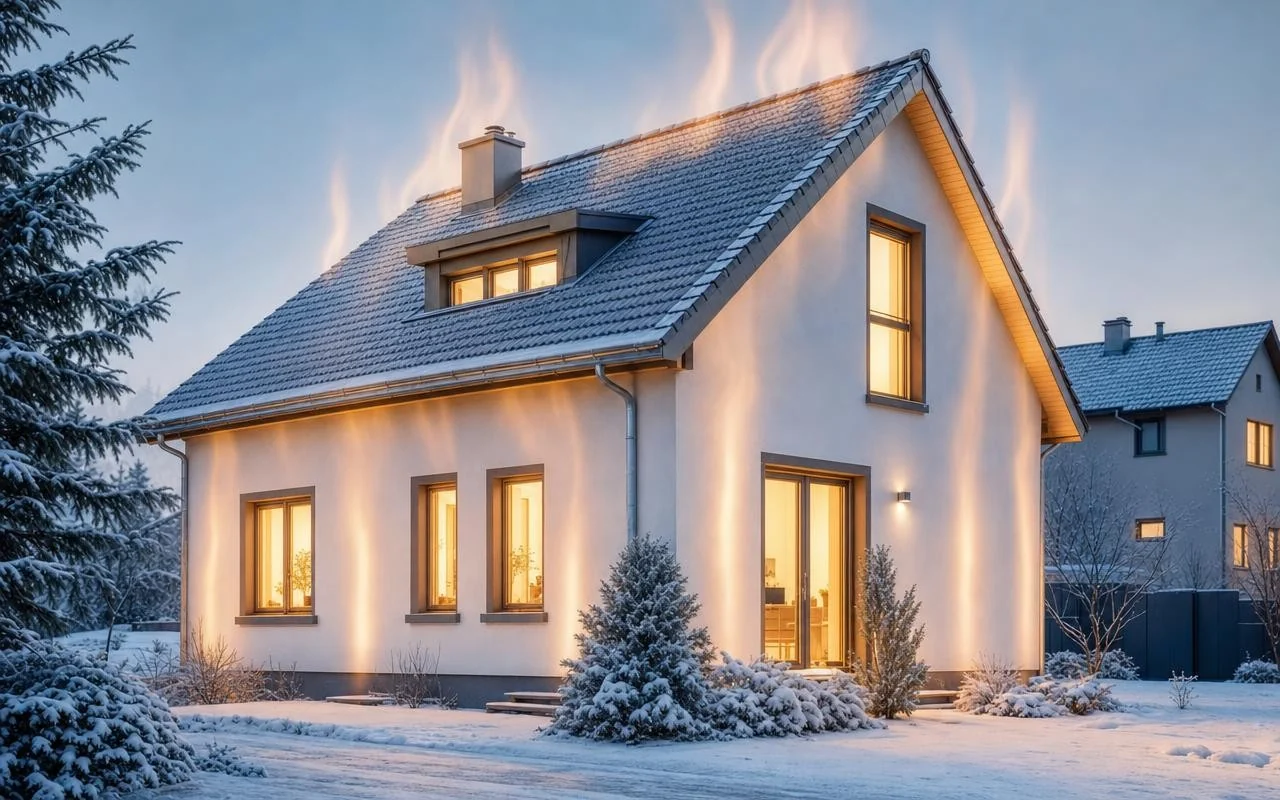
When the heating bill lands, many wonder where all that costly warmth is slipping away. Radiators blazing, rooms that feel chilly, walls that are cold to the touch: the sense of wasting money sticks around. Intuitively, people blame the windows, as if heat were escaping through poorly sealed glass.
Energy specialists tell a completely different story: “60% of a home’s heat energy escapes through the façade and the roof.” This figure, compiled by Contigo Energía from data provided by the Instituto para la Diversificación y Ahorro de la Energía (IDAE), upends common assumptions and completely changes the order of priorities for anyone planning renovations.
Heat losses: why the façade and roof account for up to 60%
It all begins with the building envelope: the set of walls that separate indoors from outdoors. According to data cited by Contigo Energía, the façade accounts for up to 35% of heat losses, the roof 25%, the floor 15%, doors and windows 15%, and air infiltrations 10%. Put differently, walls and roof alone house 60% of the leaks.
IDAE notes that the building envelope alone represents 70 to 80% of energy losses. At the same time, heating accounts for roughly 47% of a household’s energy consumption. When these two figures are added together, it becomes clear that an uninsulated wall or roof weighs far more than a simple draft around a window.
Building envelope and thermal bridges: what really drives heat loss
Why do these walls lose so many calories? The façade offers the largest contact surface with exterior air. In an old building, an uninsulated wall allows heat to continuously escape from inside to outside. The experts cited in the study summarize the situation as follows: “an uninsulated wall acts like a radiator turned inside out.”
Warm air rises, hence the significant losses at the roof, estimated at 25%. In poorly insulated attics, heat escapes through the roof and the slightest sealing defect. Add to this the thermal bridges: junctions between floors, concrete columns, the perimeter around windows where the insulation ends, often visible as mold stains in the corners.
Limiting losses through the façade and the roof: priority works and quick actions
Facing this reality, experts logically place roof and façade insulation at the top of the renovations to consider. In a house, treating the attics and the roof often yields the best return. For walls, solutions include external thermal insulation of the SATE type or filling the cavities of existing walls, especially in buildings from the 1960s to the 1980s.
Until a renovation project begins, a few actions can already reduce losses: seal the bottom of doors, replace worn seals, service the shutter boxes, avoid hiding radiators, and close shutters and curtains at night. Specialists recommend keeping indoors at 19 to 21 °C and ventilating for about ten minutes with the heating off. According to IDAE, each degree added to the thermostat increases consumption by around 7%, while lowering the temperature from 23 to 20 °C can reduce the heating share of energy by more than 20%, considering that heating on average accounts for 47% of a household’s energy use.
