
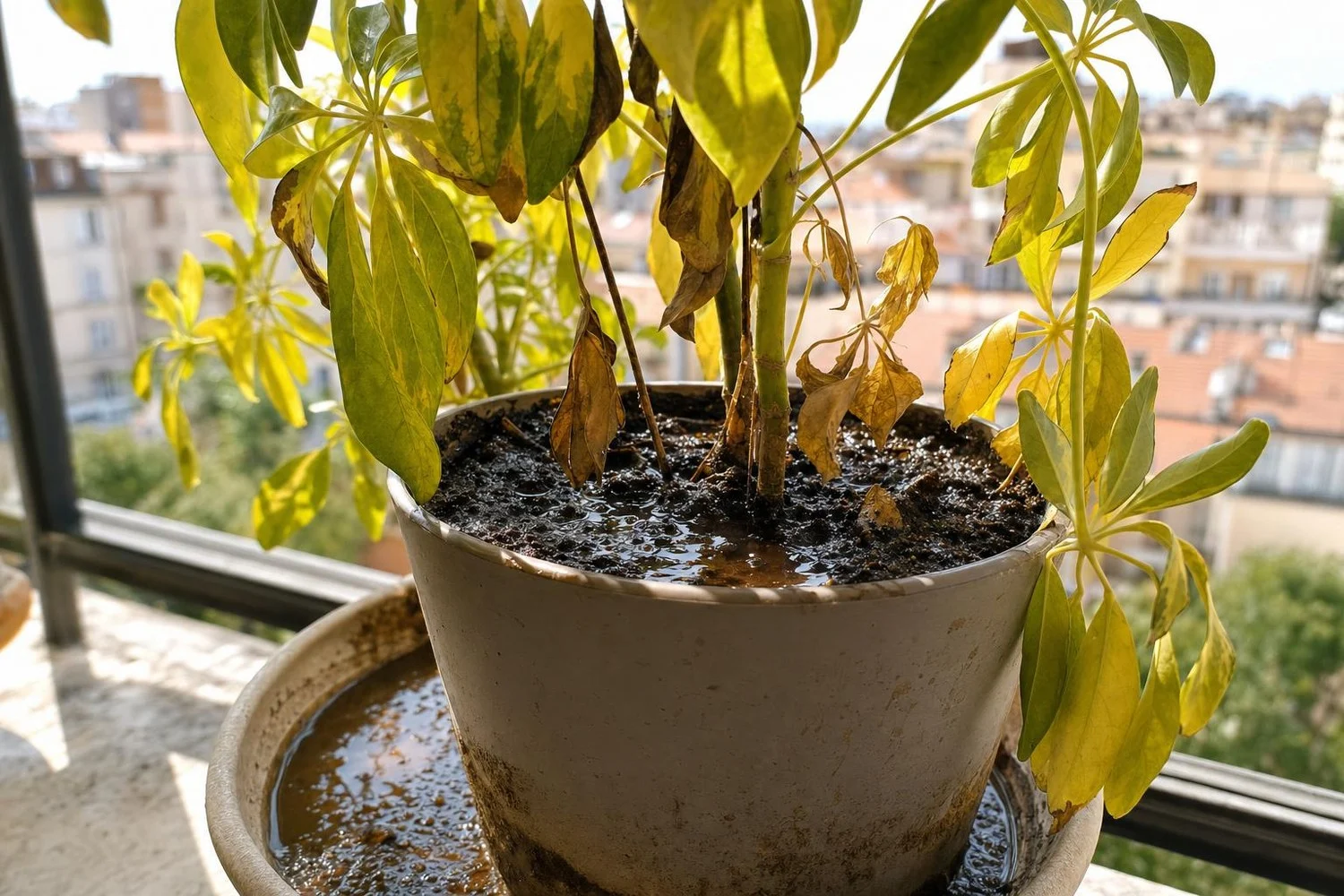
In the middle of a heatwave, the scene feels familiar: a plant turning yellow even though it seemed vigorous, the surface of the potting soil looking dusty, and you instinctively reach for the watering can. You increase the quantities, you leave a saucer well filled “to store some reserve.” Yet, despite this attention, the plant continues to wither.
Gardeners observe this every summer: that sudden yellowing does not always reflect thirst, but often a mixture of thermal stress and excess water. When temperatures hover around 35 degrees, the plant’s internal functioning changes and its roots become highly vulnerable to any standing water. Before refilling the watering can, it is worth checking what is really happening inside the pot.
Heatwave, closed stomata, and chlorosis: why your plant yellows
To limit water losses, a plant subjected to the heatwave closes its stomata, those tiny pores that regulate exchanges with the air. Photosynthesis slows, sap circulation stalls, and certain nutrients fail to reach the tips of the leaves. They pale, take on a yellow tinge: this is chlorosis. This mechanism can sometimes explain leaf discoloration even when the substrate remains moist deeper down.
Researchers studying tomatoes showed that at around 30 degrees Celsius the production of lycopene, the red pigment in the fruit, slows down, and by about 35 degrees growth can nearly stop, even with plenty of water. The gardener then sees a limp plant and concludes thirst. Yet a uniform yellowing across the entire foliage points to root problems, while localized sunburn on the southern parts evokes simply a sunburn.
Eau stagnante et asphyxie racinaire : le piège de la soucoupe en été
In a pot, the slightest watering mistake is quickly costly. When the water supplied exceeds what the plant can absorb and it does not drain, it remains trapped at the bottom of the substrate or in the saucer. The roots then bathe in a low-oxygen area; they breathe poorly and do not assimilate nutrients well, the leaves yellow and droop. In time, root rot sets in, particularly on geraniums and citrus in containers.
To distinguish excess from drought, the finger test remains the safest. Push it in a few centimeters: if the soil sticks and stays moist while the foliage yellows, excess dominates. Also look under the pot: a saucer full long after watering, a heavy clump, a smell of damp earth, or a whitish deposit on the surface already signal overwatering. In this state, pruning or removing all burned leaves, as with a hydrangea, adds stress that the plant could well have done without.
Les bons réflexes en canicule : arroser moins, mieux et protéger du soleil
Once the diagnosis is made, the action must be adapted. Rather than tiny daily doses, a deeper, less frequent watering that truly moistens the entire root ball is preferable. For many potted plants, two good soakings per week suffice when the soil has dried between them. Ideally, water at the base early in the morning, between 5 and 9 a.m., or in the evening, without wetting the foliage to limit evaporation and the spread of diseases.
A single reflex changes everything: empty the saucer about 30 minutes after watering, giving the plant time to drink what it needs, then remove the excess standing water. To help it withstand the heat, a thick mulch keeps the soil cool for longer, and a light shade veil filters the harshest rays, much like for tomatoes. Under this shade, the temperature around the foliage drops by a few degrees. In many gardens, this trio—shade, mulch, and measured watering—proves enough to see plants recover when the heat wave subsides.
