
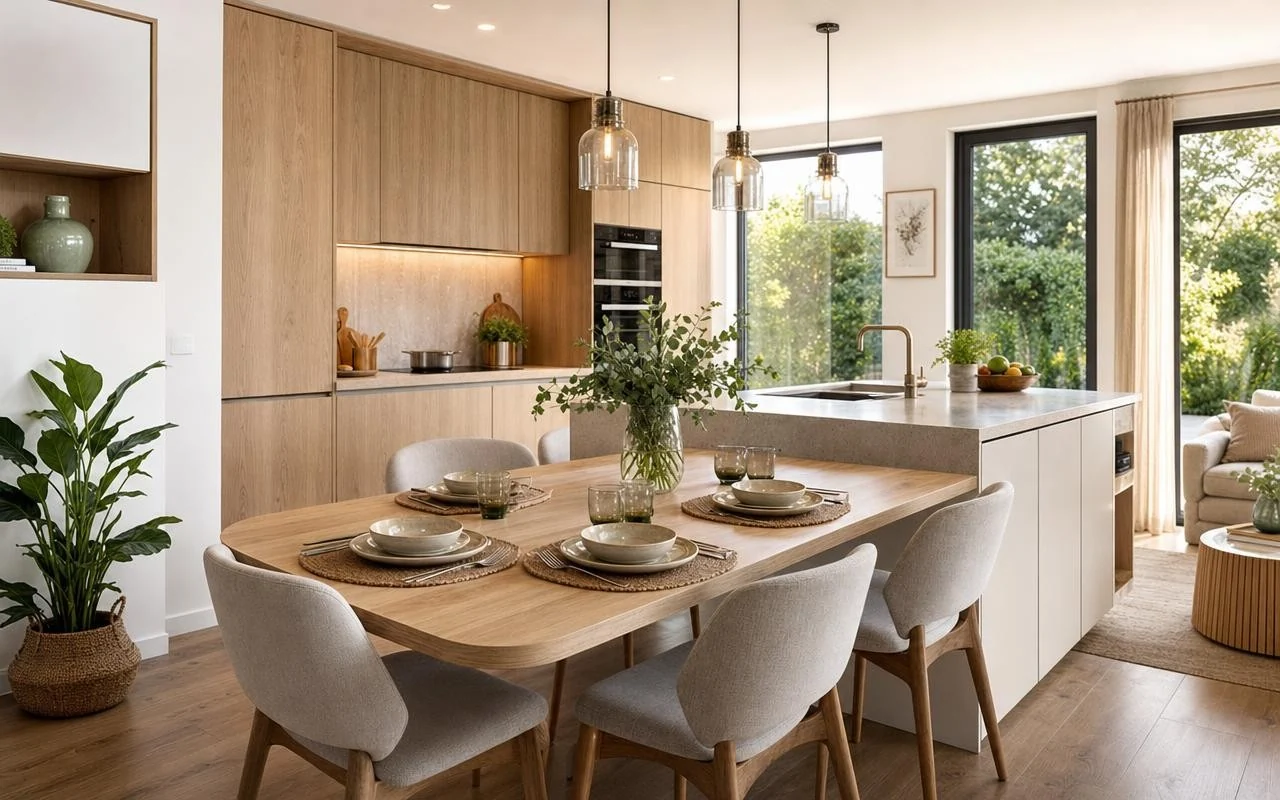
The dream of a central island often tops the list of desires when imagining a future kitchen. Then come the plans, the square meters that are missing, the dishwasher that won’t open, and the back-and-forth around a block placed in the middle of the room. Many homeowners then discover that this long-awaited island isn’t always suited to their home.
Designers had warned: the island requires a lot of space and performs poorly in closed kitchens or on average-sized spaces. In parallel, a new configuration is gaining ground, already highlighted in the 2026 trends and expected to be a real success by 2027. More compact, more flexible, more convivial. And it changes everything in the family kitchen.
Why the kitchen island is losing ground by 2027
In the collective imagination, the island has become a symbol of modernity. On paper, it offers a work surface, storage and a dining corner. In reality, specialists remind us that you need at least 15 m² for a comfortable fixed island, with a budget usually ranging from 800 to 3,000 €. Below that, the central block encroaches on the passage, especially when drawers, the oven or the dishwasher are opened.
The nuisance is even more noticeable in kitchens that do not open onto the living room. You squeeze through two people, you sidestep the island to go from the fridge to the sink, you block a door with each cooking session. Decorating guides emphasize that an island remains truly interesting only in a very large room, where you can keep at least 90 cm free all around. In the majority of standard-sized apartments and houses, the trend is therefore gradually reversing.
The kitchen peninsula with integrated table, a more practical and elegant alternative
Facing these limits, the rising star is the kitchen peninsula with an integrated table. It is an extension of the worktop, backed against a wall or a run, and open on one or two sides. You keep the island vibe, but one end remains fixed, which frees the center of the room. Industry sources mention a minimum area around 12 m² and a typical budget of 600 to 2,500 € for a equipped peninsula.
Its key advantage: it combines prep space and dining corner without adding a bulky table. The same surface is used for cooking, having breakfast, working from home, or helping children with homework. Recent models readily include retractable outlets, LED lighting, induction hobs and antibacterial surfaces. All with clean lines, light woods, matte quartz or granite, particularly harmonious in a kitchen open to the living room.
How to properly plan this kitchen peninsula with integrated table
Before replacing an island with a peninsula, decorators recommend testing the footprint. A simple tip is to draw your future outline on the floor with tape, then live with this fake volume for a few days. Open all the cupboards, pull out the dishwasher, get two or three people together to simulate a dinner to check that nothing gets in the way.
- Keep at least 90 cm between the peninsula and the facing furniture to circulate with two people.
- Test the simultaneous opening of drawers, the oven and the dishwasher.
- Position the peninsula in the sink–cook–refrigerator triangle to limit back-and-forth.
- Plan outlets and electrical connections before work, especially if adding induction or LED.
- Anticipate the number of seats and the passage behind the stools.
The concept adapts to almost all layouts: an L-shaped kitchen where the peninsula extends one side, a U-shaped kitchen where it serves as a transition to the living area, a small kitchen where it replaces a table and cart. Some opt for a raised-height plateau in a snack-style, others for a true integrated table at a lower height for daily comfort. Adding outlets, specialized lighting or a cooking plate can add a few hundred euros to the project, but really transforms how the room is used.
What remains is to choose the finishes to align this configuration with the 2026-2027 trends: many favor the white-and-light-wood duo, or soft beiges warmed by brass lighting. This makes the kitchen peninsula with an integrated table a feature that is both functional, warm and very current, without sacrificing a single square meter.
