
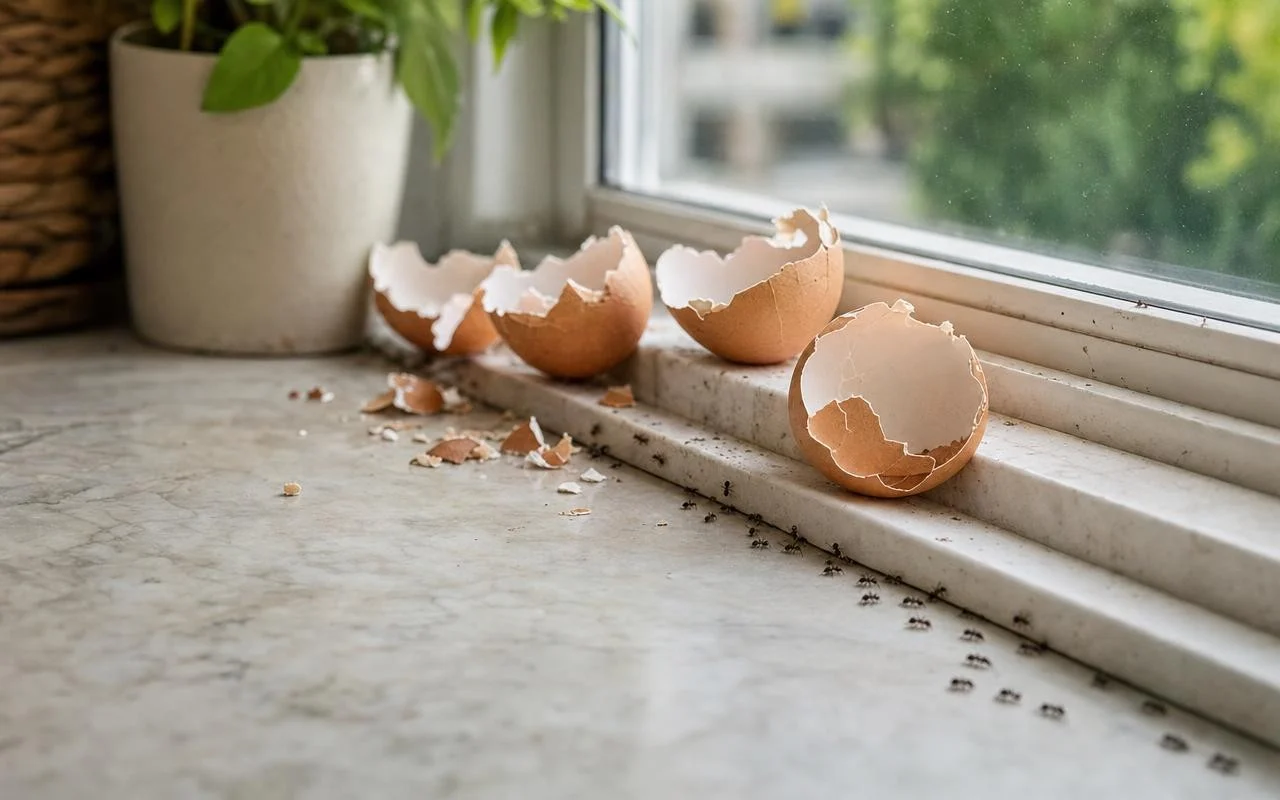
On social networks and in numerous home-and-garden blogs, eggshells against ants have become the miracle trick of the moment. The idea is appealing: recycle a kitchen waste, avoid chemical products, and draw a barrier believed to stop the ant columns in their tracks. For many households plagued by invasions, this promise of simplicity is enchanting.
Sites like ConsoGlobe, Maison et Travaux, or Doctissimo describe eggshell powder as an “foolproof” and “guaranteed” method to deter ants, to be placed on window sills or along baseboards. Yet, none of these pages links to a study or a scientific test. When you look at what entomologists say, the picture changes markedly. The reality is far less spectacular.
Eggshells against ants: what the trick really promises
In most tutorials, the instructions are the same: rinse the shells, dry them, then grind them into a very fine powder and sprinkle it in a continuous line where the ants pass or near doors. Some tips also mention roughly crushed shells, believed to be unpleasant to cross. The whole concept rests on the idea that the texture and odor would deter the insects.
These articles rarely discuss the colony or the queen: the trick is mainly to lay down a visible barrier where the ants are seen. Yet a nest can contain thousands of workers installed under a slab, behind a wall, or in old damp wood. Blocking one passage often only moves the trail a few centimeters further. This is where the specialists’ perspective becomes valuable.
Why experts doubt eggshells against ants
To date, no scientific publication demonstrates that eggshells durably repel ants in homes. Resources like the University of Minnesota Extension or the UC IPM program simply never cite this trick. The Minnesota Extension, on the contrary, reminds us: “The first step to control ants is to identify them,” and “Queens must be killed to eliminate a colony.”
For the National Pest Management Association, these home remedies attract a lot of interest. A Harris Poll survey shows that 29% of Americans have tried “natural” ant remedies, while some merely detour the trails. A preprint posted online in 2024 notes that, despite several remedies tested, up to 97% of Argentine ants still entered an attractant shelter after two hours. Eggshells were not evaluated there, and the study has not yet been peer reviewed.
Controlling ants: more reliable solutions than eggshells
For university extension services, the core issue remains the colony. Ants live in society, with workers and one or more queens capable of laying eggs for years. The University of Minnesota Extension summarizes: “The most effective method to fight ants is to place an insecticide in the nest and kill the queen(s).” The UC IPM program emphasizes, above all, baits that workers bring back to the nest and share.
Concretely, recommendations converge: start by identifying the trails, then remove what attracts the ants (crumbs, sugar, bowls, standing water). A careful cleaning of the trails with water and vinegar disturbs the odor traces, but it remains important to seal entry cracks. When the invasion persists, specialists prefer targeted baits, chosen for the species in question, so that the active ingredient climbs back up to the queen.
