
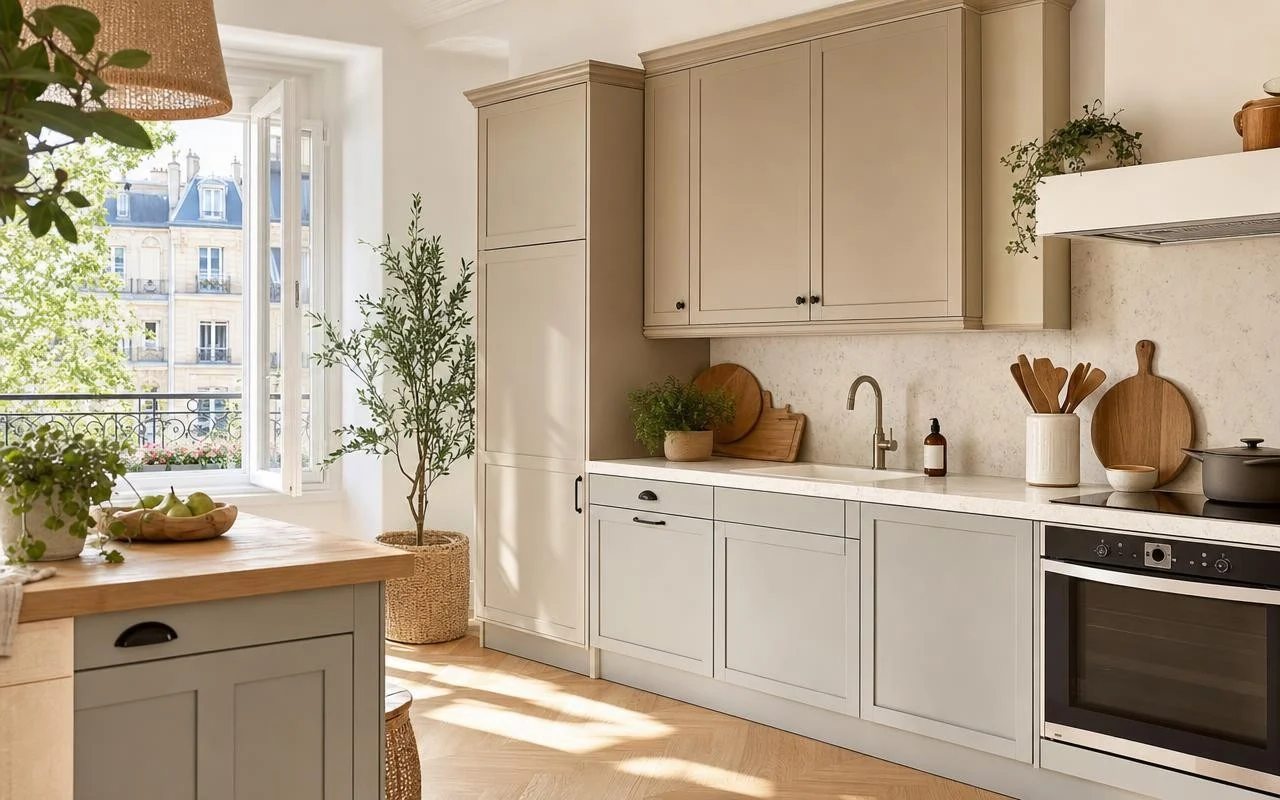
In magazine and social media photos, the ideal kitchen often appears pristine, white from floor to ceiling. This palette reassures, conveys order, and seems easy to match with appliances. Yet, in recent projects, more interior designers are moving away from it. They point to a specific color, long considered an absolute safe bet.
In 2026, the trends observed by decorators show a clear shift toward warmer atmospheres: AD notes that cold whites are being replaced by ivory, cream, or beige, paired with natural tones. The Houzz 2026 Kitchen Trends Report also indicates that 29% of kitchen renovations favor wooden furniture while 15% opt for off-white façades. Implicitly, this movement signals a real rejection of the brilliant white in the kitchen.
Why brilliant white in the kitchen no longer convinces designers
What professionals challenge isn’t white in general, but this optical white, ultraclean, without nuance, often with a blue undertone. It wins in showrooms, pairs with appliances, and evokes a sense of perfect hygiene. But the designer Leigh Spicher recalls the emotional aspect: “When you choose a color for a room, you must consider the psychology of colors and how they make us feel,” she explains. “This is especially true in the kitchen, because it’s arguably the most important room in the house.”
In practice, this extreme whiteness can quickly feel cold, even impersonal. Leigh Spicher notes this in her own projects: “I want my kitchen to be full of intensity and character, something I don’t find in entirely white and pristine layouts,” she says. As a result, portfolios are seeing all-white kitchens disappear, deemed uninspiring for a living space used from morning to night.
The very concrete drawbacks of optical white in daily life
Practically, the brilliant white kitchen reveals the slightest blemish: coffee splashes, micro-scratches on lacquered façades, joints that yellow. Designers interviewed by The Spruce emphasize that it stains visually faster than a slightly off-white, which imposes constant maintenance. For a space where one actually cooks, the color ends up seeming more theoretical than livable.
Experts cited by Homes & Gardens also note that whites with blue undertones, paired with cold LED lighting, quickly give off a clinical atmosphere. The space feels more like a laboratory than a welcoming living area. AD summarizes this weariness by explaining that whites are warming up: we now favor enveloping hues that highlight materials like wood, stone, or textured worktops rather than a flat, dazzling finish.
What colors to choose instead of dazzling white in the kitchen
For those who still want brightness, designer Laura Lees Gilbert recommends moving to a warm white, slightly creamy. “Warm white is as warm as it is clean, creating a cozy and idyllic backdrop for any room,” she explains. “It suggests a welcoming and open space, which is especially important when designing an environment for hosting and entertaining.” AD highlights ivory whites, off-white, and cream, easy to pair with sage greens, sandy beiges, or terracotta.
Laura Lees Gilbert also appreciates greige, a blend of gray and beige: “It’s a creamy and flattering shade for everything, creating a balanced and sophisticated interior,” she notes. Leigh Spicher, meanwhile, favors taupe and natural woods: “For colors that always work well in a kitchen, you can’t go wrong with classic wood or a warm taupe,” she insists. “These are proven neutrals that aren’t boring and have enough character to stay warm and welcoming without feeling sterile and cold.” For an already very white kitchen, repainting only the walls in cream, adding wood-front façades on the lower units, or introducing a warmer countertop is often enough to transform the atmosphere.
