
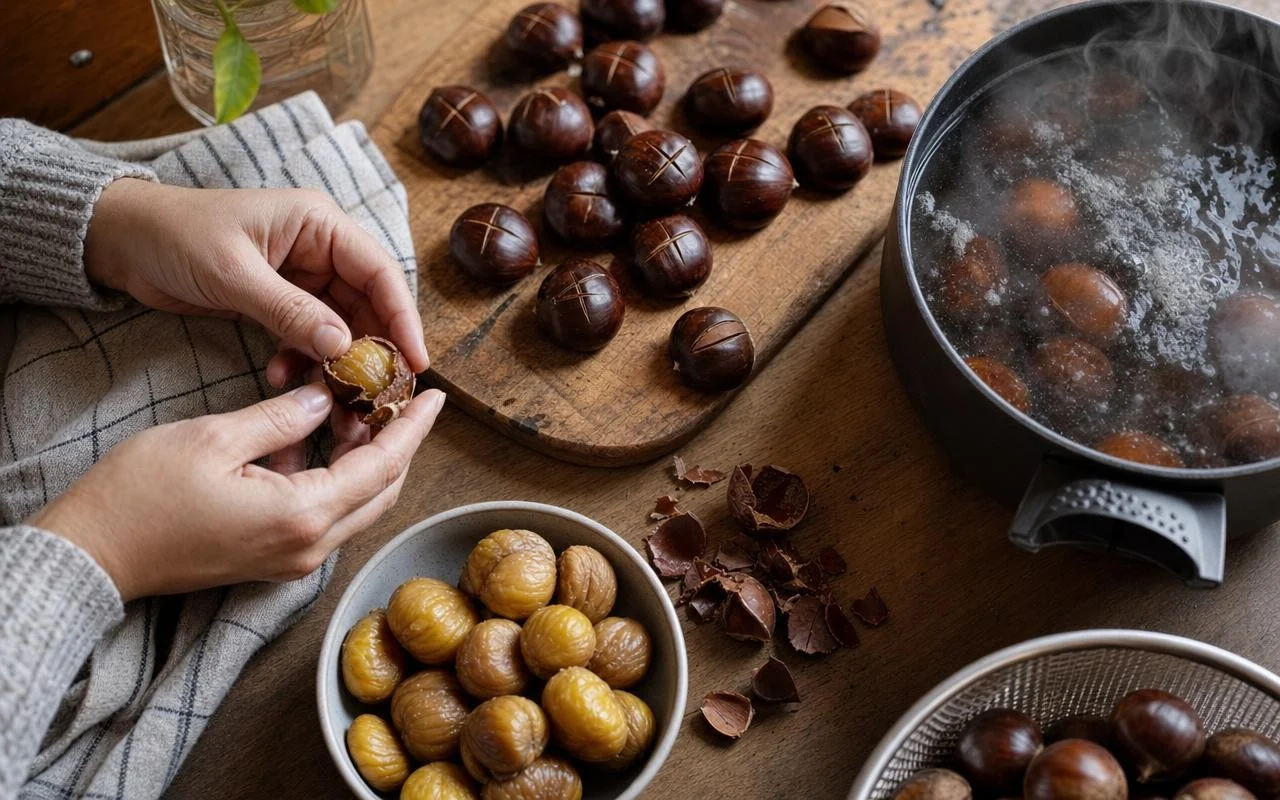
Autumn has returned, and chestnuts are roasting once again in the oven, on the stove, or in an air fryer. And every year comes the same struggle: a shell that resists, a thin brown skin that sticks, damaged nails and scorched fingers. In Spain, chefs and culinary creators have dissected the problem: it is not strength or patience that matter, but a series of precise steps to take before cooking.
In a widely shared article, they remind us that “the good news is that nearly everything depends on a few preparatory gestures, not on how hard you wrestle.” On TikTok, the creator @recetas.senor popularized a routine that became viral, validated by many professionals. Three key steps, all simple, turn the painful moment of peeling into a routine.
Cross-cut incision: the first key to peeling chestnuts without ruining your nails
The first secret among Spanish cooks is the cross-shaped knife cut. When they heat, “the water inside turns to steam, and the shell and the thin skin prevent it from escaping,” explains the Spanish media. The pressure then rises until the chestnut bursts. The incision, whether cross-shaped or a simple notch, acts as a vent: the steam escapes, the shell opens, and peeling becomes possible.
This cut must traverse the shell and the inner skin without piercing the flesh. Too shallow, and it’s useless; too deep, and the fruit dries out. For the gesture, the article recommends “a sharp little knife, always with the hand out of the blade’s path.” Many cooks summarize the method this way: “To peel chestnuts without ruining your nails, make a cross cut, soak them with salt in hot water, and let them sweat in a cloth.”
Hot salted water and cooking: the duo that lifts the chestnut skin
Once cut, the chestnuts undergo a decisive bath. “Place them all in a bowl with a pinch of salt and hot water covering them, and leave them for about 15 minutes,” the Spanish press explains. The salt remains in the water; it doesn’t really salt the fruit, but helps the thin brown skin—the tan—to peel away. This soaking then makes the shell and the film much easier to remove.
Then comes the cooking, where timings play an important role in achieving tender flesh without drying it out. The Spanish cooks point to several practical options:
- air fryer: 10 to 15 minutes at 200 °C, depending on the size of the chestnuts;
- oven: about 20 minutes at 200 °C, turning them halfway through;
- pan: around 30 minutes, stirring them often.
In all cases, the chestnuts must be nicely hot for what follows, because the internal steam will finish the job.
Cloth, safety, and ideas to enjoy your peeled chestnuts
As soon as cooking is finished, professionals in Spain wrap them in a bowl covered with a clean cloth. “Right away, they are wrapped in a cloth inside a well-sealed bowl and left to sweat for about ten minutes,” they describe. The trapped steam then lifts the shell and skin deeply; the chestnut frees itself almost completely, without pulling at your nails or burning your fingers. Peel gently, fruit by fruit, while they remain warm.
A caution appears in the recommendations: even with a cut, a chestnut can still burst. “If this happens, the best course is to stop the device, wait for everything to cool, and do not bring your face or hands near,” the article reminds us. Nutritionally, Spain’s Ministry of Agriculture notes that 100 g of chestnut provide 209 kilocalories, 40 g of carbohydrates, 6.8 g of fiber, and only 2.6 g of fats, along with potassium, phosphorus, magnesium, and calcium. Once peeled, they can be enjoyed in a velouté, a purée, or in a chestnut-chocolate fondant, not to be confused with horse chestnut, which is not edible.
Sources
- Gourmand
“These 15 autumn desserts elevate these seasonal fruits and avoid the mistake that spoils your pies”
