
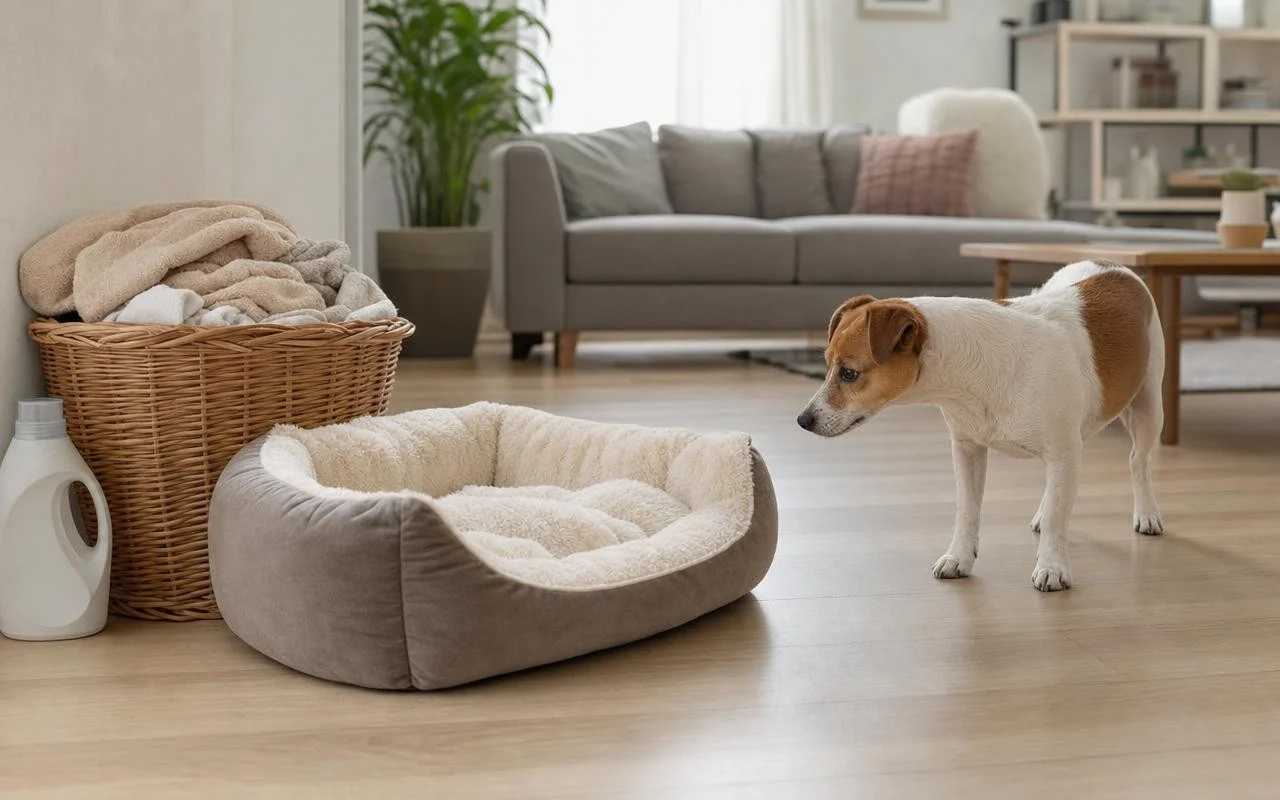
You’ve just washed your dog’s basket with a pleasantly scented fabric softener, and the house smells like clean laundry… yet your companion suddenly refuses to sleep there. Some cats, for their part, start sniffing the cushion frenetically before darting off to hide. The question quickly arises: can this pleasant scent for us bother, or even harm, the animals?
Dogs and cats literally live with their noses at the level of the basket, their sense of smell far finer than ours. When a sleeping surface smells strongly of fabric softener, olfactory discomfort is only part of the story. Behind the fragrance, there are also product residues, some of which are identified as irritants or corrosives in cases of ingestion. So, mere whim or real health risk?
Fabric softener odor on the basket: nuisance or danger for dogs and cats
The first level, the most common one: discomfort. Several manufacturers of animal bedding report that baskets washed with a lot of softener or with very perfumed detergents are sometimes shunned. A dog may lie down next to it rather than on top, a cat may prefer a cardboard box or the couch. This behavior mainly signals discomfort linked to an overly strong odor, quite comparable to a perfume that is too strong for us.
The real risk begins when the animal licks or nibbles at its bedding impregnated with product. A dog that chews the edges of the basket or a cat that grooms after sleeping on a heavily treated fabric is not only breathing the odor; it is also swallowing some of the residues of the fabric softener or, worse, of the dryer sheets left between two layers.
Fabric softener, cationic detergents and quaternary ammonium compounds on the bedding
According to the ASPCA Animal Poison Control Center, most laundry fabric softeners and dryer sheets contain cationic detergents. Used at high concentrations, these compounds can cause chemical burns and ulcers of the mouth, esophagus, and stomach. Symptoms reported in cases of significant ingestion include hypersalivation, vomiting, severe pain and sometimes fever, with a risk of internal ulcers.
The ASPCA also describes a mechanical danger: if a dog swallows one or more dryer sheets, they can act as a foreign body and promote a digestive blockage. The CAPAE-Ouest poison control center notes that quaternary ammonium compounds, present in some fabric softeners, can contaminate paws and fur, which may then be ingested during a cat’s grooming. The same scenario is possible with a very heavily treated basket or throw, especially if rinsing was insufficient.
How to wash a basket without fabric softener and protect your animal
When a dog-basket fabric softener leaves a very strong odor, it is best to act quickly. In practice, several simple steps help limit the risk:
- Remove the basket or the bedding from the animal’s resting area.
- Rewash the bedding with a mild, unscented detergent, following the label.
- Run an extra rinse to remove as much residue as possible.
- Monitor for any excessive drooling, vomiting, unusual fatigue, or refusal to eat, and promptly contact a veterinarian or a veterinary poison control center. In the United States, the ASPCA Animal Poison Control Center can be reached at (888) 426-4435.
For routine maintenance, several manufacturer guides recommend avoiding fabric softeners and dryer sheets on baskets altogether. Instead, some suggest adding a small amount of white vinegar to the fabric softener compartment to neutralize odors without adding fragrance, or a little baking soda with the laundry. Thorough drying, ideally outdoors, helps limit humidity odors that can drive overuse of perfumes. By choosing a fragrance-free detergent and avoiding quaternary ammonium compounds, especially for a cat or dog that spends hours in its bed, you keep a basket clean, but above all comfortable and safe for the animal.
