
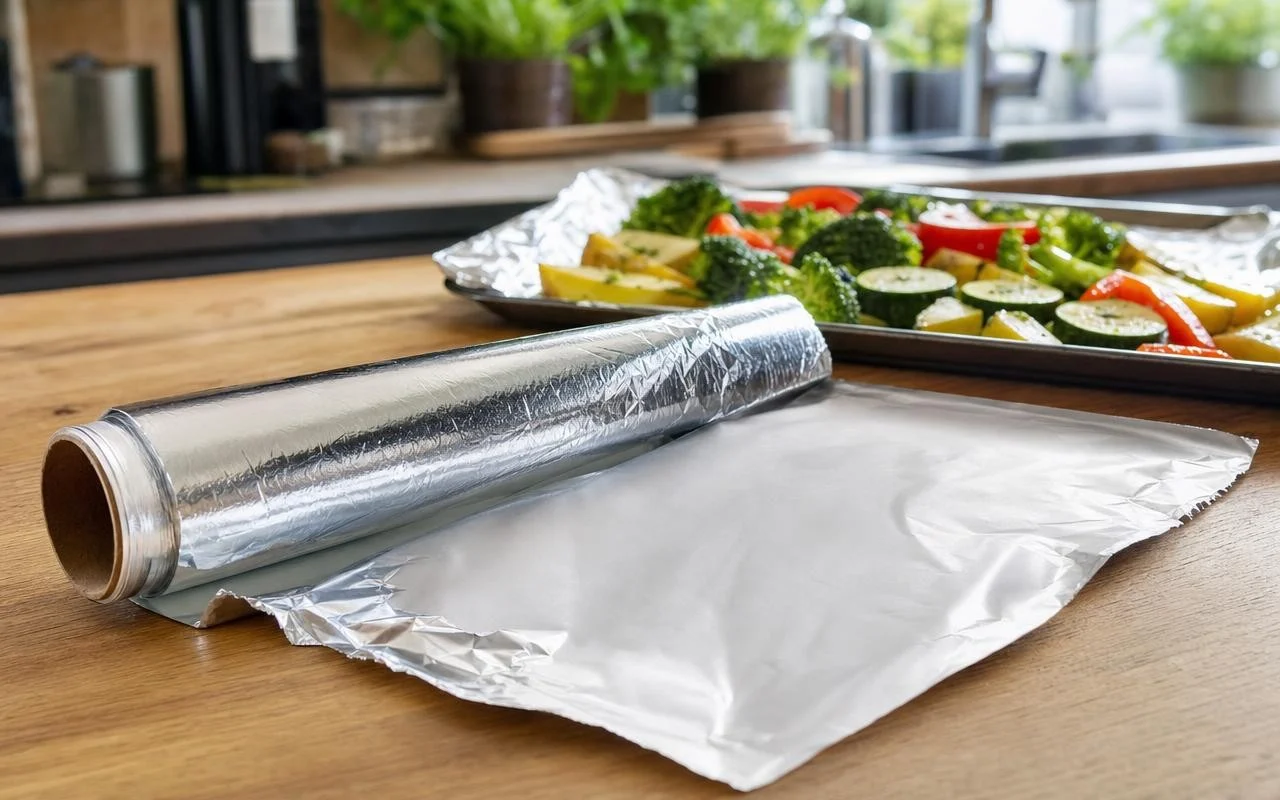
When it comes to wrapping up a leftover gratin or preparing potatoes on the barbecue, the same question often comes up: with aluminum foil, should the shiny side or the matte side face the food? This little hesitation costs a few seconds for nearly everyone, even those who cook a lot. Some have even taken to flipping the orientation depending on the dish.
Recommendations that contradict each other are read everywhere: for some, the shiny side should trap heat; for others, it should stay on the outside to reflect the oven’s radiation. Video tutorials, blogs, and even some magazines don’t say the same thing. Yet the answer from manufacturers and cooking specialists is fairly clear, and it starts with a tour of the factory.
Aluminum foil: shiny side or matte side, the reassuring answer
Before choosing a side, it helps to understand how aluminum foil behaves in the oven. By taking the shape of the dish, it partly blocks convection, creates a thin layer of hot air, and limits evaporation. The metal also ensures good thermal conduction, while its two faces bounce back a portion of the infrared radiation toward the food. It’s this trio that mainly influences cooking.
Once this setup is explained, the conclusion remains very straightforward: for a standard roll of foil, orientation does not change the cooking. On Martha Stewart’s site, Anne Wolf writes: “In short: no, it doesn’t matter. The difference between the two sides is purely aesthetic, and in everyday cooking they perform exactly the same role.” Ricardo’s site reaches the same result after its experiments.
Why aluminum foil has a shiny side and a matte side
This difference in appearance comes from the rolling process. To produce a very thin sheet without tearing it, factories pass two sheets of aluminum at once between large rollers. The faces that come into direct contact with these cylinders emerge polished and shiny, while the faces that touch stay matte. As the article sums up, “that’s all. This contrast comes from the process, not from any culinary intention.”
Many tips then play on thermal radiation: the shiny face would reflect infrared more effectively, thus holding heat or cold more. In reality, the gap remains tiny compared to the metal’s thermal conduction and the heat circulating by convection in the oven. The measurements reported by Ricardo show nearly identical temperature curves, regardless of orientation.
When the orientation of aluminum foil can truly matter in the kitchen
There are, however, a few exceptions where looking at the side makes sense. Antiadhesive aluminum foil rolls carry a coating on only one side: that side is the one that should touch the food to reduce sticking. Manufacturers, like Reynolds, clearly indicate this on the packaging. Many products choose a matte side for this role, but it isn’t universal.
Another common case is fish or vegetable en papillote that tends to stick. Many cooks place a sheet of parchment paper against the food, then wrap everything in foil; the steam remains trapped, but direct contact with the metal disappears. In culinary studios, the matte side often ends up on top to reduce reflections. In practice, three simple rules can be kept: standard foil, side chosen; non-stick foil, treated side toward the food; fragile papillote, food on parchment paper and foil on the outside.
