
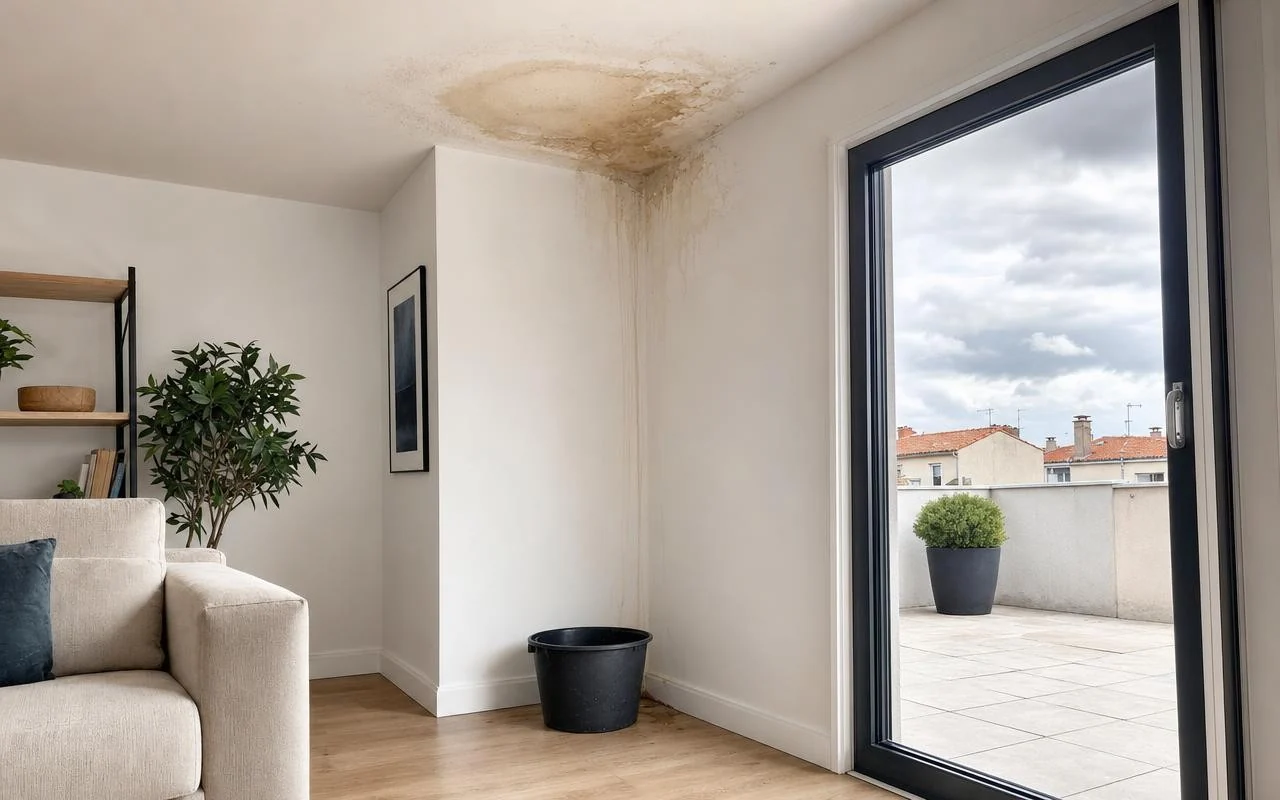
A brown halo spreading across the ceiling, a few droplets after a storm, and the same reflex: climb onto the terrace to inspect the cracked slab right above. You spot a suspicious joint, you reseal it, you repaint. Then the next rain brings back the same moisture stain. For many homeowners, chasing infiltration begins this way, with the sense of not really having control.
The masons describe a scene they see all the time: a leak treated directly above the stain, only for it to reappear a few weeks later. For them, the stain is merely a symptom, not the location of the hole to repair. France Pro Étanchéité, GCA Strasbourg, or EBS Étanchéité reach the same conclusion on their blogs. The key remains to figure out where to actually search for the origin of a terrace infiltration.
Why the moisture stain does not always match terrace infiltration
For these professionals, everything starts with the terrace structure: a multi-layer waterproofing assembly, where the tile is only the visible finish. Under the tiles lie mortar, a screed, a waterproof membrane, and sometimes insulation. Water that breaches the membrane can move horizontally, driven by the slope or by gaps between materials, before finding a path inward. As EBS Étanchéité summarizes, “Water rarely exits directly above the entry point,” in an article dated August 23, 2026.
Masons cited by the site Okdiario remind that “the stain indicates where moisture has manifested, but that is not enough to decide what must be repaired.” The Belgian center Buildwise adds that “the infiltration point is sometimes very far from the observed damp area.” Between these two extremes, water can travel through the screed, follow a poorly joined joint, or bypass a door-to-terrace threshold before appearing much higher on the ceiling.
Indications to look for and areas to inspect before any repair
EBS Étanchéité proposes reading the stain like an investigator, cross-checking three cues: its location, its timing relative to rainfall, and the visible condition of the terrace. A halo that widens after the downpour points toward active infiltration, while a stain that takes hours to appear may indicate a longer path through the screed. The masons also advise taking dated photos and recording every development.
Waterproofing companies emphasize points of weakness to examine before breaking tiles at random. Joints between the floor and walls, parapets, elevations around small walls or railings, thresholds of patio doors, drains (siphon, channel), and passages of a pipe or cable through the terrace are to be watched closely. If a puddle remains for several days after rain in the same spot, that poor slope is also a valuable clue.
How professionals locate and repair the origin of the infiltration
To confirm their hypotheses, specialists rarely perform openings haphazardly. GCA Strasbourg describes the use of zone-by-zone water tests: they wet or flood a portion of the terrace, observing the response of the ceiling stains. Buildwise mentions tests with smoke or gas in some complexes, but also infrared thermography, useful for delineating damp areas beneath the coating without removing everything.
Once the entry zone is confirmed, repairs vary from a local treatment on a cracked screed to a full overhaul when the waterproofing is aging or has been repaired multiple times, details GCA. The masons remind that applying a new layer of product on a detached substrate does not solve anything. They also warn: “Do not start cleaning and painting while the water continues to enter. You will have to redo the work a few months later,” they report from their on-site experience.
