
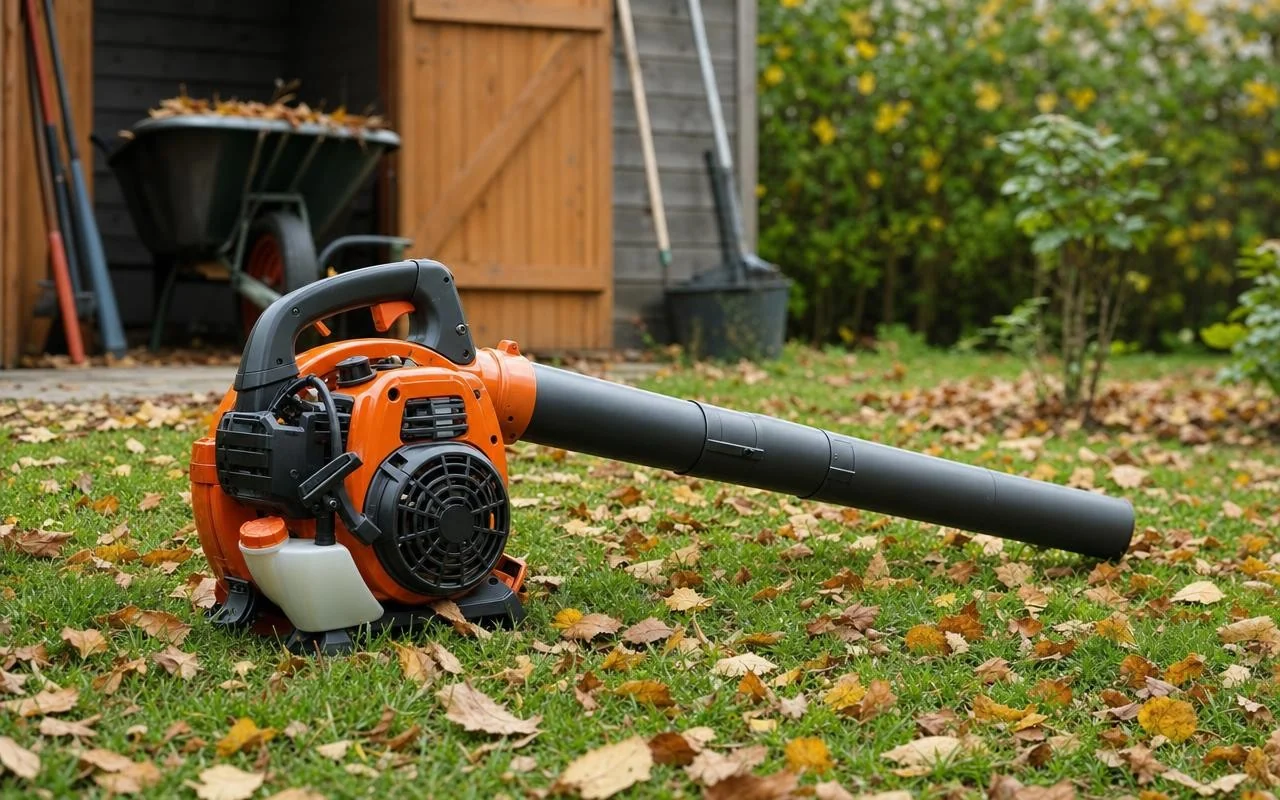
Your leaf blower starts up, purrs for a few seconds, then chokes as soon as you speed up or after a few minutes of work. This can turn a simple cleaning session into a real ordeal, regardless of the brand of the tool. Many owners immediately think of a serious engine failure, while the most frequent causes are much more ordinary.
Manufacturer guides such as Husqvarna and ECHO all remind of the same fundamental rule: a blower engine needs air, fuel, and spark in proper quantities. On electric models, the logic is similar, but with a battery or a mains supply instead of a fuel tank. And sometimes a simple fuel cap or an air intake grille blocked is enough to explain why the blower keeps shutting off.
Identify your leaf blower and read the symptoms
Before touching a screwdriver, you need to determine your device: two-stroke or four-stroke engine, cordless or corded model. Husqvarna’s guides indicate that an engine that starts but stalls quickly often lacks a proper air/fuel/spark mix. On a gas blower, a stop after 30 seconds, only at full throttle, or only when you tilt the unit will not point to the same root cause.
The practical tips compiled by HouseDigest emphasize starting with a thorough cleaning. On gas engines, remove the cover and clean the air filter, blasting away dust that blocks air passage. For cordless or corded blowers, the same principle applies: check the air intake and vents, remove leaves, spider webs, and dust. A lack of air or blocked cooling can be enough to make the device cut out during use.
Cuts on thermal blower: fuel, air, exhaust and spark plug
Webmotoculture guides remind that fuel older than two months degrades and leaves deposits. Result: the blower starts, then stops after a minute or two. The recommended remedy is to drain the tank, replace the fuel filter, check the hoses, and refill with a fresh mix. If the carburetor is clogged, internal cleaning or replacement may become necessary, something that ECHO manuals classify as workshop interventions.
Another classic cause cited by Webmotoculture: venting of the tank. A faulty cap creates a vacuum, fuel stops reaching the engine and it stalls. HouseDigest articles suggest a simple test: run the blower with the cap slightly loosened. If it runs that way but not when tightened, the cap or the breather valve is at fault. Manufacturers add the air filter (test possible by removing it for 10 seconds), the spark arrester in the exhaust which can get soot-filled, and the ignition plug to check. ECHO manuals mention a spark plug gap of 0.65 mm as a reference, reminding to follow the value given for your model. A starter that is not returned to its proper position after starting can also choke the engine for a moment a little later.
Cordless or corded leaf blower: overheating, tired battery and useful tips
For cordless blowers, HouseDigest notes that abrupt shuts often come from thermal protection kicking in when the air outlets are blocked. Thoroughly cleaning the grilles and letting the unit cool down can be enough to restore normal operation. If the blower still shuts off quickly, the battery may no longer hold a charge under load; an experiment with another compatible battery remains the simplest diagnosis.
- Clean the air filter and air intakes.
- Try with the tank cap slightly loosened.
- Check the spark arrester and the exhaust outlet.
- Briefly test without the air filter to clear a doubt.
- On cordless units, perform a cross-test with another battery pack.
Manufacturers also caution against storing batteries in direct sun, inside a hot vehicle, or in a freezing garage, and against discharging them all the way down, which accelerates aging. If, after these checks of air/fuel/spark or power supply, the blower continues to shut off, Husqvarna and ECHO guides steer toward a more thorough workshop check, especially of the carburetor, internal hoses, and engine compression.
