
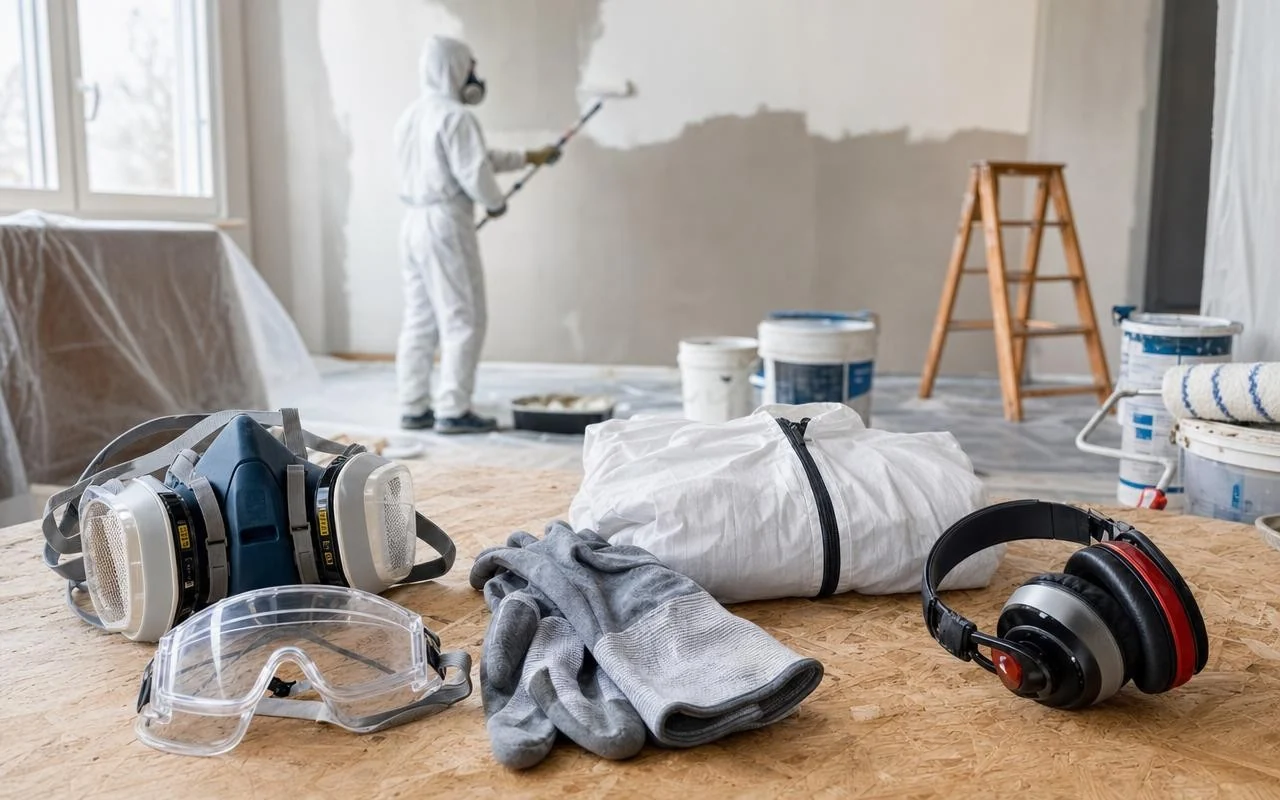
Full-body white coveralls, a mask over the face, goggles, sometimes even a helmet and earplugs: seen from the outside, a professional painter hardly differs from a laboratory technician. Repainting a living room or a façade may look excessive. Yet, this is not a chantier vanity, but a response to clearly identified risks.
Since 1989, the International Agency for Research on Cancer (IARC) has categorized painting work as a Group 1 carcinogen, a designation reaffirmed in 2010 and associated with cancers of the lung, the bladder, or mesothelioma. In other words, painting is not only a matter of color on walls; it also involves repeated exposure to chemical products—an aspect that changes everything.
EPI peintre professionnel : des risques invisibles mais bien réels
For painters, the primary danger often comes from what they inhale. Solvents and volatile organic compounds (VOCs) found in paints, varnishes, and thinners can cause headaches, dizziness, and nausea after a few hours, as noted by INRS. Even products labeled as “low VOC” are still composed of pigments, binders, additives, and resins that release other irritating or toxic substances. Day after day, these exposures accumulate.
Spraying adds another layer of risk: the CCHST describes a mist of fine droplets and vapors that lingers in the air around the painter. Some polyurethane paints contain isocyanates capable of triggering asthma or respiratory sensitization at very low doses. In the face of this cloud of fumes and vapors, respiratory PPE (filtering masks, vapor cartridges, air-supply systems) becomes the final barrier between the painter’s lungs and the product plume.
Quels EPI pour un peintre professionnel face aux solvants, poussières et chutes
On a construction site, a painter selects respiratory protection based on the product’s Safety Data Sheet (SDS) and the technique used. For sanding plasters or old coatings, he uses a mask of type FFP2 or FFP3, or an equivalent N95, which stops fine dust and possibly lead from old paints. For solvents and VOCs, he opts for a half-face respirator with filters of type A (organic vapors), sometimes combined with a P filter for particulates, or even a cabin air-supply device.
Risks do not end with the respiratory tract. INRS emphasizes that skin can absorb certain solvents, which justifies the use of appropriate gloves (often nitrile), disposable coveralls or full-coverage workwear. Painters also wear goggles or face shields to prevent splashes in the eyes, non-slip safety shoes (sometimes with steel toes to protect against falling buckets or tools), and earplugs when sanders and machines run all day.
Pourquoi les peintres professionnels sont plus stricts que les bricoleurs avec les EPI
A DIY enthusiast might repaint a hallway once every five years; a professional can work on project after project for decades. HouseDigest captures this gap well, explaining: “The good news is that the average homeowner does not have to worry about long-term exposure to painting hazards the way professionals do.” This time factor explains why companies mandate PPE even when the smell of paint seems tolerable.
Regulations follow this logic of enhanced protection: since August 24, 2023, professional use of products containing more than 0.1% diisocyanates requires specific training under REACH. In the same vein, INRS and CCHST remind us that the proper approach is to first minimize the danger (ventilation, painting booths, choosing lower-emission products), then supplement with the correct PPE. For a private individual painting at home, adopting these basic precautions whenever spraying, using strong solvents, or sanding old coatings is a straightforward way to draw from the seriousness of professional work.
