
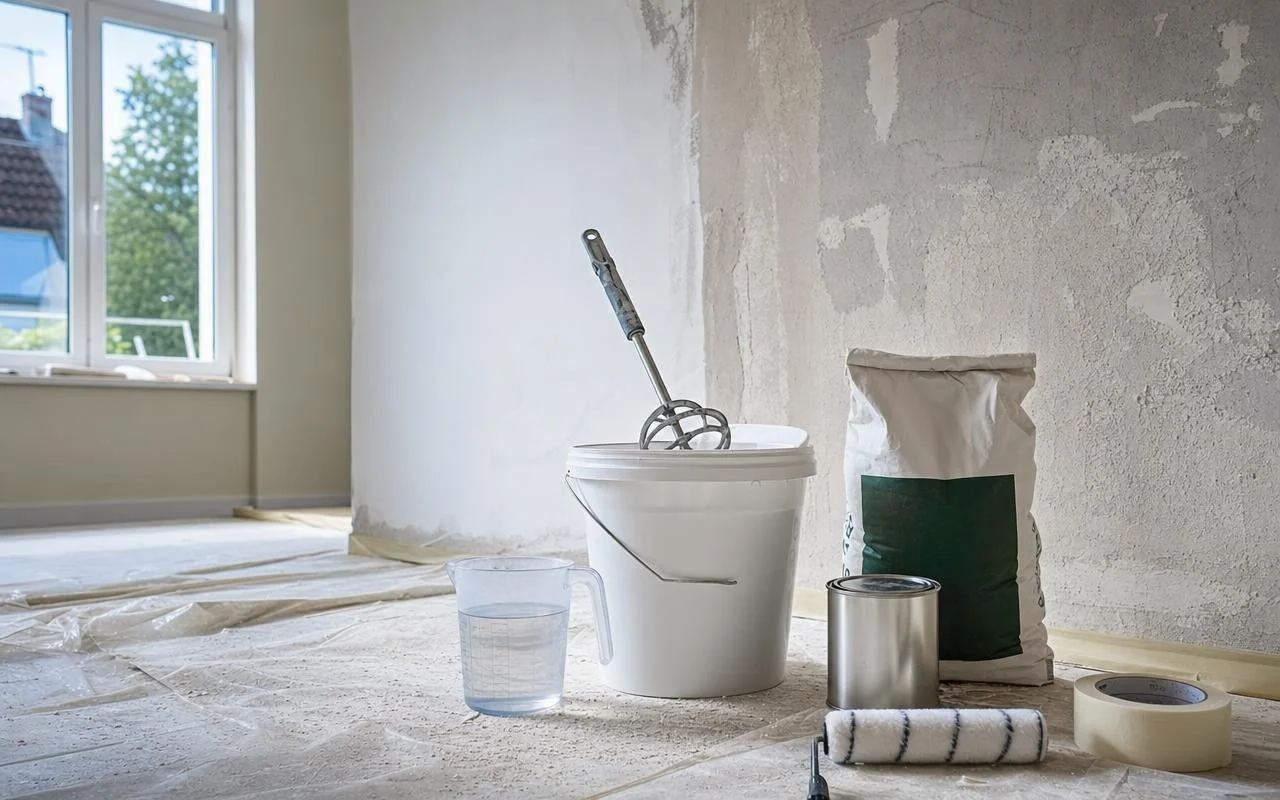
A wall that drinks the paint, darker stains, roller marks that remain visible… Many DIY enthusiasts know this scenario after a full day spent repainting a room. Masons remind us that before worrying about color or finish, everything hinges on how the surface is prepared, in particular how defects are filled and how the wall’s absorption is regulated.
For several months now, a recipe has been circulating and is repeated among many professionals: a simple mixture based on plaster putty, a sealant, and water, applied before the first coat of paint. The masons who use it daily agree that it truly changes how the wall behaves and helps limit unpleasant surprises. It all depends on a precise dosage that craftsmen repeat from job to job.
Why this putty-sealant-water mix changes everything before painting
Professionals first stress the condition of the substrate. A wall almost always shows microcracks, small holes, scratches, or dusty areas. Without preparation, these defects become evident once painted, and the surface does not absorb the paint evenly. The result can appear speckled or more matte in certain spots, especially on old plasters or very porous walls.
The mixture based on putty and sealant serves both to fill in imperfections and to unify the wall’s porosity. The masons explain that this home-made undercoat allows the paint to spread more evenly, while reducing the number of coats needed. They also point to a long-term effect: the surface stays smoother, looks cleaner longer, and small cracks reappear more slowly. Concretely, they recommend a total of 3 kg of plaster putty, 500 ml of sealant and 300 ml of water to prepare this paste.
How to prepare the 3 kg plaster putty, 500 ml sealant, and 300 ml water mix
To make this putty-sealant-water mix before painting, masons always start with a clean container, large enough to mix well. They first pour in the 3 kilograms of plaster putty, whether in powder or paste form depending on the product chosen, then add the 500 milliliters of acrylic sealant. Water is then added gradually, in several portions, to progressively adjust the consistency.
- 3 kg of plaster putty to fill cracks and defects in the wall.
- 500 ml of sealant to unify the substrate’s absorption.
- 300 ml of water to obtain a fluid, lump-free paste.
Craftsmen mix vigorously, with a wide spatula or a small mixer, until all lumps have disappeared. The paste should be soft enough to spread easily, without running. They check the texture by lightly loading a spatula: if the mixture holds without dripping while leaving a smooth film when stretched, the preparation is deemed ready for the wall.
Application on the wall: the masons’ techniques and mistakes to avoid
Before applying the paste, masons remind a few prerequisites: a dry surface, free from dust, grease, and mold. Areas that are very damaged, paints that are peeling, or humidity traces must be treated with appropriate products before this smoothing work. Then the mixture is spread in thin coats, with a spatula or putty knife, pressed into cracks and hollows, then pulled to level.
After complete drying, according to the times indicated by the manufacturers of the products used, a light sanding with fine grit helps achieve a perfectly smooth surface. A thorough dusting then prepares the wall to receive the paint. The masons emphasize that it remains important to check on the packaging that the chosen plaster putty and sealant can be mixed together, as this recipe is not suitable for all commercial products. Once these points are checked, the paint covers better, with fewer coats, and with a more even and durable finish.
