
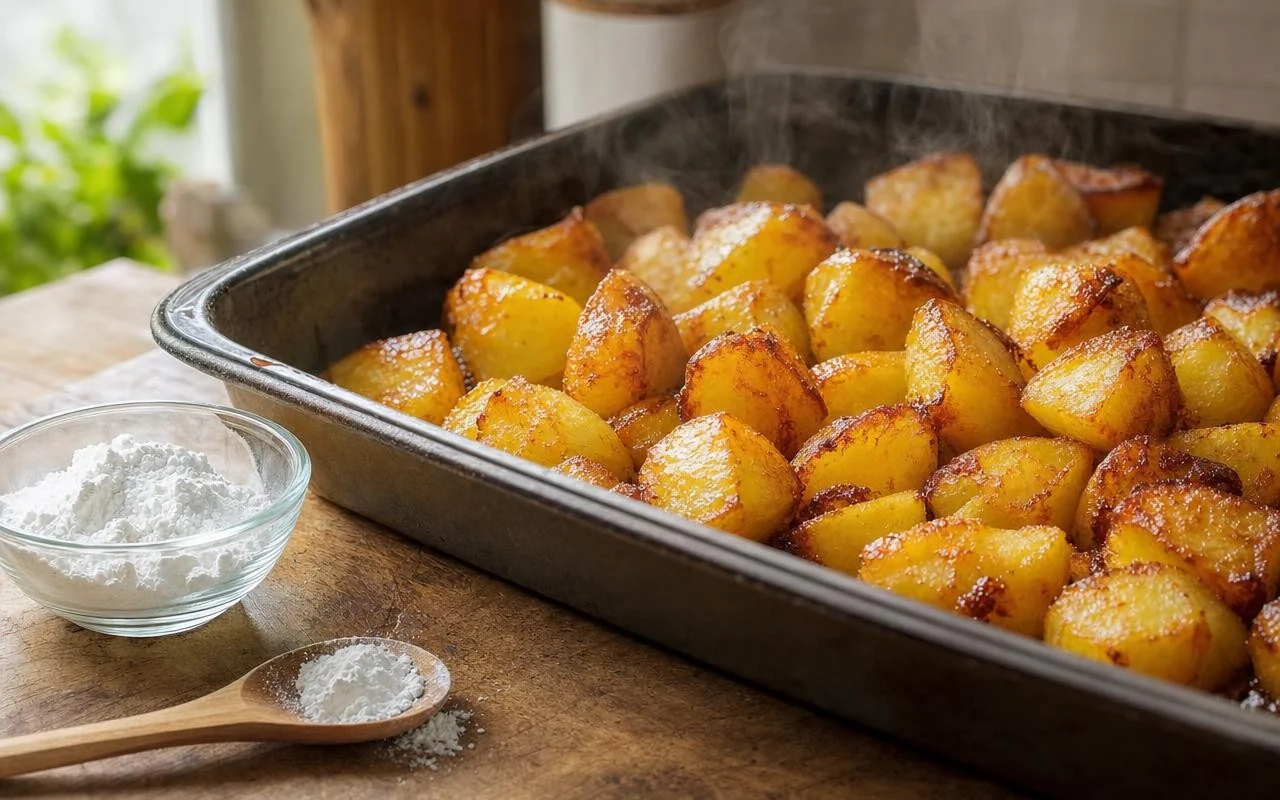
We’ve all stood in front of this scene: you pull the baking sheet from the oven, the potatoes smell wonderful, but they stay pale and soft. We had drizzled olive oil, perhaps even gone a bit heavy-handed, thinking it would help them brown. In the end, a lot of fat on the tray and little crunch on the plate.
Since September 2026, several culinary sites such as 750g, Peaches, or Aufeminin report that professional cooks are repeating the same advice. Their message is captured in a single striking sentence: “To get oven-roasted potatoes to brown nicely, don’t add more oil, but 2 tablespoons of cornstarch.” Behind this formula lies a very simple technique that requires no special equipment. And above all, it all begins even before you switch on the oven.
Oven-roasted potatoes browning: the real problem comes from moisture
The chefs interviewed all point to the same foe: surface moisture. When heated, the water inside the potato and the moisture remaining on its surface create a steam effect. The tray stops roasting and almost ends up cooking by steaming. Even with more olive oil, the surface doesn’t reach the caramelization temperature quickly enough, the edges don’t brown, and the inside soaks up fat instead of staying tender.
The solution emphasized by these professionals lies in cornstarch. Sprinkled onto dry pieces, it distributes into a very thin film that absorbs surface moisture and promotes the formation of a micro-crust. Articles from 750g or Peaches stress one point: you must first dry the potatoes with paper towels or a cloth, so that no free water dilutes this starch barrier at the moment of cooking.
The chefs’ move: 2 tablespoons of cornstarch on well-dried potatoes
Concretely, for about 1 kg of oven potatoes, the cooks cited by 750g recommend around 2 tablespoons of cornstarch, type Maizena. Not more, to avoid a floury texture. Place the dry chunks in a large bowl, add the cornstarch, salt, possibly paprika for color and flavor, then 2 to 3 tablespoons of olive oil, just enough to coat without “drowning” the pieces.
When everything is well mixed, each piece should be covered with an almost invisible veil of starch and oil. If you see white lumps, that means there is too much: you can remove the excess with your fingers. The specialists remind that this step also works for cubes or oven fries, provided you keep the same logic: very dry surfaces, a thin layer of starch, and a moderate amount of oil.
The oven method step by step for crispy potatoes
For the cooking, the sources converge. Preheat the oven to about 220 °C with static heat, or 200 °C with convection, and have a hot baking sheet ready to seize the surface immediately.
- Preheat the sheet lined with parchment paper or lightly oiled.
- Arrange the pieces in a single layer, without them touching.
- Bake for 35 to 45 minutes depending on size, monitoring the coloration.
- Turn halfway through to brown all sides.
This approach greatly limits the steam effect, especially thanks to the preheated sheet and the spacing between the pieces, which allows air to circulate. Some cooks advise adding salt only toward the end of cooking if you observe that the potatoes are “releasing moisture.” Sites like Midinews even suggest testing a tray half with starch, half without, to see how the crust obtained changes the tasting.
