
You notice it at the very first knife stroke: onions crush, tomatoes deform, and you have to press hard to slice even a simple poultry. A kitchen knife that no longer cuts turns meal preparation into a chore, or even a safety risk. Many people then think they should invest in a sharpening stone or a specialized device, as if delaying the problem.
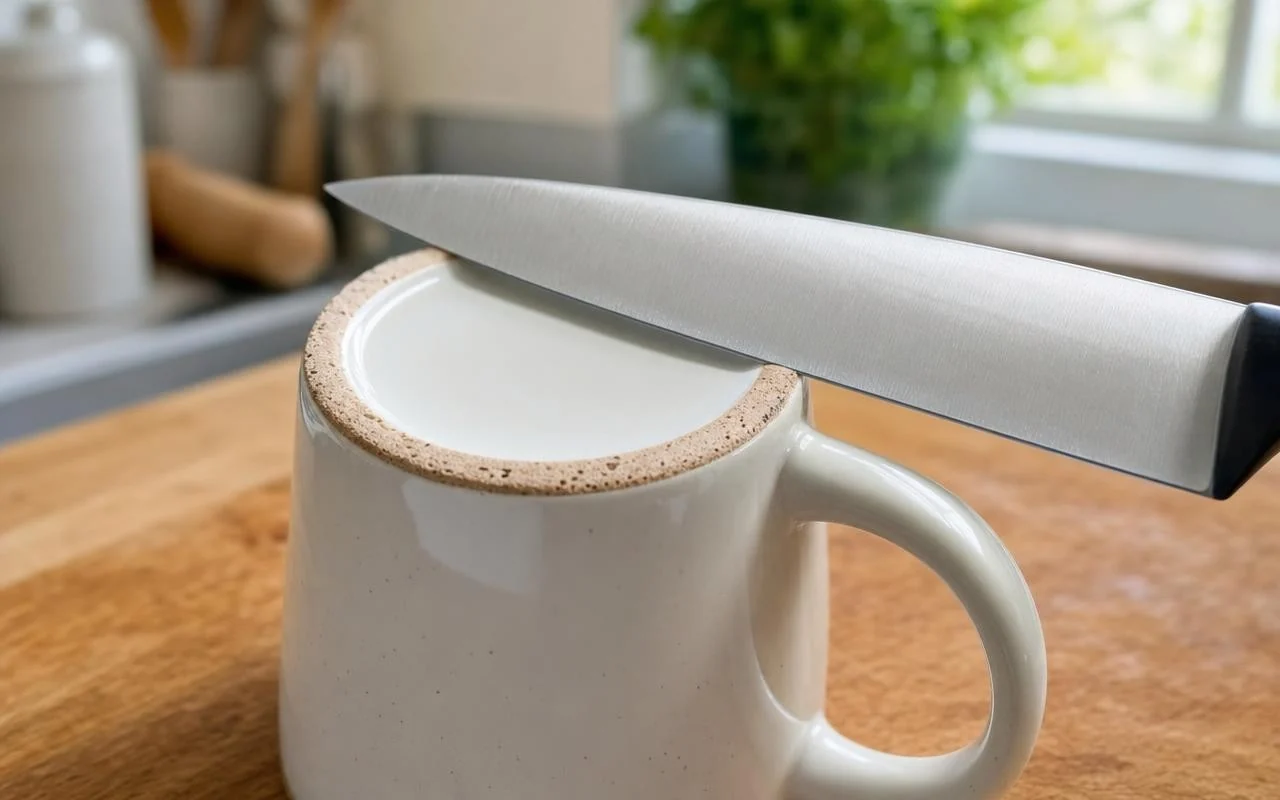
Yet several chefs and culinary sites agree on a much simpler trick, already in your kitchen. To restore the edge of a steel knife that is beginning to wear, they use the unglazed ring located under a ceramic cup or saucer. A discreet surface but sufficiently hard to work the metal’s edge, provided you use it correctly.
Why a ceramic cup can sharpen a knife
The ceramic from a cup proves harder than the stainless steel of kitchen knives. On the Mohs scale, used to compare materials, the ceramic sits around 8 to 9, while a typical steel hovers around 5.5 to 6. The rough, unglazed ring then acts like a fine stone, ideal for lightly restoring a dull edge that’s still in good condition.
This quick fix does not replace a full sharpening. If the blade has chips, is completely rounded, or needs to be entirely renewed, only a suitable stone or a professional will truly do the job. Nor should you confuse sharpening with simply realigning the edge: a honing steel, or honing rod, is mainly used to realign the existing edge, whereas an abrasive surface removes a bit of metal to recreate a sharp edge.
Sharpening a knife with a cup or a plate
To use this trick, simply flip a ceramic cup or a plate onto a stable work surface, ideally placed on a slightly damp cloth to prevent slipping. The knife blade then rests on the rough ring, at an angle of about 15 to 20 degrees, as recommended by reference guides such as BBC Good Food for most kitchen knives.
Then slide the blade from the base near the handle to the tip, as if slicing a thin ceramic film, without pressing hard. It’s better to keep a smooth, continual motion at the same angle. Six to twelve strokes per side are generally enough, making sure to perform exactly the same number on each face. To finish, rinse the blade carefully, dry it, and check the result on a piece of paper or a tomato.
Safety and care of a well-sharpened knife
Experts remind us that a well-sharpened knife works better and can even be safer, because a dull edge forces you to apply more pressure and increases the risk of slipping. To preserve the result longer, it’s best to avoid the dishwasher, where the blade bangs against other utensils. Wooden or plastic cutting boards preserve the edge far better than marble, granite, or glass—very hard surfaces that quickly dull the blade.
This method is primarily aimed at stainless steel kitchen knives with a smooth blade. Ceramic models require specialized equipment, often diamond-based, and serrated blades like bread knives do not work well on a flat surface. For very hard Japanese knives, it’s wiser to follow the manufacturer’s recommendations. Finally, avoid leaving your blades at the bottom of the sink, mixed with other dishes, as it minimizes impacts and extends the edge gained with the cup or plate.
