
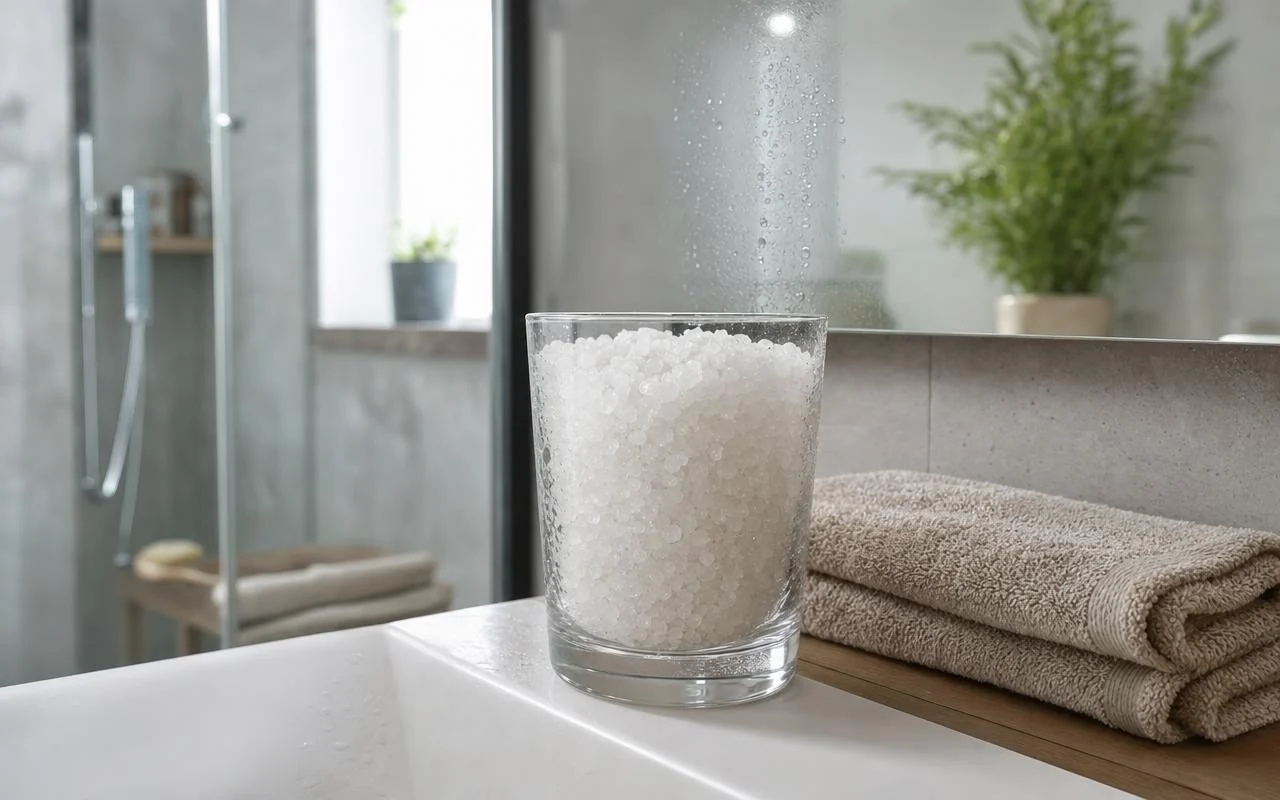
A simple glass filled with coarse salt left in the bathroom: that’s the tip circulating in Spain, passed along by plumbers and humidity experts. This inexpensive gesture intrigues as much as it charms, to the point of gradually spreading to the rest of Europe.
These professionals are not talking about magic, but about physics and practical common sense. Their idea: use a glass of coarse salt in the bathroom as a small ally against moisture and unpleasant odors, while also helping to spot potential hidden problems. The principle is straightforward, but its limits are just as clear.
Why plumbers bet on hygroscopic salt in the bathroom
The core of the “trick” lies in a property of salt: it is hygroscopic. In other words, it attracts and holds the water present in the air. Placed in a humid room, the coarse salt gradually absorbs moisture, becomes shiny, and eventually hardens into a solid block. This change in appearance shows that the ambient air is laden with water vapor.
Professionals caution, however, that this is only a very light version of consumer desiccants, which use calcium chloride, far more potent. An Australian consumer organization, Choice, found that such a desiccant removes about 2 milliliters of water per hour at 65% relative humidity, while the electric dehumidifiers tested expelled between 113 and 388 milliliters per hour under the same conditions. A simple glass of salt captures even less, which immediately sets the bar for expectations.
What exactly is a glass of coarse salt good for in a damp bathroom
In a windowless bathroom, a narrow toilet cabinet, or the cabinet under the sink, this technique can offer small conveniences. The glass acts as an ancillary sensor that slightly mitigates stagnant dampness, especially if the room remains closed for much of the day. It is also used in towel cupboards to prevent them from taking on that musty, closed-in smell.
The salt also serves as a “visual thermometer” for humidity. If the contents of the glass become very damp and compact within a few days, that signals excess humidity in the room. Some plumbers view it as a simple test to alert to a ventilation defect or the early stages of a structural issue. Another popular use: pour a few drops of eucalyptus or lavender essential oil onto the coarse salt, which then releases a faint scent while staying very economical, with no electricity or special device needed.
Mode d’emploi, limites et erreurs à éviter avec le gros sel au bain
The recommended method remains quite structured. Simply fill a small standard glass halfway with coarse rock salt or kosher salt, then place it on a stable shelf, away from shower splashes and out of reach of children and pets. To keep it active, stir it about once a week. As soon as it becomes hard, clumped, and very damp, it should be completely replaced with dry salt.
However, plumbers emphasize this point: this glass does not replace proper ventilation, anti-mold treatment, or fixing a leak. After a hot shower, the steam should ideally drop below 60 to 65% relative humidity in under an hour thanks to an open window or an extractor. If the joints blacken, the paint peels, or the musty odor persists, the problem goes far beyond this little DIY device, which remains a simple supplement and a practical alert signal.
