
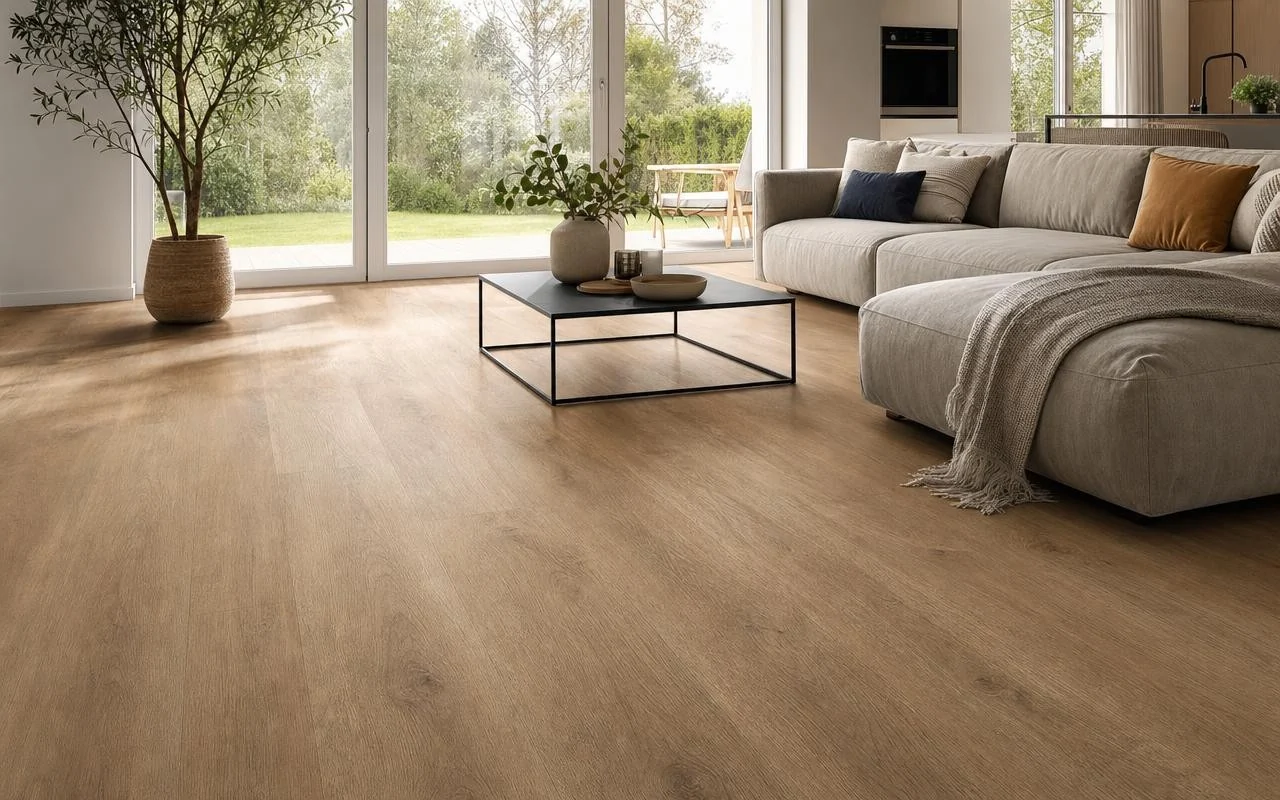
In renovation projects, a detail often decides the mood of a room: the floor covering. For years, the laminate floating parquet has stood out as the obvious solution, mimicking wood at a lower cost. 2026 marks, however, a turning point, with a new generation of floors that divert designers from this reliable staple.
In recent years, the laminate flooring has reigned in living rooms and bedrooms thanks to its favorable price-performance ratio. Comprised of an HDF core panel made from wood fibers and topped with a printed décor, it clips easily onto existing tile and cleans without particular effort. Yet its sensitivity to certain everyday constraints opens the door to an alternative considered more practical and more comfortable.
Why laminate flooring is losing ground to new coverings
The weak point of floating parquet lies in its wood-fiber core. In the presence of standing water or repeated humidity, the planks swell, the joints lift, and the floor can deform. It may then require replacing several planks. Decorators avoid this material in kitchens that see heavy use, entryways, and rooms close to water.
Another area of dissatisfaction is the walking noise. Without an appropriate underlayment, the characteristic clicking of laminate floors echoes and makes it harder to meet the Nouvelle Réglementation Acoustique, which sets the maximum impact noise level at 58 decibels in multi-unit housing. Small unevenness can also appear over time, giving a less crisp look than on day one.
Vinyl flooring, a more practical and comfortable alternative
In response to these limits, interior décor experts are turning toward the vinyl flooring, also called PVC flooring. Its structure in PVC or mineral composite SPC, sometimes in high-end LVT vinyl tiles, makes it moisture-resistant. These rigid planks generally measure about 6 to 6.5 millimeters thick and can be installed as floating or glued directly onto a suitably prepared existing substrate.
New vinyl floors often incorporate a fiberglass base and an acoustic underlayment, which improves comfort and sound insulation. They resist scratches and water and are easy to clean. Many ranges accept underfloor heating up to 27 or 28 degrees. However, they require a very flat substrate, as these floors remain sensitive to extreme heat and are more difficult to repair plank by plank.
Laminate or vinyl: how to decide based on the room and your priorities
For interior designers, the choice is no longer made at random but based on a few very concrete criteria. These benchmarks help determine whether a laminate flooring or a vinyl flooring is better suited for a given room.
- Water and humidity: bathroom, kitchen, laundry room clearly steer toward vinyl, impervious to splashes and steam.
- Comfort and noise: for an apartment subject to the new Acoustic Regulation, vinyl with an integrated underlayment better limits impact noises than many laminates.
- Sunlight and heat: in front of a large south-facing bay window, choose a vinyl specifically rated against high temperatures, or stay with a laminate in a dry room.
Practically, specialists reserve the vinyl flooring for humid rooms such as the bathroom, laundry room or entry, but also for very busy kitchens. Laminate flooring retains its place in a living room or a dry bedroom when a firmer feel underfoot is desired. One final common tip: carefully prepare the subfloor or the old tile and do not confuse these PVC vinyls with real linoleum, which is based on linseed oil.
