
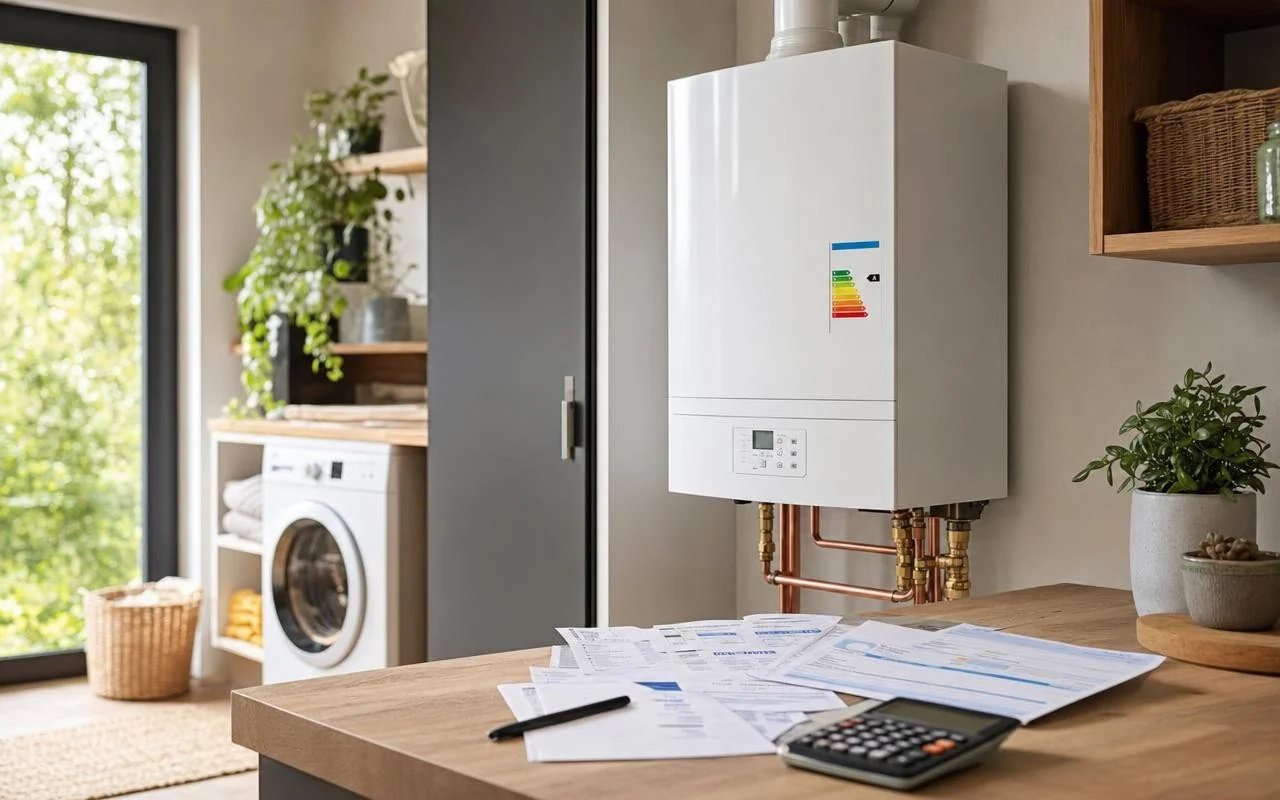
The price of gas is rising again and attention is turning to the boiler in the living room. Since November 1, 2026, the gas reference sale price published by the Energy Regulatory Commission stands at €194.90 per megawatt-hour, including tax, which represents a 6.6% increase compared to October. In this context, every kilowatt-hour wasted translates into dozens of euros on the bill.
Faced with this pressure, energy-saving experts highlight the condensing boiler. The consumer association OCU studied in 2022 fifteen wall-mounted combination boilers ranging from 18 to 25 kW and concluded that replacing a gas boiler older than 15 years with a condensing model can reduce the gas bill by about 25%. Comparisons reported by OkDiario remind that this solution remains more expensive to purchase than a conventional boiler.
Condensing boiler: where do the 25% savings on the gas bill come from?
OCU does not stop at a theoretical percentage. Its analysis sums, over fifteen years, the purchase price and the operating cost of condensing boilers with gas. For the best models tested, the organization finds less than €800 per year on average, including purchase and consumption. The roughly 25% gain thus primarily targets homes equipped with boilers older than fifteen years, which are very inefficient.
Estimates from GRDF and its expertise center Cegibat confirm this order of magnitude. They talk of savings of 15 to 20% compared with a recent, standard gas boiler, and up to 30% against a very old device. SeniorActu notes that a condensing boiler returns about 90% of the energy charged, versus 80% for an old one, which lowers the useful heat price per kilowatt-hour from 19.7 to 17.5 euro cents.
How a condensing boiler uses less gas on a daily basis
All of this stems from the very principle of the condensing boiler. A conventional boiler lets part of the heat escape with the fumes that rise through the flue. Condensation cools these fumes until the water vapor condenses, allowing heat to be recovered for the heating water. Cegibat notes that this recovery becomes truly efficient when the return temperature of the radiator water stays below 55 °C.
Under these conditions, the efficiency, calculated on the lower heating value of gas, can exceed 100%, because energy that would have departed in the fumes is recovered. To achieve this, the boiler operates at low temperature, suitable for oversized radiators or underfloor heating. OCU indicates that a home may require larger emitters or a system designed for these low temperatures. GRDF also recalls that acidic condensates, with a pH between 3 and 5, must be properly discharged to wastewater.
Replacing an old boiler: when does the extra cost of condensation become profitable?
To judge whether the initial premium is worth the effort, the price context matters a great deal. According to the Energy Regulatory Commission, echoed by SeniorActu, the kilowatt-hour of gas reaches a reference price of €0.1576 in November 2026, versus €0.2001 for electricity at the regulated rate. Taking performance into account, the site calculates the kilowatt-hour of heat at 17.5 cents with a condensing boiler, 19.7 cents with an old boiler, and 20 cents with electric heating.
For a heating requirement of 10,000 kilowatt-hours over the winter, SeniorActu estimates the bill at €1,751 with a condensing boiler, compared to €1,970 with an old boiler. The OCU, which reasons on a total cost over fifteen years, shows that the best condensing boilers remain under €800 per year, purchase and gas included. The Spanish institute IDAE, cited in this analysis, recalls that heating accounts for 41% of a dwelling’s energy consumption.
