
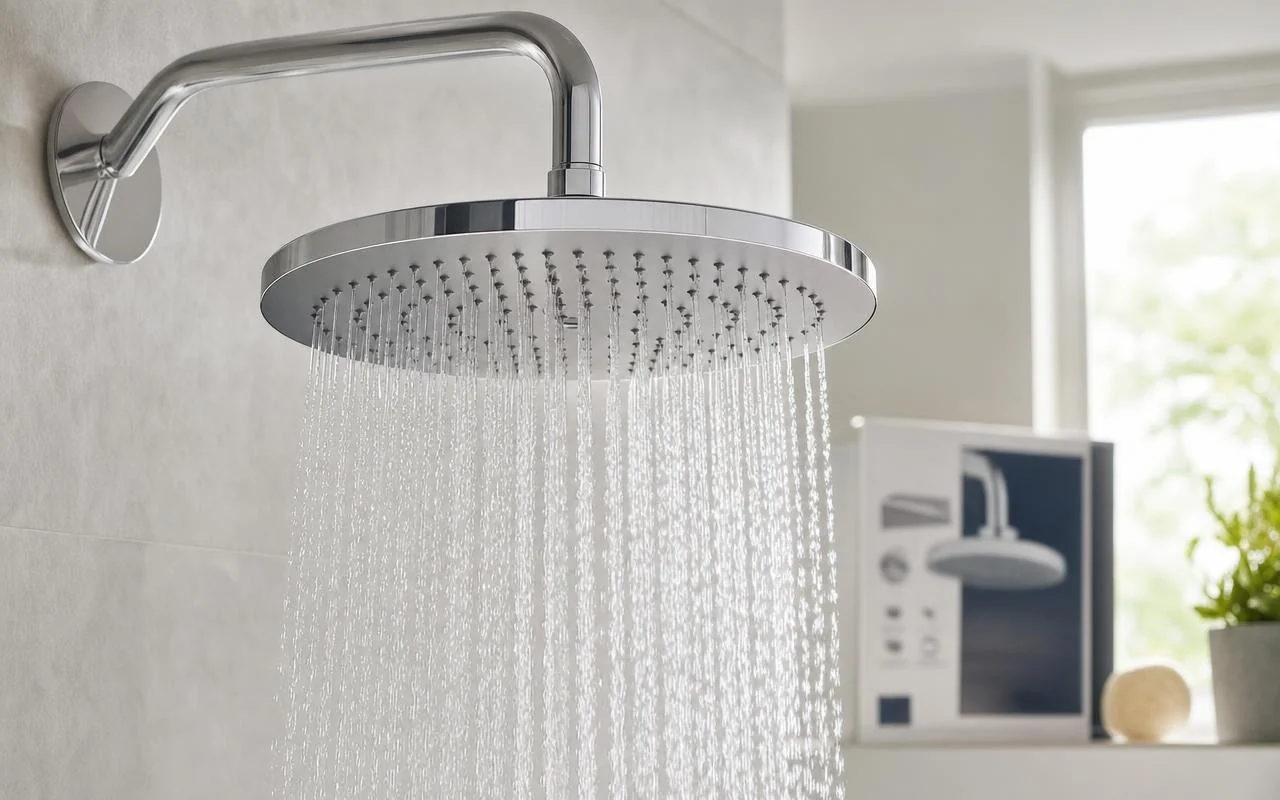
In many bathrooms, the shower moment begins with an aesthetic crush. A large rainfall-style head, a mirror chrome finish, a minimalist design: the shower head almost looks like a decorative object. The wide spray envelopes the body and gives the impression of a home spa capsule. We think comfort, pleasure, sometimes even selling the home, rarely the hot water bill.
This pursuit of style appears harmless at first glance, since you stay under the shower for the same number of minutes. Yet behind some spectacular heads lies a very precise technical feature that determines how much hot water actually flows through the pipes. As long as you don’t look at it, the extra cost remains invisible… until the arrival of the next bill.
Why a design shower head can weigh down the hot water bill
On a standard model, this feature can reach 15 to 20 liters of water per minute. An economy-focused shower head drops, for its part, below 9 liters per minute while preserving a pleasant pressure thanks to air being injected into the jet. With the same shower duration, this simple gap can raise hot water consumption by 20 to 30% compared to an economical model.
In stores, this notion remains in the background. Vendors highlight shape, color, ergonomic handle, rarely this key figure. On many packaging, it appears in small print, drowned between the head’s diameter and the type of fixing. This is where the decisive detail hides: the flow rate in litres per minute, the data that lets you anticipate the shower head’s impact on the bill.
The right flow rate in litres per minute for an economical shower head
The flow rate simply corresponds to the amount of water that runs per minute. The higher it is, the larger the volume of hot water to produce, and the boiler or water heater works harder. A so-called classic shower head lets through between 15 and 20 L/min. An economical shower head generally drops below 9 L/min thanks to a system that mixes air and water to thicken the jet.
To choose wisely, a few checks are enough in-store or on an online product sheet. Start by identifying the line where the flow rate is listed, often accompanied by the reference pressure. Then verify certain indicators that signal real control over hot water consumption.
- A flow rate listed at or below 9 L/min
- The presence of a label or mention of water conservation
- An aerated jet system that mixes air and water
- Compatibility with a flow reducer to be screwed on
How to keep your design shower head from driving up the bill
When the design head is already installed, all is not lost. A flow reducer can simply be screwed between the hose and the head or directly onto the faucet, depending on the models. This small accessory limits water passage without altering the perceived pressure, especially if the head already has an aeration system for the jet.
This type of equipment becomes even more effective when paired with simple habits: shorten the shower a little, avoid letting the water run during soap-up, set a stable temperature so as not to waste time fiddling with the faucet. By getting into the habit of checking the flow rate before any purchase, then adopting these daily reflexes, comfort remains on track while the hot water bill stops skyrocketing.
Sources
- Modes & Travaux
“This new standard 2026 divides the hot water bill, but it imposes a constraint that few anticipate”
