
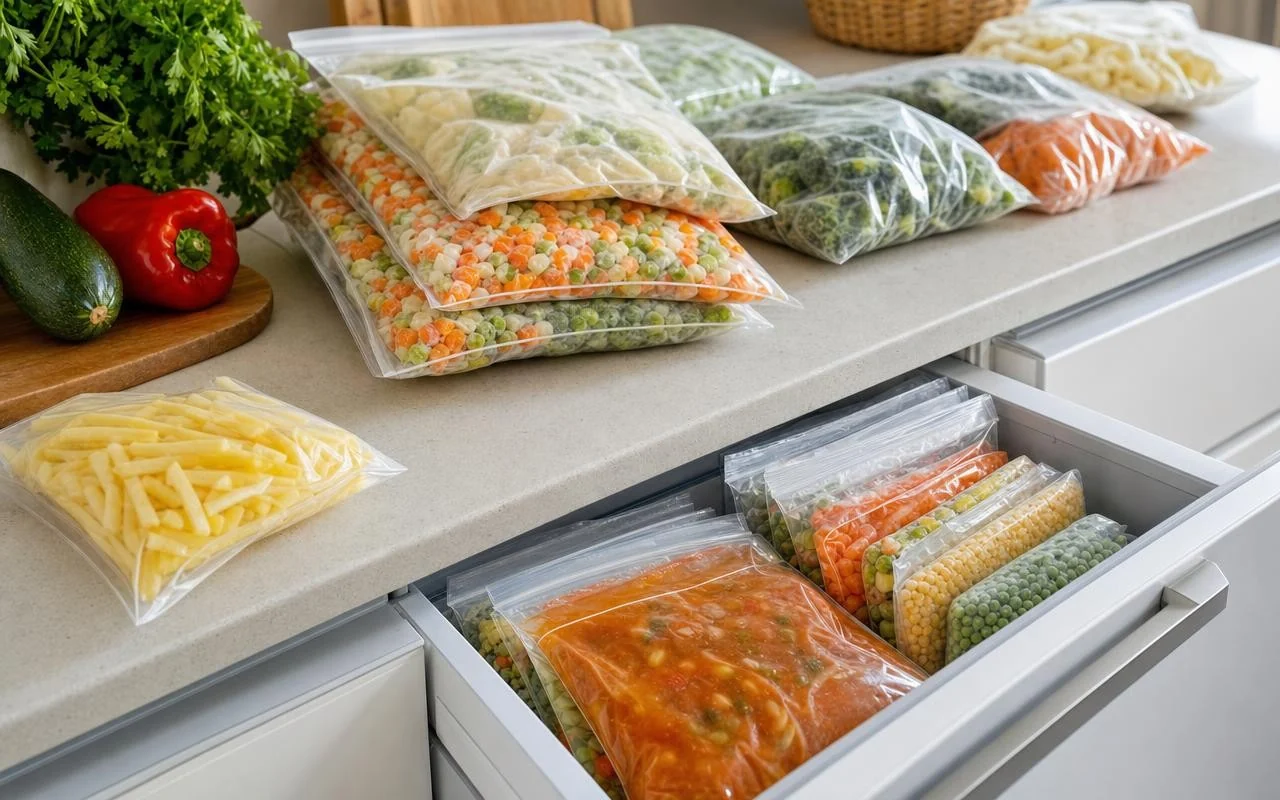
On the work surface, in the snack bag, or next to the suitcase, freezer bags are useful for everything. Between zero-waste tips and organization videos, a flood of ideas passes: flattening soup for storage, marinating meat, storing socks, or protecting the phone at the beach. But among these 20 trendy uses, some raise a real safety question.
For a bag designed for cold, it has not necessarily been tested for heat, nor for prolonged or repeated use. European regulation tightly governs plastics in contact with food, just as kitchen hygiene does. Behind a seemingly innocent gesture like reusing a freezer bag, the trio of food contact, cleanliness, and heat completely changes the verdict.
Freezer bags and food contact: what the texts say
The Directorate-General for Competition, Consumers and Fraud Prevention reminds that plastics in contact with food fall under Regulation (EC) No 1935/2004 and Regulation (EU) No 10/2011, applied since May 1, 2011. These texts impose a positive list of authorized substances and migration limits. The global migration must not exceed 10 mg/dm² of contact surface, with a limit of 60 mg/kg for materials intended for infants and young children. Behind a functional barrier, non-listed substances must not migrate beyond 0.01 mg/kg. Materials are tested under standardized conditions, according to NF EN 1186 for global migration and EN 13130 for certain specific migrations.
For users, the message is simpler: packaging must be used according to the planned conditions. The DGCCRF mentions the “type of product, temperature and duration of contact, single-use or repeated,” which fully applies to a freezer bag. When a manufacturer adds the microwave pictogram, they have tested the material for that exact use. Some, like Ziploc, clearly limit usage to defrosting or reheating, bag left slightly open, and reserve sous-vide cooking for other silicone ranges. Regulation (EC) No 2023/2006 governs good manufacturing practices, which only make sense if the user then follows these guidelines.
Reusing a freezer bag: 20 uses spread across three families
The 20 most circulated uses fall into three broad categories. There are first the ones related to cold and freezer organization: flat portions of soup, fruits for smoothies, bread leftovers, chopped herbs, pie dough, cold marinade or pre-prepared breading. Next come hot uses, especially in the microwave or bain-marie. Finally, there are all the off-kitchen diversions: toiletry kits, travel bags for underwear, storage of children’s toys or household cleaning products.
- “Practical” uses: solid or semi-solid foods, cooled, for freezing or transport, without raw meat or eggs.
- “Useless” uses: freezing water for ice cubes, storing a single applesauce, keeping a tiny leftover that would be better in a jar.
- “Risky” uses: microwave steam cooking, prolonged bain-marie, sous-vide cooking, reuse after contact with raw or allergenic foods.
Articles from Doctissimo, Top Santé or 750g converge: reusing a freezer bag remains feasible for foods that are not fragile, dry, or packaged (bread, raw vegetables that are not contaminated, cookies), or for non-food uses. The right reflex is to wash the bag with warm soapy water, rinse, then dry completely open, opening downward. Thick zip-top models are better suited than simple thin bags. In case of scratches, holes, a zipper that closes poorly, persistent odor, or a stain that won’t come out, the bag should go to the trash.
When a freezer bag becomes really risky
Risks increase as soon as heat, fragile foods, and reuse are mixed. A bag that is not explicitly microwave-compatible should not be used to reheat soup, mashed potatoes, or a sauced dish, even less for steam cooking. Fats and high temperatures favor the migration of substances from the plastic into the food, whereas regulatory tests were designed for other scenarios. Keeping a baby- or young-child food for a long time in the freezer in a heavily worn bag is also not desirable, given the strengthened limit of 60 mg/kg for these audiences.
Another sensitive point: cross-contamination. A bag that previously held raw meat or fish, eggs, dairy products, or highly allergenic foods like peanuts should not be reused for another food. Microcracks and the zipper can trap residues, even after washing, with microbiological or allergenic risks. For frequent hot uses, the safest solution remains to switch to glass, stainless steel, or silicone cooking bags, and reserve freezer bags for cold foods and small everyday storage.
