
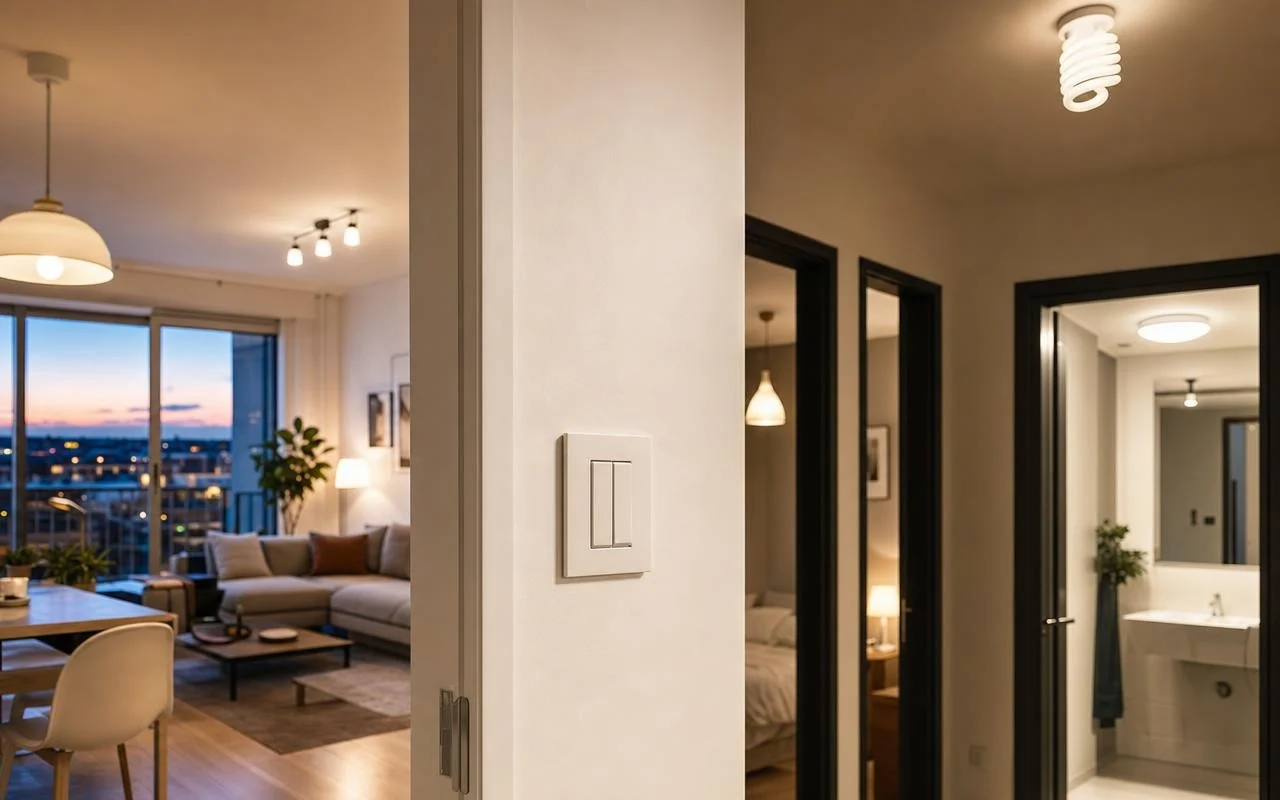
We’ve all heard it when leaving the kitchen or the bedroom: “Turn off the light, you’re wasting it!” With rising electricity bills, this reflex seems obvious. Yet specialists in energy efficiency remind us that this action, repeated mechanically, does not always produce the effect we imagine on the bill.
Behind the seemingly simple question ” Should you turn off the light when leaving a room ? “, the answer depends on the type of bulb and the time the room will remain empty. Some models handle frequent switching very well, while others wear out faster when used continually. This gap between intuition and reality explains why “turning off at all costs” does not always work as we expect.
Should you turn off the light when leaving a room with a LED, a halogen, or an incandescent?
LED bulbs have changed the game. A small 6-watt LED uses about 0.006 kWh per hour; at the regulated electricity rate around €0.20 per kWh, that’s barely €0.12 per hour, according to JeChange’s calculations. ADEME indicates that these lamps can last around 20,000 to 40,000 hours, and the Spanish source Okdiario cites a lifespan of about 25,000 hours. They tolerate repeated switch-ons very well. Experts therefore recommend turning them off as soon as they’re no longer needed, even for a few minutes.
For halogens and especially traditional incandescent bulbs, the issue is even clearer. Okdiario notes that halogens convert between 80 and 90% of energy into heat, and incandescent bulbs convert only about 10% of electricity into light. Their lifespan, between 750 and 2,000 hours, remains far shorter than that of LEDs. The well-known startup surge exists, but analyses reported by JeChange show that it is very brief and hardly impacts the bill. In this case, specialists advise turning them off as soon as a room is empty and replacing them with LEDs as soon as possible.
Ampoule fluocompacte ou tube fluorescent : quand le réflexe d’éteindre use l’ampoule
Compact fluorescent lamps, often marketed as “low energy,” and neon-type fluorescent tubes operate differently. According to Okdiario and the technical data sheets cited by écoconso, a CFL consumes much less than an incandescent and shows an average lifespan of around 8,000 hours. However, its longevity depends heavily on the number of on/off cycles. The more you switch it on and off, the faster it ages.
That is where the reflex to systematically switch off can become counterproductive. Experts cited by JeChange and écoconso advise turning off a CFL if the room will stay empty for about 15 minutes or more. For just a few minutes of absence, the electricity savings remain small while the wear caused by repeated switching can shorten the bulb’s life, forcing an earlier replacement. The startup surge does not justify leaving it on continuously, but this timing compromise explains why the right move is not always to slam the switch at every opportunity.
How much energy do we really save, and where are the big consumption spots?
The figures give a sense of magnitude. JeChange estimates that a small LED left on four hours every evening in an empty room costs around €1.75 per year, and a house where five rooms remain lit in that manner would run around €8 to €9 per year. That’s not negligible, but far from tens of euros per month. The main benefit remains avoiding waste and taking advantage of the options offered by LEDs, for example with presence detectors in corridors or bathrooms, recommended in several practical guides.
To substantially reduce the bill, organizations like EDF remind us that heating accounts for more than 60% of a dwelling’s energy consumption, and that lowering the thermostat by a degree can cut heating consumption by about 7%. In other words, lighting is a real lever but secondary compared to insulation or the set temperature. Energy-saving experts thus converge: turn off LEDs as soon as a room is unoccupied, apply the 15-minute rule for CFLs, modernize old halogens or incandescent bulbs, and, in parallel, tackle the major components like heating to achieve much more noticeable savings.
