
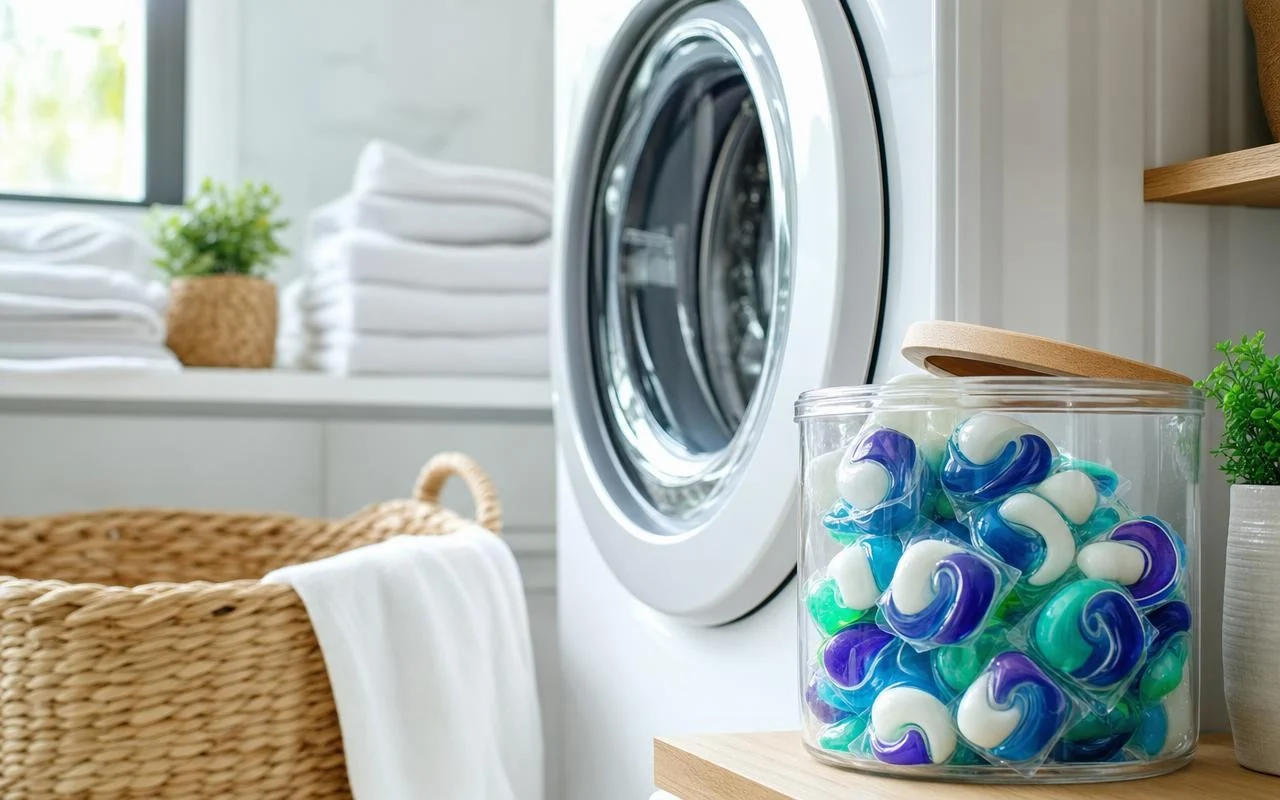
On the packaging, the laundry capsule often promises garments that look dazzling and carry the scent of cleanliness. In many minds, this tiny concentrated dose does everything: it would wash, deodorize, and, almost by magic, disinfect the laundry basket with a single shot, even after a gastro or a flu.
Health authorities do not see things so simply. The Centers for Disease Control and Prevention (CDC) clearly distinguishes cleaning, sanitizing and disinfecting, while eco programs and the “sanitize” cycles proliferate on washing machines. All of which can be confusing… and lead one to wonder if a single capsule truly is enough to disinfect the laundry.
Laundry Capsule, Laundry Cleaning, and Real Disinfection
The CDC recalls that “cleaning removes most germs, dirt and impurities from surfaces. It is done with water, soap and rubbing,” and that disinfection, on the other hand, “kills most germs on surfaces and objects.” In short, removing a large share of microbes is not the same as killing them in large numbers. The agency also adds that “disinfecting or sanitizing to reduce the spread of diseases at home is probably not necessary, unless someone in the home is sick.”
A standard laundry capsule is formulated to wash: it delivers a concentrated detergent that removes stains, sebum and a large portion of microbes from textiles. The magazine Maison & Travaux reminds that it is not intended to disinfect, nor to descale the washing machine drum. With a very short cycle or at 20–30°C, the capsule sometimes dissolves less well and acts for a shorter duration, which further reduces its effect on microorganisms.
Désinfecter le linge : température, produit et séchage à respecter
For genuine disinfection, temperature matters as much as chemistry. In its recommendations for care facilities, the CDC notes that washing at least 71°C for 25 minutes is used as a method of disinfecting textiles. Public-facing guidelines, such as those from Darty or Speed Queen, tend to set 60°C on a fairly long cycle as a benchmark for enhanced home hygiene. Eco 60°C cycles often do not reach as high or last as long, which limits the disinfecting effect, regardless of the capsule used.
The CDC also specifies that when washing occurs at lower temperatures, microbiological effectiveness depends more on additives such as chlorinated bleach or active oxygen agents. Maison & Travaux, regarding sodium percarbonate, emphasizes that the term “disinfect” should be used cautiously, as it falls under biocidal regulation. In plain terms, only formulas explicitly registered as disinfectants can claim that term. A standard capsule without a specific disinfectant agent cleans well, but does not guarantee this action.
Quand une capsule peut vraiment désinfecter le linge et les bons réflexes
In some markets, capsules or liquids carry the disinfectant label and are registered with the Environmental Protection Agency (EPA). In an labeling reviewed by the agency, the disinfection of laundry is achieved by adding the product to the rinse cycle, with a precise dose and a contact time of 16 minutes. This “contact time” is critical: if the rinse is too short or interrupted, the claimed microbicidal action cannot be achieved. In parallel, the CDC states: “Wash the laundry with a detergent at the recommended temperature. Dry items completely. It is safe to wash dirty laundry from a sick person with that of other household members. Wash your hands after handling dirty laundry,” the CDC details.
For a household without a special medical situation, the main objective remains therefore a regular washing with a good détergent, at the temperature appropriate for the textiles, followed by thorough drying. Before believing that a capsule “disinfects,” a few key points deserve verification:
- the nature of the product (simple laundry capsule or clearly disinfectant formula, with dedicated authorization);
- the chosen program (true 60°C or higher, fairly long cycle, machine not overloaded);
- the contact time and drying (sufficient rinse, laundry well dried and stored promptly).
