
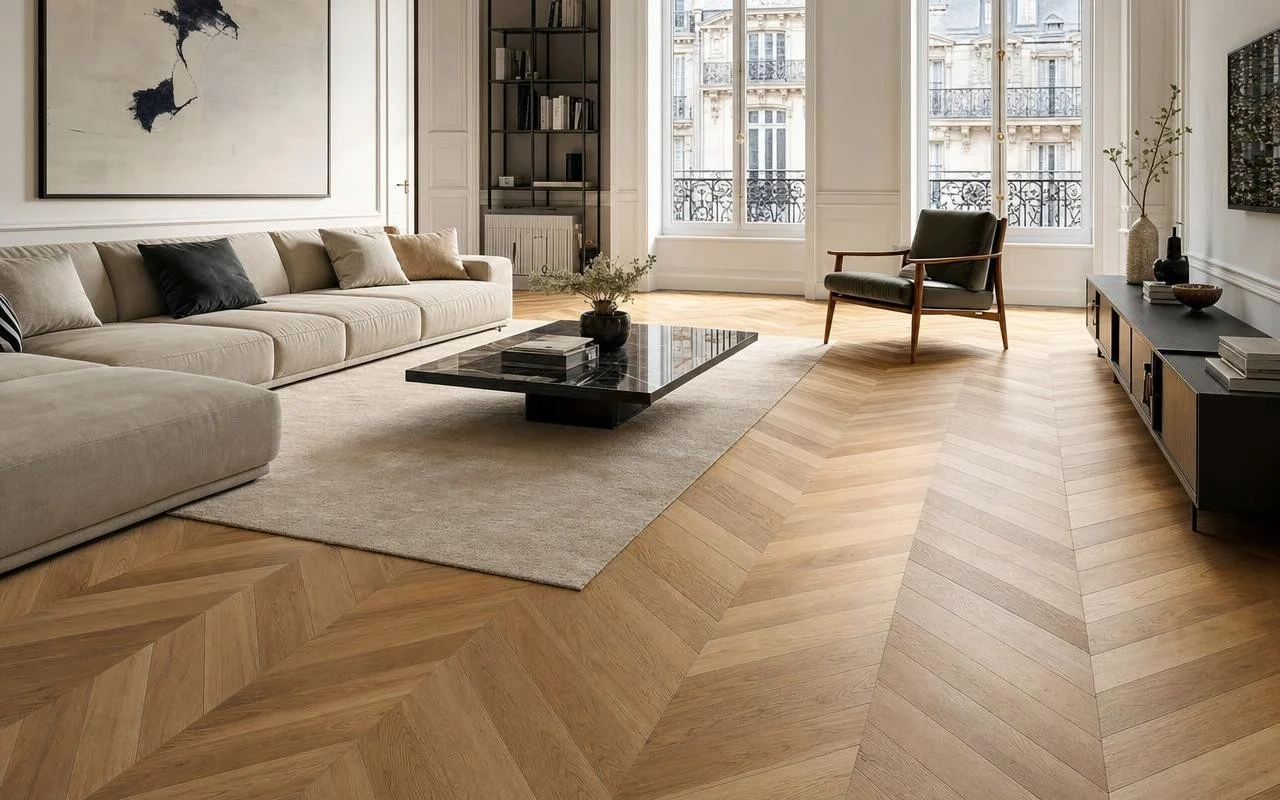
Interior designers regard it as the quickest route to a chic home. The Argentine media outlet TN reported that, for many specialists, the chevron parquet pattern has returned to the forefront of projects and that “if you want your home to look much more elegant, chevron flooring is the solution,” according to decoration experts.
This V-shaped or zigzag motif recalls the floors of yesteryear and, according to Castorama, brings a “note of timeless elegance and luxury.” Yet many still hesitate: the difference between the Hungarian point and running bond, which wood species to choose, and the direction in which to lay the planks to achieve this upscale look without missteps?
Chevron Parquet and Hungarian Point: The Duo That Changes Everything
Castorama’s parquet guides remind us that chevron parquet refers to a type of installation rather than a material. The planks join to form regular Vs. When the ends are cut on a bevel, typically at 45° or 60°, the tips align perfectly: this is known as the Hungarian point. With straight, right-angled ends interlocked, the pattern takes the name of batons rompus.
Some manufacturers also refer to these chevron arrangements as “French parquet.” The experts cited by TN emphasize that this geometry, built from successive angles, creates a visual sequence that breaks the monotony of parallel boards. The floor gains movement without garish colors or heavy materials, letting the pattern become the guiding thread of a classic living room as well as a more contemporary interior.
Choosing a Chevron Parquet: Wood Type, Color, and Finish
At Castorama, the chevron motif is available in , engineered wood, or wood-look laminate. The solid version, made of noble wood throughout the thickness, delivers a very authentic finish and can be refinished several times. The engineered option pairs a wear layer of noble wood with a multi-layer substrate, ensuring good stability and allowing floating installation. The laminate offers a wood-like appearance protected by a surface layer, clips in easily, and cannot be refinished.
Common wood species for a chevron parquet include oak, beech, walnut, and ash, prized for their durability and easy maintenance. TN notes that light or honey-toned oak colors brighten a room, medium tones add depth, while dark shades look sophisticated if the space is large enough and well lit. Castorama identifies three finishes: oiled (a warm look but more prone to staining, suitable for humid rooms), varnished (glossy or satin, ideal in high-traffic areas), and raw—the most traditional but requiring protection after installation.
Laying a Chevron Parquet for a Truly Elegant Look
To let the pattern shine, the orientation of the installation is crucial. Castorama advises directing the chevron points toward the main source of natural light, which lengthens the perspective and enhances the design. Gala Decoración’s specialists also emphasize the plank format: in a large room, long elements showcase the chevron well; in a hallway, entry, or bedroom, shorter boards maintain a pleasing visual balance.
The installation guidelines are straightforward but strict. Castorama recommends a clean, dry, and well-planed substrate, possibly leveled, then letting the planks acclimate to the room. A central axis helps align the chevron points, followed by floating installation on an appropriate underlayment or glued installation with a compatible adhesive, always maintaining an expansion joint along the walls. Since each plank must be cut, experts suggest budgeting 10 to 15% extra surface to absorb offcuts and maintain a perfectly regular pattern.
