
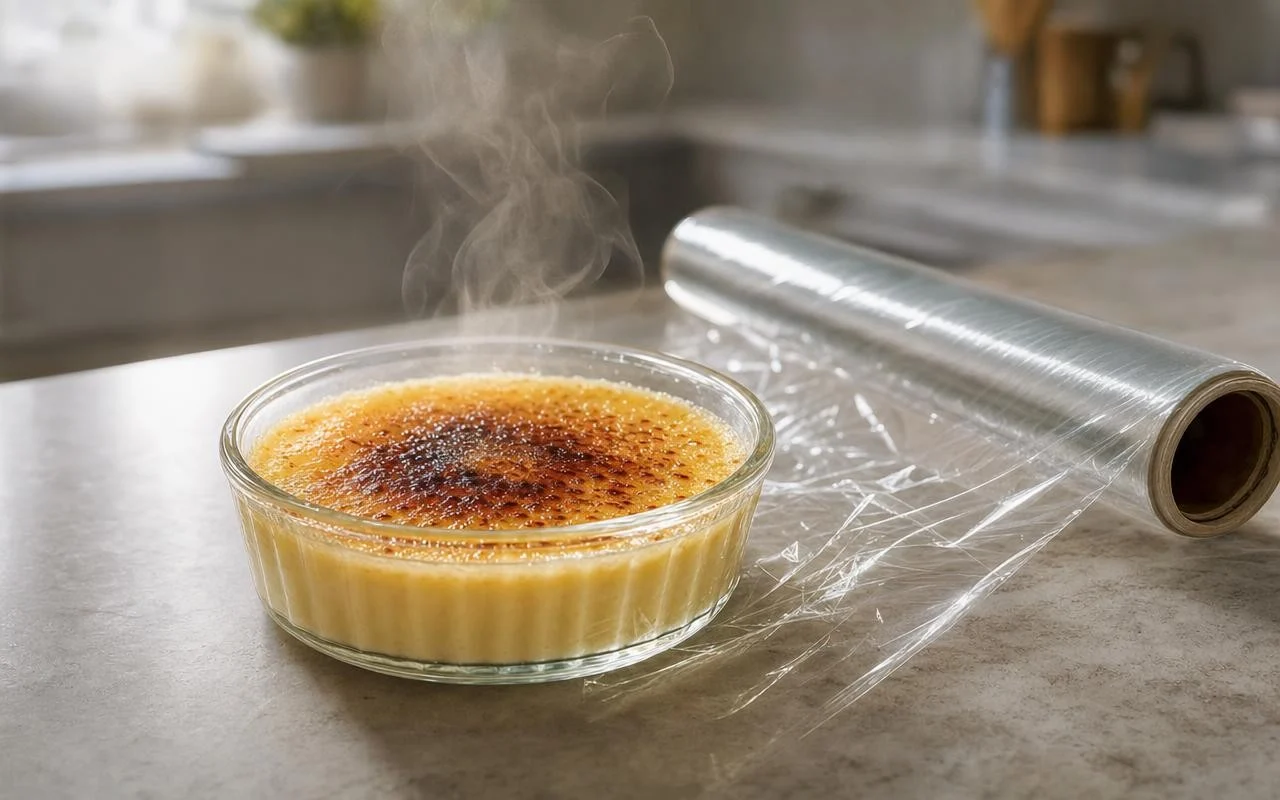
Your pastry cream has just come to a boil, the surface still trembles, and the immediate reflex is to pull off a piece of film to cover it. In most recipes, this gesture even has a name, “covering with film in contact,” presented as the secret to perfectly smooth creams. With the rising concerns about plastic in the kitchen, some hesitate in the face of this hot pot.
The Dirección générale de la competencia, de la consommation et de la répression des fraudes (DGCCRF) reminds that materials in contact with food can release substances into the food, and that heat or cold intensifies this phenomenon. Wrapping a still-hot cream with film concentrates exactly this situation: fatty preparation, high temperature, and prolonged contact.
Covering a hot cream in contact: what is it really for?
In the language of pastry chefs, covering a hot cream in contact means applying the film directly to the surface of the preparation, with no air left underneath. This gesture prevents the infamous “skin” that forms when the cream cools in open air. Less air, less surface drying, a more homogeneous texture at the moment of whisking or using the cream.
The best-practice guides in pastry cite this gesture for pastry cream: the cream is poured into a shallow dish, covered in contact, then cooled rapidly before refrigeration, at around +4 °C. In domestic cooking, the logic is the same, but one condition is added: the food-grade film used must indeed withstand direct contact with a very hot preparation.
DGCCRF, FCMs and heat: when food-contact film becomes problematic
The DGCCRF talks about food-contact materials (FCMs). These materials should remain as inert as possible under normal usage conditions. When the temperature rises strongly, the risk of migration of chemical substances into the cream increases. Hence the administration’s emphasis: only use films and containers designed for food use, clearly identified by the pictogram “glass and fork” or an equivalent mention.
On the packaging of stretch films, you often find other useful information as well: microwave compatibility, potential temperature range (for example -18 °C to 120 °C), restrictions with fatty foods. If your roll only mentions storage in the refrigerator or freezer, without any heat indication, direct contact with a cream just removed from the heat becomes questionable. In this case, a prudent approach is to let the preparation cool a little before applying the film in contact.
How to film a very hot cream safely at home
Before laying film on a still-smoldering cream, a few quick reflexes help you stay in line with the DGCCRF recommendations while preserving the advantages of the pastry gesture. The principle: verify that the film is indeed part of the FCMS designed for this exact situation, i.e., this type of food and this temperature zone.
In practice, the right reflex is to read the packaging of the film:
- look for the “glass and fork” pictogram or the mention “for contact with food,”
- identify a temperature range or the mention of possible microwave use,
- respect the restrictions indicated for fatty foods, such as creams,
- in the absence of any heat indication, wait for the cream to cool a bit before film contact.
To speed up this cooling without losing the benefits of the film, professionals pour the cream into a wide dish, which increases the surface area of contact with air, then wrap it in contact with film to protect the product. This practice fits into sanitary control plans and HACCP-type approaches: controlled cooling, protection by film, then storage afterwards at a positive temperature around +4 °C.
