
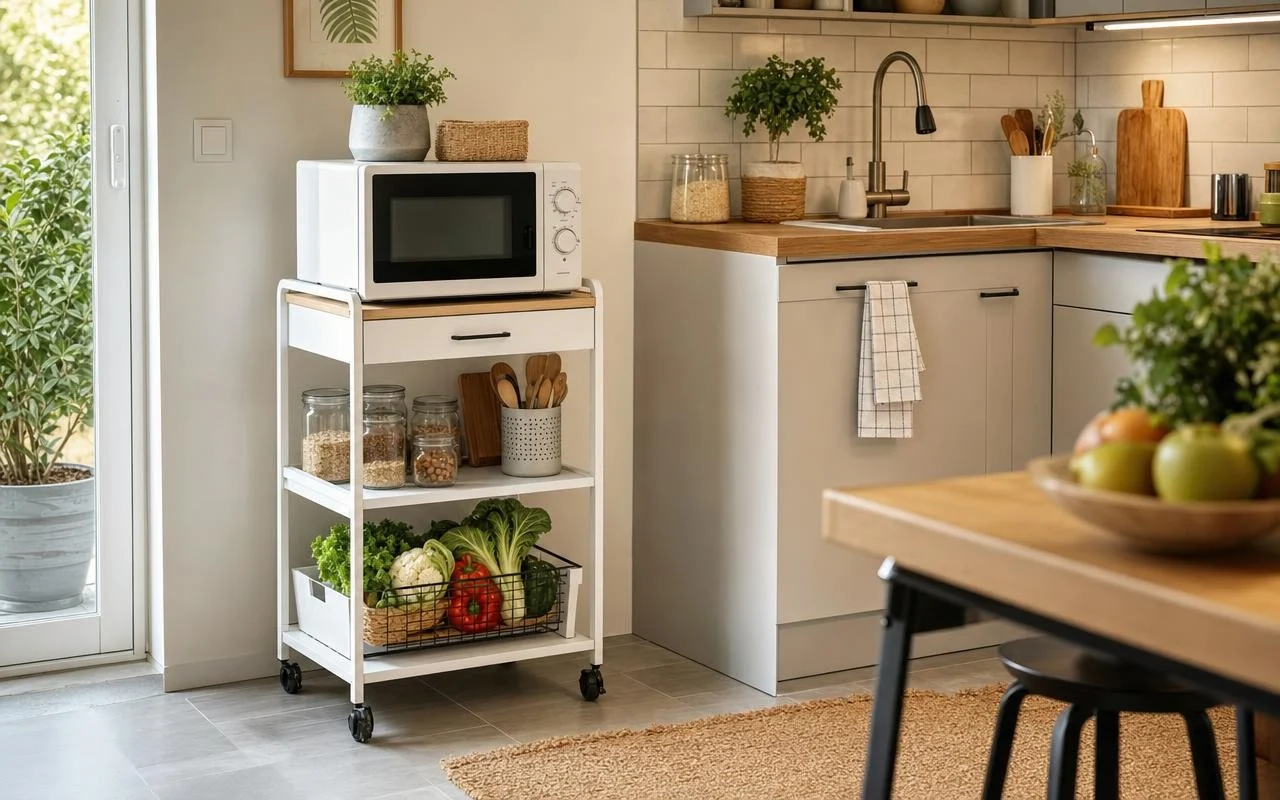
In 1980s kitchens, the same small rolling piece of furniture could be found everywhere. It slid between the fridge and the stove, supported the era’s star appliance, and hid behind its doors a jumble of crockery. Then it disappeared, replaced by plainer, more integrated kitchens.
This piece of furniture is making a strong comeback today under its official name, the microwave cart, and it checks exactly the boxes that small modern kitchens dream of: hidden storage, a sturdy surface, mobility. Born in the late 1970s when the microwave oven invaded homes before kitchen layouts were designed to accommodate it, it already understood the space-saving game.
Why the 80s microwave cart is returning to our kitchens
Back then, the microwave was added to a refrigerator, a dishwasher, and an already bulky oven. The microwave cart offered a dedicated surface for the appliance, often with a drawer and a low cabinet to store pots, dishes, and accessories. Today, the problem has changed in appearance but not in essence: studios, ultra-compact open-plan kitchens, and rentals where walls cannot be knocked down make this wheeled furniture highly relevant.
Decoration sites remind us that new models can be found in major hardware or furniture chains starting at around 50 dollars, roughly fifty euros. Vintage enthusiasts prefer to browse for these trolleys at flea markets, estate sales, or second-hand platforms. Their advantage remains the same as forty years ago: thanks to the wheels, you can move them from one corner to another as needed, without any construction or drilling.
Bien choisir un chariot micro-ondes moderne pour gagner de la place
Current models keep the spirit of the 80s but with much smarter details. Some carts around 80 × 40 × 88.7 cm claim a total load capacity of 35 kg, with five wheels including two with brakes and a cable pass-through at the back. Other formats, more compact, measure around 59 × 40 × 92 cm or 40 × 59 × 92 cm, with four wheels, an extendable tray, a drawer, and two full doors to hide the chaos.
Before buying, a few points are really worth checking.
- Dimensions: measure the available niche and the size of your microwave.
- Load capacity: compare the appliance’s weight to the top surface and cabinet capacity (often between 25 and 35 kg for the whole unit).
- Wheels: opt for wheels with brakes to prevent the cart from moving during use.
- Ventilation and cables: a space behind and a pass-through hole limit overheating and loose wires.
- Storage layout: a drawer for small utensils, a closed cabinet for provisions, open shelves for what you reach for often.
Détourner son chariot micro-ondes en station café, bar ou coin repas
Many households no longer place a microwave on top of these. The furniture becomes the perfect coffee station: a top surface for the coffee maker, the espresso machine, and the grinder; a drawer for cups, spoons, and capsules; a lower compartment for coffee packets, filters, and biscuits. A tutorial published on June 16, 2026 even shows the restoration of a cart about thirty years old, transformed into a coffee corner after sanding, painting, changing the handles, and highlighting the top surface.
Another trendy reinterpretation is the bar cart: glasses, shaker, and citrus fruits on top, bottles and syrups tucked behind the doors, rolled up near the sofa as guests arrive. Some also turn it into a mobile breakfast nook, with a toaster, kettle, and cereals. In all cases, this simple microwave cart on wheels acts as a true portable organizer for the kitchen. The question remains where you’ll find yours: in stores, online, or by dusting off your parents’ old one.
